The short answer
- Look behind the head. Most multicolored Asian lady beetles have a whitish section there with a small black mark shaped like an M or a W. Penn State says that white section with its black mark sets it apart from many other lady beetle species.[1][3][2]
- Asian lady beetles are larger than most native lady beetles and their color runs from tan or pale orange to red, sometimes black with red spots, with anywhere from no spots to 19.[2][1][8][3]
- Lady beetles clustering on the sunny side of a house in fall, crawling on windows, pinching skin or leaving yellow, smelly spots are almost always the Asian lady beetle.[1][3][7]
- A coppery or yellow-orange "lady beetle" chewing lacy holes in bean or squash leaves, with spiny yellow larvae, is a Mexican bean beetle or squash beetle, the plant-eating members of the family.[15][14][16]
Lady beetles on this site
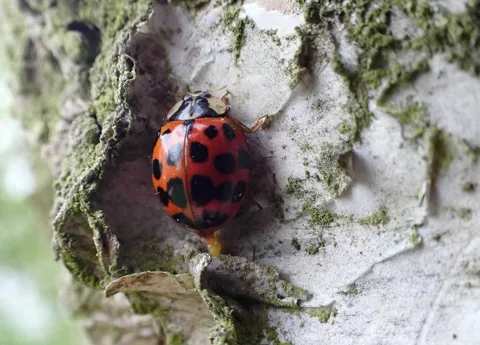 Multicolored Asian Lady Beetle
Harmonia axyridis
The multicolored Asian lady beetle is a beneficial aphid predator outdoors but becomes a nuisance when it flies to buildings in fall to overwinter and ends up indoors. Clemson and Colorado State extension both describe it as a valuable aphid predator on crops, trees and shrubs.
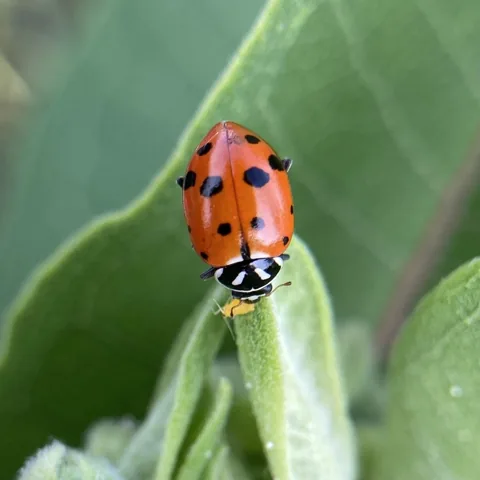 Convergent Lady Beetle
Hippodamia convergens
The convergent lady beetle is a native lady beetle named for the two short white marks on its thorax that angle toward each other. Adults and larvae eat aphids and other soft-bodied insects, and it is essentially the only lady beetle sold in stores and catalogs for aphid control.
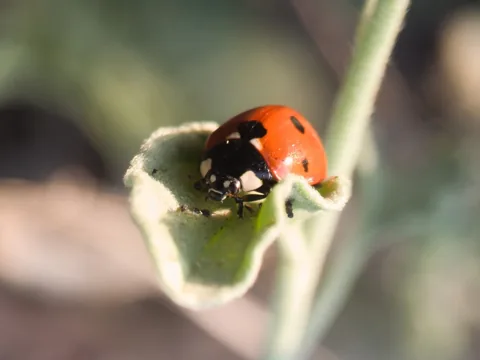 Sevenspotted Lady Beetle
Coccinella septempunctata
The sevenspotted lady beetle is native to Eurasia and is said to be the most common lady beetle in Europe. It was brought into North America on purpose to fight aphids and is now established here.
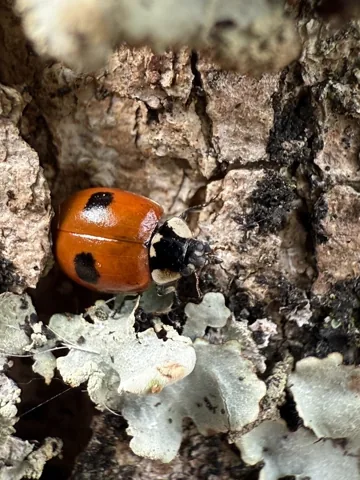 Twospotted Lady Beetle
Adalia bipunctata
Twospotted lady beetles hunt aphids, especially on trees and shrubs, and they're confusing to identify because individuals come in very different colors.
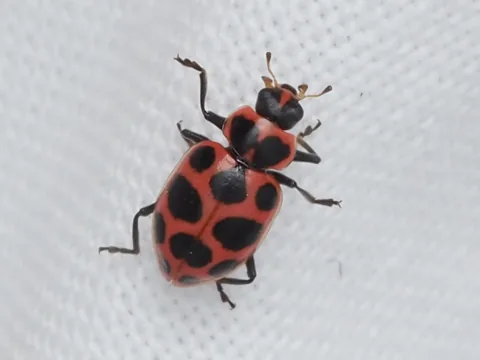 Pink Spotted Lady Beetle
Coleomegilla maculata
The pink spotted lady beetle is a native North American predator of aphids and insect eggs, and unlike most lady beetles it eats a lot of pollen, up to about half its diet.
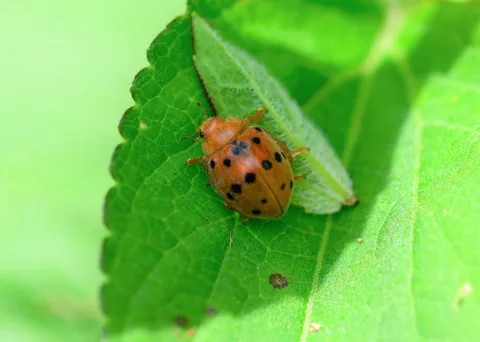 Mexican Bean Beetle
Epilachna varivestis
The Mexican bean beetle is a plant-eating member of the lady beetle family. Adults and spiny yellow larvae feed almost entirely on the undersides of bean leaves, leaving them lacy, and heavy infestations can defoliate plants and cut yields.
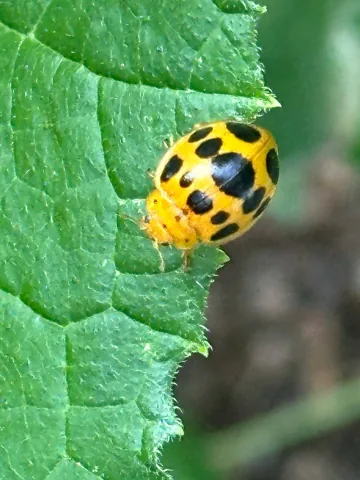 Squash Beetle
Epilachna borealis
The squash beetle is a plant-eating lady beetle. While most lady beetles hunt aphids and other small insects, adults and larvae of this one chew the leaves of squash, zucchini, cucumber and pumpkin.
Ladybug, lady beetle, ladybird: one family
Penn State and the Missouri Department of Conservation both say "ladybug", "lady beetle" and "ladybird beetle" are common names for every species in the family Coccinellidae. Posts that claim to show the difference between a "true ladybug" and an "Asian lady beetle" are comparing one lady beetle species with others. Biologists prefer "lady beetle" because they reserve "bug" for true bugs such as stink bugs and aphids.[2][13]
There are a lot of them. The Missouri Department of Conservation says nearly 500 species live in North America north of Mexico, UC IPM says about 200 occur in California, Colorado State says some 70 species are native to Colorado plus 10 to 12 that have established in the past century, and Minnesota Extension counts more than 50 native species there.[13][8][12][11]
How to recognize the multicolored Asian lady beetle
The multicolored Asian lady beetle (Harmonia axyridis) is native to eastern Asia. Kentucky Extension says the first field populations in the United States were found in Louisiana in 1988, after decades of USDA release attempts; Penn State gives the same 1988 date for establishment in North America and says releases go back to California in 1916.[1][2][4]
Kentucky and Minnesota Extension both point to the whitish area behind the head with a dark M-shaped mark as the feature to look for. Kentucky calls the mark M- or W-shaped, and Penn State describes a white pronotum with a black "W" that can show as four spots, a W, or a solid black triangle or patch in dark beetles.[1][3][2]
Sources give slightly different sizes: about 1/4 inch long (Kentucky, Washington State), 9/32 inch or 7 mm long by 7/32 inch wide (Penn State), and about 1/3 inch (Minnesota, Wisconsin). Penn State and Minnesota agree it is larger than most native lady beetles.[1][6][2][3][4]
Color is the least reliable clue, which is how the beetle got its name. Kentucky Extension says it ranges from tan to orange to red, and Washington State from black with two red spots to red with 19 black spots. Spot counts differ by source: Penn State says most have red wing covers with up to 18 black spots, while Minnesota, Wisconsin and UC IPM give up to 19, and all say some beetles have none. Kentucky Extension adds that heavily spotted beetles tend to be females and lightly spotted ones males.[1][6][2][3][4][8]
Larvae look like small spiny alligators. Penn State describes them as dark gray with rows of orange markings and double-branched spines, and Minnesota as blue to black with two orange stripes. Colorado State says the larvae differ from typical Colorado lady beetle larvae in having prominent fleshy spines. Penn State says the orange, black-spotted pupae are often found attached to plants and walls.[2][3][12]
Common lady beetles it gets mixed up with
Not every lady beetle in the yard is native, and not every non-native one is the Asian lady beetle. A few you are likely to see:[12][8]
- Convergent lady beetle (Hippodamia convergens): native, and Colorado State calls it the most abundant lady beetle there. UC IPM describes it as 1/6 to 1/4 inch long and more oblong than most lady beetles, with orange wing covers that commonly have 13 black spots (sometimes fewer or none) and a black thorax with a white margin and two white marks angled toward each other. Those converging marks are what to look for.[12][9][8]
- Sevenspotted lady beetle (Coccinella septempunctata): a European species that Colorado State says has become established there, so it is introduced too. UC IPM says it is almost 1/3 inch long, with seven black spots on orange or reddish wing covers and a black head and thorax that each carry two separate white blotches.[12][10]
- Twospotted lady beetle (Adalia bipunctata): UC IPM describes it as red with two black spots, or black with four reddish spots, and a black thorax with two white blotches. Colorado State calls it a common native species found mostly on trees and shrubs.[8][12]
- Pink spotted lady beetle (Coleomegilla maculata): Colorado State describes it as pink or reddish with abundant black spots and an important predator of insect eggs.[12]
The plant-eating lady beetles: Mexican bean beetle and squash beetle
Colorado State says the Mexican bean beetle (Epilachna varivestis) feeds only on plants and is an important pest of beans. Clemson Extension says the squash beetle is the only other species in the lady beetle family that feeds on vegetable crops, and that its adults look like the familiar beneficial lady beetles: yellow to orange, dome-shaped and black-spotted.[12][16]
Cornell describes the adult Mexican bean beetle as about 6 to 8.5 mm long with 16 black spots, yellow when young and coppery brown when older; UMass says adults are coppery brown with black spots and look very much like large lady beetles. Both say the yellow or yellow-orange eggs are laid in groups of 40 to 50 on the undersides of leaves.[14][15]
The larvae give these two away. Cornell says Mexican bean beetle larvae are bright yellow with six rows of black-tipped spines, and Clemson shows the squash beetle larva as a spiky thing on the underside of a cucumber leaf. Predatory lady beetle larvae are gray or black with spots of white, yellow, orange, red or blue, and feed on small soft-bodied insects.[14][16][11][12]
The damage is distinctive too. Cornell and UMass say Mexican bean beetle adults and larvae feed mostly on the undersides of bean leaves, leaving them lace-like, and heavy infestations can strip plants and damage pods. Their profiles and the garden beetle guide cover management.[14][15]
Spotted beetles that aren't lady beetles
UC IPM points to the spotted cucumber beetle, a black-spotted plant feeder, as one to watch for: its long antennae give it away. Lady beetles have short antennae that can be hard to see.[8]
Fall swarms on the house
This is the behavior that sends most people looking for answers. Kentucky Extension says Asian lady beetles fly to buildings from September through November depending on locale and weather, heaviest on sunny afternoons after a cool spell. They gather on the sunnier southwest sides of buildings and favor light-dark contrast such as dark shutters on light siding; homes near woods or fields are especially prone. Minnesota Extension says the same about sunny sides and contrast, and adds they can fit through openings as small as 1/8 inch.[1][3]
Other lady beetles mostly winter outdoors. Minnesota Extension says most species spend the winter clustered in leaf piles, bark, dead trees or buildings, and Colorado State lists plant debris, bark flaps and the walls of homes. The convergent lady beetle is known for mass migrations to overwintering sites at high elevations, which is where the beetles sold to gardeners are collected.[11][12]
Asian lady beetles do not breed indoors. Kentucky and Minnesota Extension both say the beetles you see in late winter and spring are the same ones that got in the previous fall, and Iowa State says they don't feed indoors or damage the house, furniture or fabrics.[1][3][5]
Do lady beetles bite?
Asian lady beetles sometimes do. Kentucky Extension says beetles landing on people during fall flights occasionally bite or pinch, which feels like a pinprick and is seldom serious; Iowa State calls it an infrequent pinch and says they don't feed on people. Minnesota Extension says some can bite hard enough to break the skin, causing minor, short-lived discomfort, and Penn State describes bites ranging from slightly annoying to painful.[1][5][3][2]
University of Arkansas Extension says the willingness to bite people is one way the Asian lady beetle differs from native lady beetles, and that bites may raise welts lasting 24 to 48 hours. Penn State says it is not known why they bite; beetles that fed on blood actually died at higher rates. Iowa State and Minnesota Extension both say lady beetles cannot sting or carry disease.[7][2][5][3]
Odor, stains and allergies
When disturbed, Asian lady beetles release a foul-smelling yellowish fluid from their leg joints. Kentucky, Minnesota and Penn State Extension all say it can stain walls and other light-colored surfaces, and Iowa State says squashed beetles leave a slimy smear and a distinct odor. Minnesota Extension notes that other lady beetles may also give off a bad-smelling liquid when handled.[1][3][2][5][11]
For most people the problem is nuisance, but some react. Penn State says rhinoconjunctivitis, asthma and facial swelling have been linked to lady beetle infestations in homes, and Kentucky Extension says reactions range from eye irritation to asthma. Wisconsin Extension describes allergic reactions in a small number of people with repeated exposure. A survey of residents of infested Kentucky homes, published in Annals of Allergy, Asthma and Immunology, found half reported ladybug allergy, but that was self-reported among 99 respondents living in infested homes.[2][1][4][17]
A University of Virginia study found IgE antibodies to the beetle in people's blood and named two of its proteins as allergens. Some people with asthma who reported no exposure to the beetle still had antibodies to it that cross-reacted with German cockroach, and Penn State says that cross-reaction means some people may be sensitized before they ever meet the beetle. Kentucky Extension advises not touching your eyes after handling the beetles and seeing a doctor if you suspect an allergic reaction.[18][2][1]
Pets can be hurt by eating them. Penn State says dogs that eat Asian lady beetles may get chemical burns inside the mouth, and a case report in Toxicon describes a dog with beetles embedded in the roof of its mouth.[2][19]
Friend or pest?
Both. Kentucky Extension says Asian lady beetle larvae and adults eat aphids, hundreds per day, on roses, corn, soybeans and other crops, and Colorado State calls it an important aphid predator on Colorado trees and shrubs. Minnesota Extension says it preys on soybean aphid.[1][12][3]
The downsides go beyond the house. Penn State says it is outcompeting native lady beetles and has been implicated in the decline of the twospotted and pink spotted lady beetles, and the Missouri Department of Conservation lists competition from it among the threats to native species. Penn State says it can contaminate grapes and other fruit, and Minnesota Extension says it moves to ripening grapes, apples and fall raspberries when aphids run out.[2][13][3]
Buying lady beetles rarely pays off. Penn State says it generally isn't effective to buy Asian lady beetles for home gardens because they are usually already present and fly off when prey is scarce. Colorado State says nearly all lady beetles sold are field-collected convergent lady beetles that tend to fly away and may not lay eggs for weeks; UC IPM says most leave within one or two days of release. The release guide covers when it can work.[2][12][9]
What to do next
Which guide helps depends on which beetle you have and where it is:[1][11][14]
- Asian lady beetles coming into the house: the Asian lady beetle guide covers sealing in summer, timing of exterior treatments, vacuuming and light traps. Kentucky Extension says to seal cracks around windows, doors, soffits, fascia boards, utility pipes and wires before the beetles start flying to buildings.[1]
- Lady beetles in the garden: leave them be. Minnesota Extension suggests shallow flowers such as alyssum, coriander and dill, some leaf litter for winter, tolerating a few aphids, and limiting broad-spectrum insecticides.[11]
- Lacy holes in bean or squash leaves: check the leaf undersides for spiny yellow larvae and see the Mexican bean beetle or squash beetle profile.[14][16]
Common questions
- Are Asian lady beetles the same as ladybugs?
- They are one kind of ladybug. Every species in the lady beetle family can be called a ladybug, lady beetle or ladybird; the multicolored Asian lady beetle is one non-native species in that family.[2][13]
- Is an orange ladybug always an Asian lady beetle?
- No. Many native and introduced lady beetles are orange with black spots, and Asian lady beetles can be red, tan or black. Check behind the head for the white area with a black M or W.[9][1][2]
- Do Asian lady beetles bite?
- Sometimes. Extension services describe it as a pinch or pinprick that can occasionally break the skin; Arkansas Extension says welts may last 24 to 48 hours. They don't sting and don't carry disease.[1][3][7][5]
- Are Asian lady beetles poisonous to dogs?
- Penn State says dogs that eat them can get chemical burns inside the mouth, and a published case report describes beetles lodged in a dog's palate.[2][19]
- Will they lay eggs in my house?
- No. Asian lady beetles don't reproduce indoors; the ones you see in spring got in the fall before.[1][3]
- Is the Mexican bean beetle a lady beetle?
- Yes. It is in the lady beetle family but eats bean leaves instead of insects. The squash beetle is the other plant-eating one.[14][12][16]
Photo credits
- Multicolored Asian Lady Beetle: (c) Sascha Nunheim, some rights reserved (CC BY) — via iNaturalist, CC BY 4.0
- Convergent Lady Beetle: (c) Jody, some rights reserved (CC BY) — via iNaturalist, CC BY 4.0
- Sevenspotted Lady Beetle: (c) Atalay Karakuş, some rights reserved (CC BY) — via iNaturalist, CC BY 4.0
- Twospotted Lady Beetle: (c) Halema J, some rights reserved (CC BY) — via iNaturalist, CC BY 4.0
- Pink Spotted Lady Beetle: Zygy, public domain (CC0), via iNaturalist
- Mexican Bean Beetle: (c) Neptalí Ramírez Marcial, some rights reserved (CC BY) — via iNaturalist, CC BY 4.0
- Squash Beetle: Anne P, public domain (CC0), via iNaturalist
Sources
- University of Kentucky Entomology, “ENTFACT-416: Asian Lady Beetle.” entomology.mgcafe.uky.edu/ef416 (accessed 2026-11-10)
- Penn State Extension, “Multicolored Asian Lady Beetle.” extension.psu.edu/multicolored-asian-lady-beetle (accessed 2026-11-10)
- University of Minnesota Extension, “Multicolored Asian lady beetles.” extension.umn.edu/nuisance-insects/multicolored-asian-lady-beetles (accessed 2026-11-10)
- University of Wisconsin-Madison Extension, Wisconsin Horticulture, “Multicolored Asian Lady Beetle (XHT1050).” hort.extension.wisc.edu/articles/multicolored-asian-lady-beetle/ (accessed 2026-11-10)
- Iowa State University Extension and Outreach, Yard and Garden, “Ladybug (Multicolored Asian Lady Beetle).” yardandgarden.extension.iastate.edu/encyclopedia/ladybug-multicolored-asian-lady-beetle (accessed 2026-11-10)
- Washington State University Extension, “Common Insects and Mites: Asian lady beetle (Hortsense).” hortsense.cahnrs.wsu.edu/fact-sheet/common-insects-and-mites-asian-lady-beetle/ (accessed 2026-11-10)
- University of Arkansas System Division of Agriculture, Cooperative Extension Service, “Multi-Colored Asian Lady Beetle (MALB) Pest Management handout.” www.uaex.uada.edu/farm-ranch/pest-management/docs/Multi-Colored%20Asian%20Lady%20Beetle%20MALB%20Pest%20Management%20HANDOUT.pdf (accessed 2026-11-10)
- University of California Statewide IPM Program, “Lady Beetles (Home and Landscape).” ipm.ucanr.edu/home-and-landscape/lady-beetles/ (accessed 2026-11-10)
- University of California Statewide IPM Program, “Convergent Lady Beetle (Natural Enemies Gallery).” ipm.ucanr.edu/natural-enemies/convergent-lady-beetle/ (accessed 2026-11-10)
- University of California Statewide IPM Program, “Sevenspotted Lady Beetle (Natural Enemies Gallery).” ipm.ucanr.edu/natural-enemies/sevenspotted-lady-beetle/ (accessed 2026-11-10)
- University of Minnesota Extension, “Lady beetles.” extension.umn.edu/yard-and-garden-insects/lady-beetles (accessed 2026-11-10)
- Colorado State University Extension, “Lady Beetles (Fact Sheet 5.594).” extension.colostate.edu/topic-areas/insects/lady-beetles-5-594/ (accessed 2026-11-10)
- Missouri Department of Conservation, “Lady Beetles (Ladybird Beetles; Ladybugs).” mdc.mo.gov/discover-nature/field-guide/lady-beetles-ladybird-beetles-ladybugs (accessed 2026-11-10)
- Cornell University, New York State Integrated Pest Management, “Mexican Bean Beetle (Epilachna varivestis) Vegetable IPM Fact Sheet.” cals.cornell.edu/integrated-pest-management/outreach-education/fact-sheets/mexican-bean-beetle-epilachna-varivestis-vegetable-ipm-fact-sheet (accessed 2026-11-10)
- UMass Amherst Center for Agriculture, Food, and the Environment, “Mexican Bean Beetle.” www.umass.edu/agriculture-food-environment/vegetable/fact-sheets/mexican-bean-beetle (accessed 2026-11-10)
- Clemson Cooperative Extension, Home & Garden Information Center, “What Is It? Wednesday: Squash Beetles (J. Ballew, 2023).” hgic.clemson.edu/what-is-it-wednesday-squash-beetles/ (accessed 2026-11-10)
- Annals of Allergy, Asthma and Immunology, abstract via PubMed, “Sharma and others 2006, Ladybug hypersensitivity among residents of homes infested with ladybugs in Kentucky.” pubmed.ncbi.nlm.nih.gov/17069109/ (accessed 2026-11-10)
- Journal of Allergy and Clinical Immunology, abstract via PubMed, “Nakazawa and others 2007, Asian ladybugs (Harmonia axyridis): a new seasonal indoor allergen.” pubmed.ncbi.nlm.nih.gov/17291858/ (accessed 2026-11-10)
- Toxicon, abstract via PubMed, “Stocks and Lindsey 2008, Acute corrosion of the oral mucosa in a dog due to ingestion of Multicolored Asian Lady Beetles.” pubmed.ncbi.nlm.nih.gov/18582484/ (accessed 2026-11-10)