The short answer
- Friends: lady beetles (and their spiny, alligator-shaped larvae), ground beetles and soldier beetles. All three eat other insects and are worth protecting.[1][5][7]
- Foes: Japanese beetles (metallic green with copper wing covers), striped and spotted cucumber beetles, flea beetles (tiny jumpers that leave shot holes), Colorado potato beetles (ten black stripes), asparagus beetles and bright red lily leaf beetles.[11][13][16][17][19][22]
- Mixed: blister beetles chew garden plants and their body fluid blisters skin, but their larvae eat grasshopper eggs.[10]
- Quick tells: a lady beetle has short antennae and a head mostly hidden from above. A yellow beetle with black spots and long antennae is a spotted cucumber beetle, and an orange one with twelve spots on asparagus is a spotted asparagus beetle.[1][19]
Profiles of garden beetles
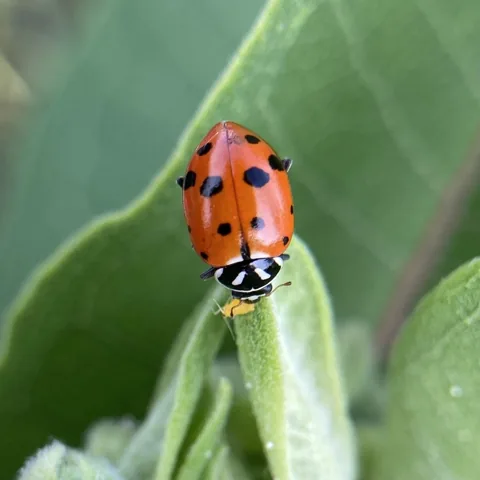 Convergent Lady Beetle
Hippodamia convergens
The convergent lady beetle is a native lady beetle named for the two short white marks on its thorax that angle toward each other. Adults and larvae eat aphids and other soft-bodied insects, and it is essentially the only lady beetle sold in stores and catalogs for aphid control.
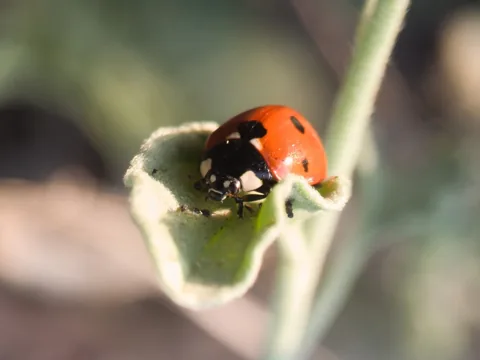 Sevenspotted Lady Beetle
Coccinella septempunctata
The sevenspotted lady beetle is native to Eurasia and is said to be the most common lady beetle in Europe. It was brought into North America on purpose to fight aphids and is now established here.
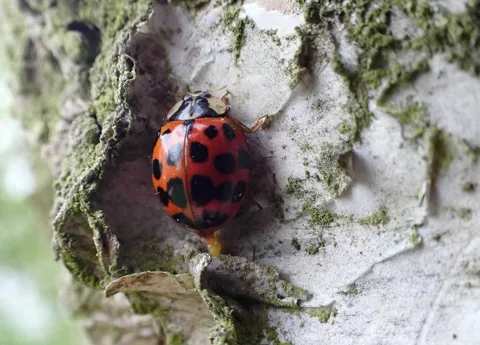 Multicolored Asian Lady Beetle
Harmonia axyridis
The multicolored Asian lady beetle is a beneficial aphid predator outdoors but becomes a nuisance when it flies to buildings in fall to overwinter and ends up indoors. Clemson and Colorado State extension both describe it as a valuable aphid predator on crops, trees and shrubs.
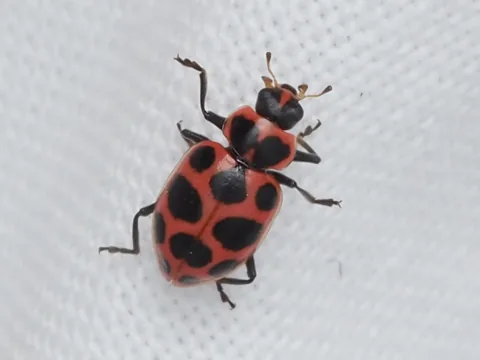 Pink Spotted Lady Beetle
Coleomegilla maculata
The pink spotted lady beetle is a native North American predator of aphids and insect eggs, and unlike most lady beetles it eats a lot of pollen, up to about half its diet.
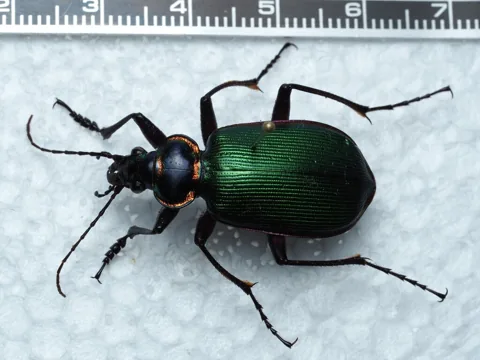 Ground Beetles
Family Carabidae (e.g., Calosoma scrutator, the fiery searcher)
Ground beetles are one of the largest groups of beetles in North America. They sometimes crawl indoors under doors or through small openings, but they prefer to live outside where prey is common, and outdoors they are valuable predators of garden pests.
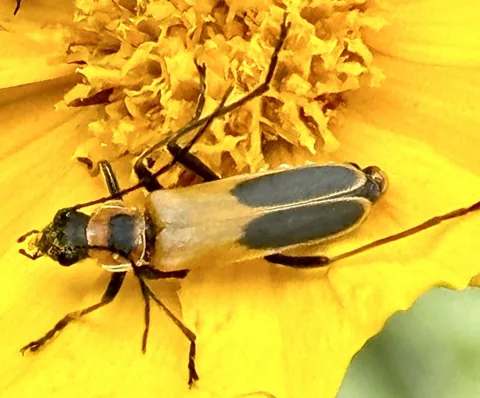 Soldier Beetles
Cantharidae (shown: Chauliognathus pensylvanicus)
Soldier beetles, also called leatherwings, are common flower visitors that resemble lightning bugs. They're beneficial: many pollinate flowers, adults of some species eat aphids and other soft insects, and the larvae hunt insect eggs and larvae in the soil and leaf litter.
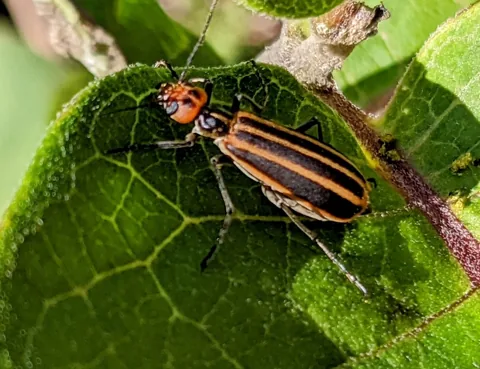 Blister Beetles
Epicauta spp. (shown: striped blister beetle, Epicauta vittata)
Blister beetles (family Meloidae) are plant-feeding beetles that carry cantharidin, a defensive chemical. Crushing one against your skin can raise a painful blister, and beetles baled into hay can poison horses and other livestock.
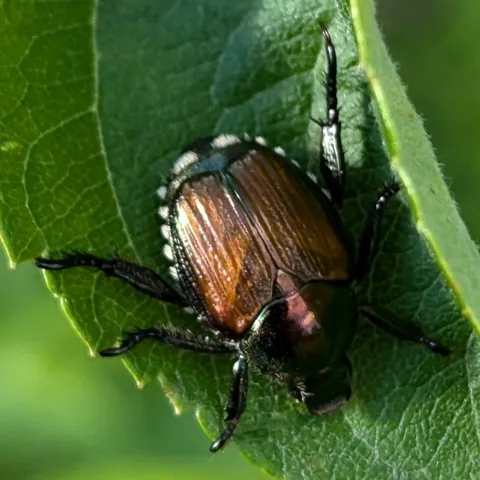 Japanese Beetle
Popillia japonica
The Japanese beetle damages landscapes twice: metallic green adults chew the leaves, flowers and fruit of hundreds of plants in early summer, and their white grubs feed on grass roots underground. A review of its biology calls it the most widespread and destructive insect pest of turf, landscapes and nursery crops in the eastern United States.
 Striped Cucumber Beetle
Acalymma vittatum
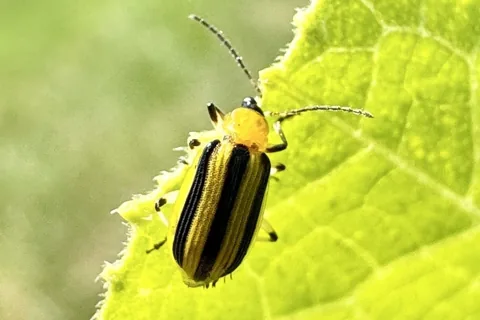
Cucumber beetles are small yellow-and-black beetles that feed on squash, cucumbers, melons and other cucurbits. The striped cucumber beetle is the main concern because it can carry bacterial wilt into cucumbers and muskmelons.
 Spotted Cucumber Beetle
Diabrotica undecimpunctata
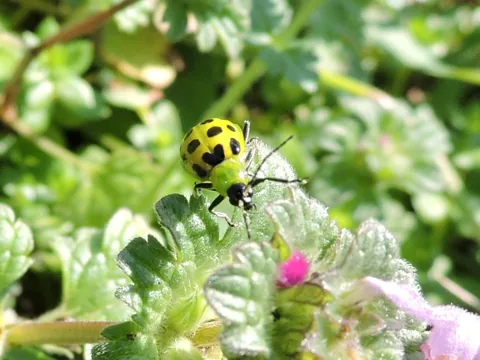
The spotted cucumber beetle, also called the southern corn rootworm, is a yellow-green beetle with 12 black spots. Adults feed on cucurbits and many other plants and can carry bacterial wilt into cucumbers and muskmelons.
 Western striped cucumber beetle
Acalymma trivittatum
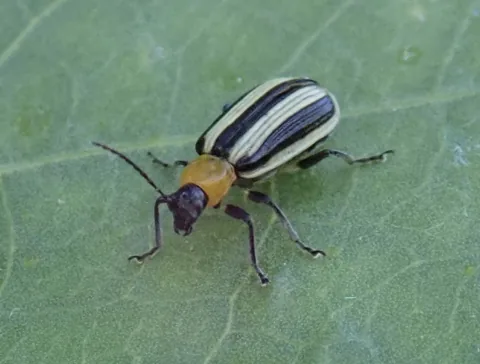
The western striped cucumber beetle is a small yellowish orange beetle with three black stripes down its back. It feeds on cucurbits in western gardens and fields, and its larvae feed only on cucurbit roots.
 Flea Beetles
Phyllotreta striolata
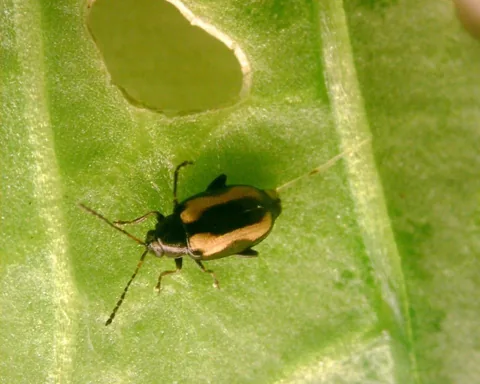
Flea beetles are tiny, shiny beetles with enlarged hind legs that jump like fleas when disturbed. Adults chew small holes and pits in the leaves of radishes, cabbage and other crucifers, eggplant, potatoes, tomatoes and many other vegetables, and they do the most harm to seedlings in spring.
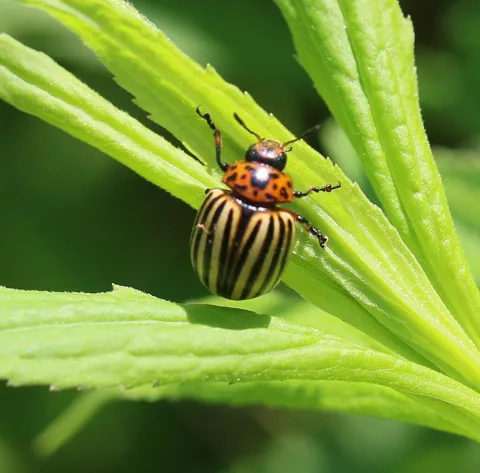 Colorado Potato Beetle
Leptinotarsa decemlineata
The Colorado potato beetle, the black and yellow-striped 'potato bug' of home gardens, is the most serious insect pest of potatoes. Adults and larvae eat the leaves of potatoes, eggplant and tomatoes and can strip plants completely.
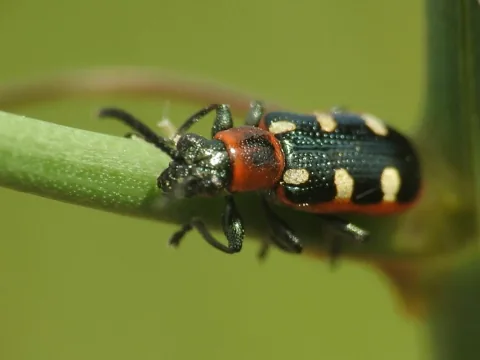 Asparagus Beetles
Crioceris asparagi (common) and Crioceris duodecimpunctata (spotted)
Two beetles attack garden asparagus: the common asparagus beetle and the spotted asparagus beetle. The common species is found more often and does more damage, scarring spears in spring and stripping the ferns later in the season.
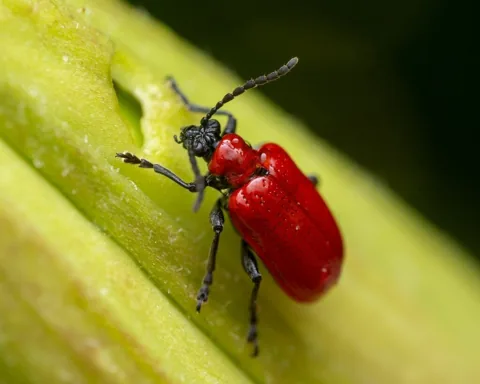 Lily Leaf Beetle
Lilioceris lilii
The lily leaf beetle is a bright red beetle from Europe that feeds on true lilies and fritillaria. Adults and especially the larvae chew leaves, buds and flowers, and an unchecked infestation can leave nothing but bare stems.
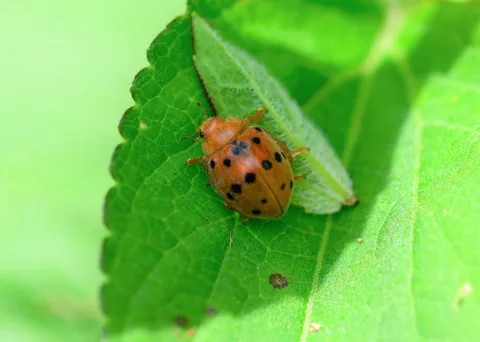 Mexican Bean Beetle
Epilachna varivestis
The Mexican bean beetle is a plant-eating member of the lady beetle family. Adults and spiny yellow larvae feed almost entirely on the undersides of bean leaves, leaving them lacy, and heavy infestations can defoliate plants and cut yields.
Friend or foe at a glance
Look at what the beetle is doing as well as what it looks like. Predators move around plants hunting, and lady beetle eggs and larvae turn up where aphids, mealybugs or scales are. Plant feeders sit on the plant and leave chewed leaves, shot holes, skeletonized leaves or bare stems.[2][11][16]
- Lady beetles: friend. Adults and larvae feed on aphids, scales, mealybugs, mites and other soft-bodied insects. One species, the Mexican bean beetle, feeds only on plants.[3][2]
- Ground beetles: friend. Adults and larvae hunt caterpillars, root-feeding and soil insects, slugs and snails. WSU says no control is needed outdoors.[4][5]
- Soldier beetles: friend. Minnesota calls them harmless to plants, and Kentucky says they don't damage foliage.[7][8]
- Blister beetles: mostly foe in the garden. They can strip pepper, radish and bean plants quickly, and they cause blisters if crushed on skin.[10][9]
- Japanese, cucumber, flea, Colorado potato, asparagus and lily leaf beetles: foe. Each has a host range and damage pattern described below, with a separate control guide for the first four.[11][13][15][17][19][22]
Lady beetles (ladybugs) and their larvae
Lady beetles are the best-known garden predators, and both adults and larvae eat insects. UC IPM counts about 200 species in California; Minnesota has more than 50 native species plus introduced ones. Minnesota says the larvae eat more pests than the adults do, which is why it pays to recognize every life stage.[1][2]
- Adults: domed, hard, round to oval bodies. Many are red with black spots, but some species are mostly black, yellow, pink or orange. The convergent lady beetle has two converging white marks behind the head and 0 to 13 spots.[2][1]
- Larvae: they look nothing like the adults. UC IPM says they are active, with six long legs, and resemble tiny alligators; some have spines. Minnesota describes them as black with white, orange or red areas, and the larval stage lasts 2 to 3 weeks.[1][2]
- Eggs: yellow, orange or red, oblong or football-shaped, laid in groups of 5 to 30 near aphids, mealybugs or scales. Species that feed on scales or spider mites lay eggs singly instead of in clusters.[2][1][3]
- Pupae: orange to red with black spots and a shriveled look, stuck to leaves, bark or stems. They don't crawl but may wiggle if disturbed, and the stage lasts 1 to 2 weeks.[2]
- Specialists: the mealybug destroyer has a dark body with an orange head and tail, and its waxy larva looks like a mealybug. The twenty-spotted lady beetle, about 1/16 inch long, eats powdery mildew spores.[1]
- The plant-eating exception: the Mexican bean beetle is a lady beetle that feeds only on plants and damages bean leaves and pods.[3]
- Handling: adults may give off a bad-smelling defensive liquid when picked up.[2]
- Buying lady beetles: Minnesota says almost all released beetles leave within a few days, and Colorado State says to expect most to fly away. Minnesota calls making your garden welcoming to the lady beetles already there the more sustainable choice.[2][3]
Ground beetles
Ground beetles are the dark, fast-running beetles you uncover when you lift a board, a rock or a pile of mulch. North America has over 2,500 species, and UC IPM lists caterpillars, root-feeding insects, soil insects, millipedes, slugs and snails among their prey.[4]
- Look: long legs, long unclubbed antennae and a hard, shiny back. Many are black or dark reddish, and some are bright or metallic. The section behind the head is usually narrower than the abdomen.[4][5]
- Size: UC IPM gives 1/8 to 1 inch for most species. WSU says common Northwest species run from about 1/4 inch to over an inch.[4][5]
- Habits: they hunt at night and hide by day in leaf litter, mulch, compost and under rocks and logs. Many species climb plants at night to feed on caterpillars. They run when disturbed and rarely fly; many can't fly at all.[4][5]
- Larvae: long, with a relatively large head and curved jaws. They live in leaf litter or topsoil and are predators too.[4][5]
- Life span: many species take about a year to develop from egg to adult, and ground beetles can live 2 or more years.[4]
- Caution: larger species may bite, and some release chemicals that irritate sensitive skin or smell bad, so don't pick them up bare-handed.[5]
- Lookalike: darkling beetles are plant feeders that look similar. UC IPM says ground beetles have enlarged segments at the base of the hind legs that darkling beetles lack.[4]
Soldier beetles (leatherwings)
Soldier beetles are the soft, narrow beetles that crowd onto goldenrod and other flowers in summer. They are related to fireflies but have no light organs. Their wing covers are soft and flexible, which gives them the name leatherwings.[8][7][6]
- Look: Kentucky describes them as elongate, soft-bodied and about 1/2 inch long, yellow to red with brown or black wings or trim. UC IPM gives the family a size range of 1/16 to 1-1/8 inches.[8][6]
- Pennsylvania leatherwing: a common, easy-to-spot species, yellowish to tan, about 1/2 inch, with a black spot behind the head and one oval black spot on each wing cover.[7][8]
- Diet: adults eat caterpillars, eggs, aphids and other soft-bodied insects, plus nectar and pollen. UC IPM notes that some kinds feed only on honeydew, nectar and pollen. Minnesota calls them beneficial pollinators.[8][6][7]
- Larvae: dark, velvety and bristly, up to 3/4 inch, living in soil and leaf litter and feeding mostly on insect eggs and larvae. They spend the winter as larvae.[6][7][8]
- When you'll see them: Minnesota, describing the Pennsylvania leatherwing, says adults are active from late July to September. UC IPM says soldier beetle adults are usually seen in spring through early summer, so timing depends on the species and region.[7][6]
- Any harm? Kentucky says they occasionally feed on soft fruit such as raspberries and cherries, but this is uncommon, and larvae sometimes wander into houses in fall. Minnesota's advice is to leave them alone.[8][7]
Blister beetles
Blister beetles are plant feeders with a chemical defense. Their bodies contain cantharidin, and crushing or even brushing one against bare skin can raise a painful blister.[9][10]
- Look: long, narrow and soft-winged. Kentucky gives 3/4 to 1-1/4 inches, with a broad head and antennae about a third of the body length. South Dakota State describes a velvety look, a thorax narrower than the head and abdomen, and an abdomen that sticks out past the wing covers.[9][10]
- Common kinds: Kentucky lists the ashgray, black, margined and striped blister beetles in the eastern and central states. The striped blister beetle is a common one in gardens.[9][10]
- Damage: they feed on leaves and are drawn to flowers. Problems in gardens are not frequent, but when a group arrives it can defoliate peppers, radishes or green beans quickly.[10][9]
- The upside: blister beetle larvae eat grasshopper eggs, and populations tend to be highest where grasshoppers were dense the year before.[10]
- Handling: wear disposable gloves if you handpick them, and don't let the gloves touch bare skin. Livestock owners have a separate worry: dead beetles baled into hay can poison horses, cattle and sheep.[10][9]
Japanese beetles
Japanese beetles are an invasive pest found throughout the eastern US except Florida and still moving west. Adults feed on leaves, flowers and fruit of about 300 kinds of plants, and their grubs feed on grass roots.[12][11]
- Look: metallic green head and thorax with copper-brown wing covers. Kentucky gives 7/16 inch and Minnesota 1/3 to 1/2 inch. A row of white hair tufts runs along each side of the abdomen (Minnesota counts five), with two more at the tip.[11][12]
- Damage: they chew the tissue between leaf veins, leaving lacy, skeletonized leaves, and feed in groups from the top of the plant down. Roses can lose petals and leaves entirely.[11]
- Timing: adults start feeding in June, with the heaviest activity over 4 to 6 weeks from late June. Each beetle lives about 30 to 45 days.[11]
- Grubs: C-shaped, white to cream with a tan head, up to about 1 inch, living about 10 months in the soil. They look like other white grubs.[12][11]
- Next step: see the Japanese beetle guide for handpicking, traps, netting and spray timing.[11][12]
Striped and spotted cucumber beetles
Cucumber beetles chew on cucumber and melon plants, but the bigger risk is bacterial wilt, a disease the striped cucumber beetle carries and spreads as it feeds. Cantaloupe and muskmelon are hit hardest.[14][13]
- Striped cucumber beetle: yellow (Kentucky says yellow-green) with three black stripes down the back. Minnesota gives about 1/5 inch long and Kentucky 1/4 inch.[13][14]
- Spotted cucumber beetle: yellow-green with 12 black spots, about 1/4 inch. Kentucky notes it is also called the southern corn rootworm.[14][13]
- Larvae: about 3/8 inch and creamy white, feeding on roots and underground stems.[13][14]
- Lookalike: the western corn rootworm. The striped cucumber beetle's stripes are straighter, and the middle segment of its hind leg is yellow where the rootworm's is black.[14]
- Next step: see the cucumber beetle guide for row covers, trap crops and timing.[13][14]
Flea beetles
If a seedling's leaves are peppered with tiny round holes and small beetles jump away when you bend down, they are flea beetles. The damage pattern is distinctive.[16][15]
- Look: most are 1/16 to 1/8 inch, shiny, with enlarged hind legs for jumping. The spinach flea beetle is bigger, about 1/4 inch.[15][16]
- Damage: shallow pits and small rounded holes, usually less than 1/8 inch, in leaves. UC IPM says damage usually isn't serious once plants are past the seedling stage.[15][16]
- Next step: see the flea beetle guide for row covers, timing and treatment options.[15][16]
Colorado potato beetles
Colorado potato beetles strip potato plants and also feed on eggplant, tomato, pepper and tomatillo. Both the adults and the larvae eat leaves and can defoliate plants.[17][18]
- Adults: oval, about 3/8 inch, with a yellow-orange area behind the head and yellowish-white wing covers bearing 10 narrow black stripes.[17]
- Eggs: bright yellow-orange ovals in clusters on the undersides of leaves. Kentucky says about two dozen per batch, with 500 or more per female.[17][18]
- Larvae: humpbacked, with two rows of black spots on each side. Newly hatched larvae are brick red with black heads.[18][17]
- Next step: see the Colorado potato beetle guide. Minnesota notes that many insecticides fail because of resistance, so a combination of tactics works better than spraying alone.[17][18]
Asparagus beetles (common and spotted)
Two beetles feed on asparagus. Both scar and brown the spears, and the common asparagus beetle's adults and larvae also eat the ferns, which weakens the next year's crop.[19][20]
- Common asparagus beetle: bluish-black with six cream-colored spots and a reddish thorax. Minnesota gives 1/4 inch and UMass 6 to 9 mm (about 3/8 inch). Its dark brown eggs stand on end in rows along the spears, and its larvae are gray with a black head.[19][20]
- Spotted asparagus beetle: reddish orange with twelve black spots, 6 to 8 mm in UMass's description. Its larvae are orange and feed only inside the berries, so they don't hurt the plants.[19][21]
- Friend or foe check: Minnesota warns not to confuse the spotted asparagus beetle with a lady beetle. Lady beetles have rounder, domed bodies, short antennae and a head partly hidden from above.[19]
- Garden tips from UMass: harvest every spear daily during the season, clean up old ferns and crop edges in fall, and grow all-male varieties that don't make berries.[20][21]
Lily leaf beetles
The lily leaf beetle is a European beetle first found in the US in Cambridge, Massachusetts, in 1992. It has spread through New England and New York, and UMass expects it to establish across much of North America.[22][23]
- Look: about 1/2 inch, bright shiny red on top with black legs, head, antennae and underside.[22][23]
- Plants: it develops only on true lilies (Lilium) and fritillaria. Daylilies are not hosts.[22]
- Larvae: slug-like, orange, brown, yellowish or greenish with black heads, and usually covered in their own excrement. They do most of the damage and can strip a plant to bare stems.[22][23]
- Life cycle: each female lays 250 to 450 eggs in rows on the undersides of leaves, and there is one generation a year.[22]
- What helps: handpick adults, eggs and larvae on small plantings. URI reports three parasitic wasps released in seven northeastern states are now established, and UMass cites University of Maine research suggesting some Oriental and other hybrid lilies hold up better than the more susceptible Asiatic hybrids.[22][23]
Lookalikes that fool gardeners
- Spotted cucumber beetle vs lady beetle: both can be yellowish with black spots, but the cucumber beetle has long antennae. Lady beetles have short, sometimes hard-to-see antennae.[1][14][2]
- Spotted asparagus beetle vs lady beetle: an orange beetle with twelve black spots on asparagus is the pest. Look for the lady beetle's domed body and hidden head.[19]
- Colorado potato beetle eggs vs lady beetle eggs: Colorado State says a few leaf beetles, including the Colorado potato beetle, lay egg masses that look like lady beetle eggs. Watch what hatches: young Colorado potato beetle larvae are brick red with black heads and feed on the leaves.[3][17]
- Soldier beetle vs blister beetle: Kentucky says blister beetles have a square-shaped head and a visible neck because the thorax is narrower than the head and abdomen.[8]
- Lady beetle larva vs pest: the spiny, alligator-shaped larvae look nothing like the adult, and they are the ones doing most of the aphid control.[1][2]
- Ground beetle vs darkling beetle: both are dark ground dwellers, but only the ground beetle is a predator. UC IPM separates them by the enlarged segments at the base of the ground beetle's hind legs.[4]
What to do next
- Protect the friends: grow plants that flower through the season (Minnesota names shallow flowers such as alyssum, coriander and dill), leave some brush or leaves for lady beetles to spend the winter in, and tolerate a few aphids.[2][3]
- Spray with care: broad insecticides kill lady beetles along with pests. If you need one, Minnesota suggests a selective product that won't harm them.[2][3]
- Handle the foes early: Japanese beetles, cucumber beetles, flea beetles and Colorado potato beetles each have a control guide on this site, linked below.[11][14][15][18]
- Wear gloves for blister beetles, handpick lily leaf beetles and their larvae, and clean up asparagus ferns and stems in fall.[10][22][20]
Common questions
- What do lady beetle larvae look like?
- Long, six-legged and alligator-shaped, usually black with orange, red or white markings, and often spiny. They are predators, eating aphids and other soft-bodied insects.[1][2]
- Are black beetles in my garden good or bad?
- Shiny black beetles that run fast on the ground are usually ground beetles, which eat caterpillars, slugs and other pests. A shiny black beetle that jumps off seedlings is a flea beetle, a plant feeder.[4][15]
- Do soldier beetles hurt plants?
- No. Minnesota calls them harmless to plants and beneficial, and Kentucky says they don't damage foliage, though they occasionally nibble soft fruit.[7][8]
- What is the red beetle on my lilies?
- A bright red beetle about 1/2 inch long with black legs and head is the lily leaf beetle. It feeds on true lilies and fritillaria, not daylilies.[22][23]
- Can blister beetles hurt me?
- Their body fluid contains cantharidin, which can raise a painful blister if a beetle is crushed or brushed against bare skin. Wear disposable gloves to remove them.[9][10]
Photo credits
- Convergent Lady Beetle: (c) Jody, some rights reserved (CC BY) — via iNaturalist, CC BY 4.0
- Sevenspotted Lady Beetle: (c) Atalay Karakuş, some rights reserved (CC BY) — via iNaturalist, CC BY 4.0
- Multicolored Asian Lady Beetle: (c) Sascha Nunheim, some rights reserved (CC BY) — via iNaturalist, CC BY 4.0
- Pink Spotted Lady Beetle: Zygy, public domain (CC0), via iNaturalist
- Ground Beetles: Brighton Lee, public domain (CC0), via iNaturalist
- Soldier Beetles: Anne P, public domain (CC0), via iNaturalist
- Blister Beetles: (c) Jason Hill, some rights reserved (CC BY) — via iNaturalist, CC BY 4.0
- Japanese Beetle: (c) Emmett Collins-Sussman, some rights reserved (CC BY) — via iNaturalist, CC BY 4.0
- Striped Cucumber Beetle: (c) L.J. Lamera, some rights reserved (CC BY) — via iNaturalist, CC BY 4.0
- Spotted Cucumber Beetle: (c) Sam Kieschnick, some rights reserved (CC BY) — via iNaturalist, CC BY 4.0
- Western striped cucumber beetle: (c) Cricket Raspet, some rights reserved (CC BY) — via iNaturalist, CC BY 4.0
- Flea Beetles: 螯蝦, public domain (CC0), via iNaturalist
- Colorado Potato Beetle: (c) Barry Cottam, some rights reserved (CC BY) — via iNaturalist, CC BY 4.0
- Asparagus Beetles: (c) Yves Bas, some rights reserved (CC BY) — via iNaturalist, CC BY 4.0
- Lily Leaf Beetle: (c) Zachary Dankowicz, some rights reserved (CC BY) — via iNaturalist, CC BY 4.0
- Mexican Bean Beetle: (c) Neptalí Ramírez Marcial, some rights reserved (CC BY) — via iNaturalist, CC BY 4.0
Sources
- University of California Statewide IPM Program, “Lady Beetles (Home and Landscape).” ipm.ucanr.edu/home-and-landscape/lady-beetles/ (accessed 2026-11-10)
- University of Minnesota Extension, “Lady beetles (Schuh).” extension.umn.edu/yard-and-garden-insects/lady-beetles (accessed 2026-11-10)
- Colorado State University Extension, “Lady Beetles (Fact Sheet 5.594).” extension.colostate.edu/topic-areas/insects/lady-beetles-5-594/ (accessed 2026-11-10)
- University of California Statewide IPM Program, “Predaceous Ground Beetles (Natural Enemies Gallery).” ipm.ucanr.edu/natural-enemies/predaceous-ground-beetles/ (accessed 2026-11-10)
- Washington State University Pestsense, “Predaceous ground beetles (Carabids).” pestsense.cahnrs.wsu.edu/fact-sheet/predaceous-ground-beetles-carabids/ (accessed 2026-11-10)
- University of California Statewide IPM Program, “Soldier Beetles (Natural Enemies Gallery).” ipm.ucanr.edu/natural-enemies/soldier-beetles/ (accessed 2026-11-10)
- University of Minnesota Extension, “Soldier beetles.” extension.umn.edu/yard-and-garden-insects/soldier-beetles (accessed 2026-11-10)
- University of Kentucky Entomology, “ENTFACT-707: Soldier Beetles.” entomology.mgcafe.uky.edu/ef707 (accessed 2026-11-10)
- University of Kentucky Entomology, “ENTFACT-102: Blister Beetles.” entomology.mgcafe.uky.edu/ef102 (accessed 2026-11-10)
- South Dakota State University Extension, “Blister Beetles Causing Problems in Gardens.” extension.sdstate.edu/blister-beetles-causing-problems-gardens (accessed 2026-11-10)
- University of Kentucky Entomology, “ENTFACT-451: Japanese Beetles in the Urban Landscape.” entomology.ca.uky.edu/ef451 (accessed 2026-11-10)
- University of Minnesota Extension, “Japanese beetles in yards and gardens.” extension.umn.edu/yard-and-garden-insects/japanese-beetles (accessed 2026-11-10)
- University of Minnesota Extension, “Cucumber beetles.” extension.umn.edu/yard-and-garden-insects/cucumber-beetles (accessed 2026-11-10)
- University of Kentucky Entomology, “ENTFACT-311: Cucumber Beetles.” entomology.ca.uky.edu/ef311 (accessed 2026-11-10)
- University of Minnesota Extension, “Flea beetles (reviewed 2022).” extension.umn.edu/yard-and-garden-insects/flea-beetles (accessed 2026-11-10)
- University of California Statewide IPM Program, “Flea Beetles (Pest Notes, Home and Landscape).” ipm.ucanr.edu/home-and-landscape/flea-beetles/ (accessed 2026-11-10)
- University of Minnesota Extension, “Colorado potato beetle.” extension.umn.edu/garden-and-home/yard-and-garden/yard-and-garden-insects/colorado-potato-beetle (accessed 2026-11-10)
- University of Kentucky Entomology, “ENTFACT-312: Colorado Potato Beetle Management.” entomology.ca.uky.edu/ef312 (accessed 2026-11-10)
- University of Minnesota Extension, “Asparagus beetles.” extension.umn.edu/garden-and-home/yard-and-garden/yard-and-garden-insects/asparagus-beetles (accessed 2026-11-10)
- UMass Amherst Center for Agriculture, Food, and the Environment, “Common Asparagus Beetle (Vegetable fact sheet).” www.umass.edu/agriculture-food-environment/vegetable/fact-sheets/common-asparagus-beetle (accessed 2026-11-10)
- UMass Amherst Center for Agriculture, Food, and the Environment, “Spotted Asparagus Beetle (Vegetable fact sheet).” www.umass.edu/agriculture-food-environment/vegetable/fact-sheets/spotted-asparagus-beetle (accessed 2026-11-10)
- UMass Amherst Center for Agriculture, Food, and the Environment, “Lily Leaf Beetle (Landscape fact sheet).” www.umass.edu/agriculture-food-environment/landscape/fact-sheets/lily-leaf-beetle (accessed 2026-11-10)
- University of Rhode Island Biocontrol Lab, “Lily Leaf Beetle (Biocontrol Lab).” web.uri.edu/biocontrol/projects/lily-leaf-beetle/ (accessed 2026-11-10)