The short answer
- Confirm it's flea beetles: tiny beetles that hop away when you approach, and leaves full of small round holes or shallow pits, usually less than 1/8 inch across.[5][6][8]
- Cover seedlings and transplants with floating row cover right at seeding or transplanting, seal the edges with soil, and use hoops over eggplant. UC IPM says covers can stay on until about the sixth leaf stage.[7][8][6][1]
- Time planting so young plants grow fast. University of Minnesota suggests planting later in the normal window, when warmer weather speeds growth and plants miss the first flush of beetles.[5][6]
- Plant a trap crop of radish, mustard or another favored brassica 7 to 14 days before the main crop, and deal with the beetles where they gather.[5][7]
- Pull nearby weeds and clear old crop debris in fall, because adults spend the winter in leaf litter and weedy edges.[5][1][6]
- Eggplant is the crop to watch. Its seedlings are slow to establish and can be eaten to lace, while tomatoes and potatoes often grow fast enough to outpace the damage.[8][10]
- If seedlings are losing ground, sources list spinosad, pyrethrins, carbaryl and several pyrethroids for flea beetles. UC IPM says sprays usually aren't necessary in home gardens and often only the outside rows need treatment.[5][6][1]
Flea beetles to know
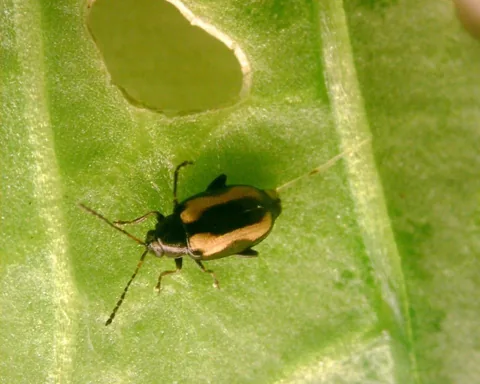 Flea Beetles
Phyllotreta striolata
Flea beetles are tiny, shiny beetles with enlarged hind legs that jump like fleas when disturbed. Adults chew small holes and pits in the leaves of radishes, cabbage and other crucifers, eggplant, potatoes, tomatoes and many other vegetables, and they do the most harm to seedlings in spring.
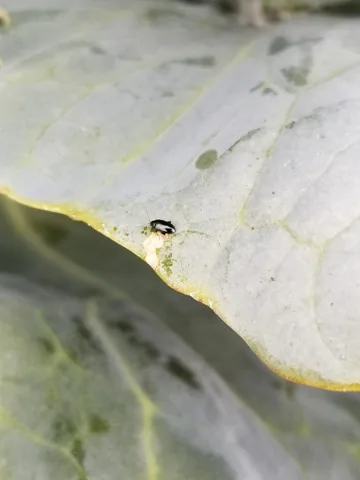 Crucifer flea beetle
Phyllotreta cruciferae
If the shot holes are in arugula, mustard, bok choy or cabbage and not in the tomatoes next door, the beetle is almost certainly a brassica specialist, and the plain black one is the crucifer flea beetle. It feeds only on brassica crops and weeds, winters in the shrubby or wooded borders of the field, moves in during May, and sends a second generation out in late July to work the fall plantings. On the Canadian prairies it and the striped flea beetle are devastating pests of canola.
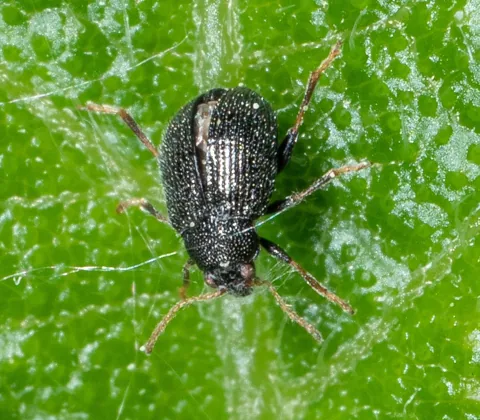 Eggplant flea beetle
Epitrix fuscula
Eggplant is a favorite host of several flea beetles, most of them in the genus Epitrix, and the eggplant flea beetle is the one named for the crop. It is a 2 mm black beetle that UMass says looks very much like the potato flea beetle but occurs farther south. The beetles are around all season, yet UC IPM says they matter most in the month after transplanting, when they can defoliate and kill young plants that a month later would tolerate them.
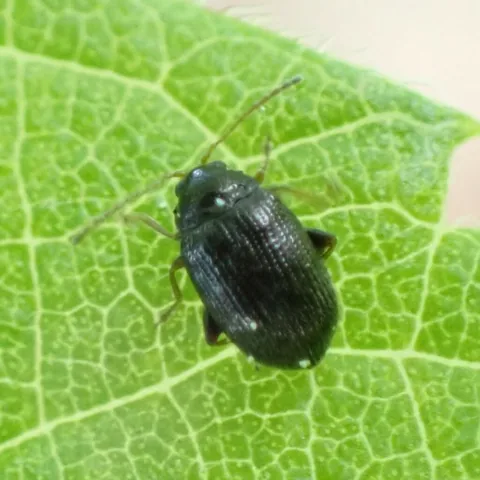 Potato flea beetle
Epitrix cucumeris
When eggplant, tomatoes or potatoes in the Northeast come up looking like they were hit with birdshot, the potato flea beetle is usually the one responsible. It overwinters in the leaf litter at the field edge, feeds on horse nettle and pokeweed in early spring, then moves into the crop and stays until August, with a second flush of summer adults from mid July to mid August. Potatoes and tomatoes often grow fast enough to outrun it; slow-starting eggplant seedlings do not, which is why UMass sets a threshold of just two beetles per newly set transplant.
 Tuber flea beetle
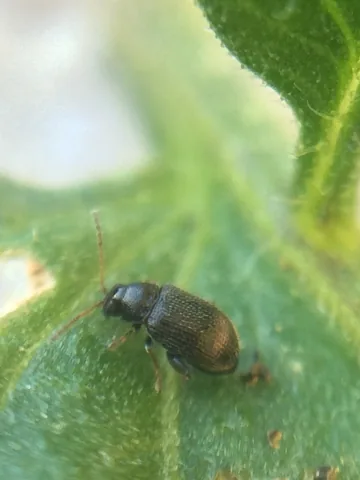
Epitrix tuberis
Most flea beetles only pepper potato leaves. The tuber flea beetle is the exception: its soil-dwelling larvae carve shallow, wavy furrows just under the skin of the tubers, damage the PNW Handbook says is almost identical to symphylan injury, and the second and third generations hit the late crop. It is a serious problem in some areas west of the Cascades, particularly Washington's Skagit Valley, and European plant-health agencies watch for it because its tuber damage can make a crop unmarketable.
 Palestriped flea beetle
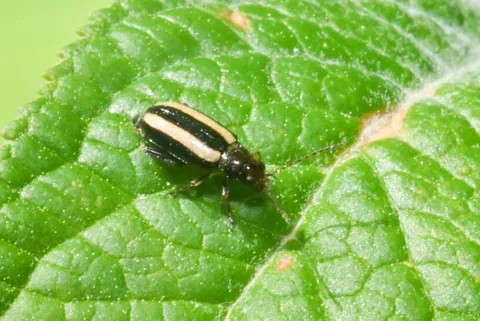
Systena blanda
Most flea beetles are plain black specks. The palestriped flea beetle wears a broad creamy white stripe down each brown wing cover, and it is about twice the size of the potato flea beetle it often shares a field with. Adults pit and hole the undersides of seedling leaves on crops from alfalfa and corn to carrots, eggplant and hemp, and this species also does something many flea beetles do not: its larvae feed on the roots of young plants and on germinating seed, and in California's Imperial and San Joaquin Valleys they scar carrot taproots badly enough to be mistaken for cavity spot disease.
 Corn flea beetle
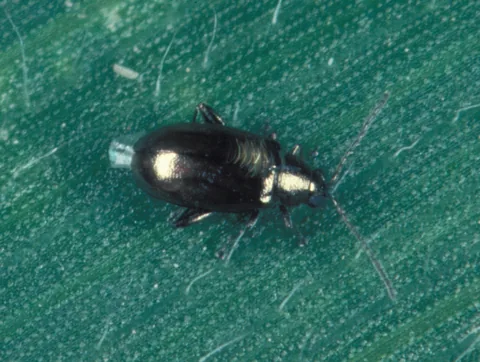
Chaetocnema pulicaria
The corn flea beetle is about the size of a pinhead, and by itself it seldom kills a corn plant. What makes it matter is the bacterium it carries through the winter: Pantoea stewartii, the cause of Stewart's wilt, which can severely cut yields in susceptible sweet corn and seed corn inbreds. A beetle can pick up the bacterium after as little as six hours of feeding on an infected plant and pass it to a healthy one in under three. How many beetles survive to spring depends on the winter, which is why Purdue's advice starts with adding up December, January and February temperatures.
 Redheaded Flea Beetle
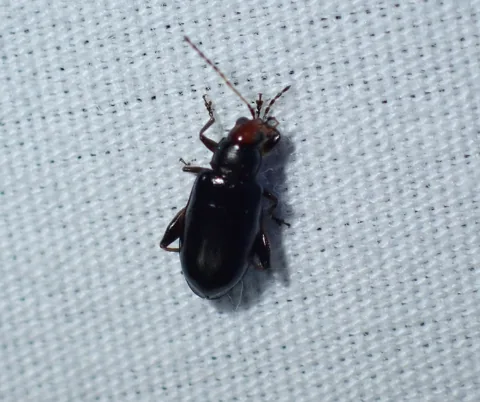
Systena frontalis
The redheaded flea beetle is a tiny, native, shiny black beetle with a red head that jumps like a flea and chews numerous small holes in the leaves of panicle hydrangeas, roses, sweetspire and many other shrubs, perennials and weeds.
How to tell it's flea beetles
Flea beetles are easy to name once you see them move. They have enlarged hind legs and jump like fleas when disturbed. UC IPM puts them at less than 1/10 inch long; University of Minnesota gives 1/16 to 1/8 inch for most species, with the spinach flea beetle reaching 1/4 inch, and UW-Madison gives a range of 1/16 to 1/4 inch. They are black, bronze, bluish, brown or metallic gray, and some are striped.[1][5][6]
- Shot holes. Adults chew small rounded holes and shallow pits, usually less than 1/8 inch across. University of Minnesota calls this damage unique to flea beetles, and UC IPM's tomato guidelines describe leaves that look sievelike.[5][4]
- Check before blaming them. UW-Madison notes that certain plant diseases can occasionally cause similar shot holes, so look for the beetles themselves.[6]
- Look under the leaves. UW-Madison and UC IPM say adults often feed on the undersides, and the pits don't always go all the way through.[6][2]
- Count damage, not beetles. UMass says flea beetles are hard to count because they hop away, so feeding damage is probably the best measure on eggplant, tomato and potato. University of Minnesota says scouting is easier on cool mornings, when they move more slowly.[8][7][5]
- Timing. UW-Madison says adults are most active on calm, warm, sunny days. They become active in early spring once temperatures reach about 50°F.[6]
Which flea beetle is on which crop
Several species are involved, and most stick to one plant family. From a gardener's point of view they look much alike: small, dark and quick to hop. The crop they're on is the best clue.[8][5][6]
- Cabbage family (broccoli, cabbage, kale, radish, mustard, bok choy, arugula): the crucifer flea beetle, uniformly shiny black and about 2 mm long, and the striped flea beetle, with two yellow stripes on its back. UMass says these feed only on brassicas, and prefer tender, glossy-leaved greens such as mustard, bok choy, tatsoi and mizuna over waxy-leaved cabbage and broccoli.[7][6]
- Eggplant: the eggplant flea beetle, black, slightly hairy and a little more than 1/16 inch long according to NC State. UMass says it is found in more southern areas and looks very similar to the potato flea beetle. Clemson says eggplant is a favorite host of several flea beetle species, mostly in the genus Epitrix.[9][8][10]
- Potato, tomato, eggplant and pepper: the potato flea beetle, almost 1/8 inch long and much less hairy than the eggplant flea beetle per NC State. UMass describes it as shorter, broader and more pitted than the crucifer flea beetle, and says that when eggplant, tomato and potato are hit hard, the damage is usually caused by this species.[9][8][6]
- In the West: UC IPM lists the tobacco flea beetle (brown with black markings) and the western potato flea beetle (shiny bronze or black) as widespread in the western U.S., and the tuber flea beetle in Washington and Oregon. In Pacific Northwest potato fields, the potato-feeding species have yellowish-brown legs, while the Phyllotreta flea beetles sometimes found there feeding on weeds have black legs.[1][11]
- A Virginia Tech field study found crucifer and striped flea beetles on cabbage, and eggplant and tobacco flea beetles on eggplant.[12]
- Elsewhere in the garden: the palestriped flea beetle feeds on squash, beans, corn, sunflowers, lettuce, potatoes and many weeds, and the spinach flea beetle feeds on beets, spinach and Swiss chard.[5][6]
How much damage is too much
Young plants are the ones at risk. Heavy feeding can kill seedlings or stunt them, while older plants usually tolerate a fair amount of injury. University of Minnesota says crops at the 4- or 5-leaf stage are generally strong enough to survive the feeding, and UC IPM says damage usually isn't serious beyond the early seedling stage. Seeded crops are less tolerant than transplants.[5][1][6][10]
- Seedlings in general: University of Minnesota's home-garden advice is to treat seedlings when there are more than five flea beetles per plant.[5]
- Eggplant: University of Minnesota, UW-Madison and UMass use the same sliding scale. Under 3 inches tall, act at about 2 beetles per plant; at 3 to 6 inches, about 4 per plant; over 6 inches, about 8 per plant. UMass says full-size plants rarely need treatment.[5][6][8]
- Cabbage family: UMass suggests acting on young plants at an average of 1 beetle per plant or 10% leaf damage, but says no fixed threshold fits all brassicas because they differ so much in attractiveness. University of Minnesota's commercial guidance uses 10 to 20% of the stand showing damage. UW-Madison lists the cole crop threshold as undetermined.[7][5][6]
- Tomato: UW-Madison lists more than 2 beetles per plant. UC IPM suggests treating rows where 5 to 10% of seedlings or young plants show heavy feeding, and says treatment usually isn't needed once plants have more than 4 true leaves. Dry, windy weather makes injured seedlings more likely to die.[6][4]
- Leafy greens: crops grown for their leaves, such as kale and spinach, and glossy greens such as bok choy and mustard, can be damaged enough to be unusable even when the plants survive.[6][7]
- Edges first. Beetles arriving from outside the garden tend to concentrate along borders, so UC IPM says treating only the outside rows is often enough.[1][2][4][5]
Row covers and when to put them on
Row cover keeps flea beetles off young plants, as long as it goes on before the beetles do. UMass says spun-bonded row cover gives excellent protection if it's secured with soil or weights around all edges immediately after seeding or transplanting.[7][8][6]
- Timing: UW-Madison says to set covers up just before the crop emerges or immediately after transplanting, so beetles can't get in first.[6][7]
- Eggplant and tomato: UMass says to place the cover on hoops immediately after transplanting and seal the edges well. University of Minnesota adds that the fabric can't lie directly on eggplant.[8][5]
- How long: UC IPM says seedlings can be protected until about the sixth leaf stage; older plants are less likely to suffer. University of Minnesota says to remove covers before flowering so pollinators can reach plants that need them.[1][5]
- Rotate the bed. University of Minnesota says covers exclude flea beetles as long as crops are rotated. UMass advises rotating spring crops as far as possible from where flea beetles overwintered.[5][7]
- Lifting lets them in. Beetles can slip under whenever the cover is opened, and weeding is harder under fabric. UMass says to remove and replace covers the same day when you need to work the bed.[5][7]
- For fabric weights, anchoring and crop-by-crop timing, see the row cover guide.[7]
Trap crops for flea beetles
Flea beetles have strong favorites, and a trap crop uses that. University of Minnesota says adults are drawn to the tallest, earliest crops available, and UMass says their numbers build up on the more attractive plants, where they can be killed without spraying the main crop.[5][7]
- Plant it first. Sow the trap crop 7 to 14 days before the main crop, or at least make sure it's as far along (for example, transplanted the same day).[5][7]
- What to plant: radish is the example University of Minnesota gives. It also cites Washington studies that found a mustard variety and pac choi most effective, and studies suggesting a mix of three brassica species beats one or two.[5]
- How much and where: University of Minnesota suggests about 10% of the crop area, along the border or one side. UMass suggests a border around the planting, with traps at row ends to close the perimeter.[5][7]
- Keep it healthy. UMass warns that if the trap crop gets too ragged the beetles leave it and move back to the main crop; it may need fertilizer, reseeding or other care.[7]
- Deal with the beetles there. Both University of Minnesota and UMass say to spray the trap crop once beetles are feeding on it, rather than the crop you're protecting.[5][7]
- University of Minnesota says trap crops have been studied and used with success in cole crops. The trap crop guide covers what the research says works and doesn't for other pests.[5][7]
Planting date, rotation and garden cleanup
Adults spend the winter in leaf litter, hedgerows, windbreaks, wooded edges, and soil or debris near where they fed, then search out new food plants in spring. Much of the prevention aims at that spring move.[5][6][8][7]
- Plant a little later. University of Minnesota says planting later in the normal window can help plants avoid the first generation, and warmer weather helps potatoes grow fast enough to shrug off feeding. UW-Madison says planting after adults emerge helps.[5][6]
- Break the cycle in brassicas. UMass suggests separating early and late brassica plantings and moving spring crops as far as possible from last fall's brassicas. It notes that skipping brassicas before July breaks the cycle, though that may not be practical.[7]
- Rotate. UC IPM reports research showing tomato seedling damage was significantly higher in fields previously planted to tomatoes, which points to beetles overwintering on site.[4][6]
- Pull host weeds. Brassica weeds harbor crucifer flea beetles, and solanaceous weeds such as horse nettle and pokeweed feed potato flea beetles in early spring before they move to the garden.[7][8][2]
- Clean up. Remove crop debris after harvest and in fall so fewer beetles find winter shelter.[5][1][7]
- Water and feed. UW-Madison says watering at midday may reduce feeding, and UMass recommends adequate water and nutrients and avoiding compacted soil.[6][7]
- Reflective mulch: UC IPM says reflective mulch put down very soon after planting can help.[1]
- Replant if needed. UC IPM notes that replanting heavily damaged border rows is an option.[4]
Sticky traps: monitoring, not control
Sticky traps show when flea beetles arrive and roughly how many. Sources differ on color: University of Minnesota, UW-Madison and UMass name yellow sticky traps or cards, while UC IPM's home page names white sticky traps.[5][6][7][1]
- Place cards in the plant canopy. UW-Madison says trap catches correspond to the amount of feeding damage nearby.[7][6]
- Start early. University of Minnesota says to watch as soon as seedlings emerge, and UW-Madison suggests checking newly planted beds every one to two days.[5][6]
- UC IPM says white sticky traps can be used to monitor or trap adults; the other sources use traps to detect beetles and judge their numbers.[1][5]
Kaolin clay
Kaolin clay is sprayed on leaves as a film that discourages feeding. The Pacific Northwest handbook lists it among home-garden options for potato flea beetles, noting that applied to foliage it repels certain insect pests.[11][5]
- Mixed results: University of Minnesota says kaolin can provide a physical barrier to feeding, but that studies and grower experience report mixed results, and it has to be reapplied after rain.[5]
- Push-pull: UMass suggests coating the main crop with kaolin while a trap crop pulls the beetles away, and lists kaolin with spinosad and pyrethrin as the organic choices for brassica flea beetles.[7]
- It's awkward to apply. UMass says growers hesitate because the clay is difficult to mix and spray: it has to be kept in suspension or it clogs nozzles.[7]
- UMass adds that kaolin can also help protect squash-family transplants from striped cucumber beetles.[7]
Natural enemies
Flea beetles have natural enemies, though the ones sources name are not very common or can't be bought. A 2024 review of flea beetles in brassica crops notes a lack of resistant varieties and other practical alternatives, and emphasizes biological control as an area with potential.[5][13]
- A native wasp, Microctonus vittatae, develops inside adult flea beetles and keeps females from reproducing. University of Minnesota says it is more common in the eastern U.S., not very common overall, and not available for purchase.[5]
- Generalist predators: lacewing larvae have been seen feeding on flea beetles. The Pacific Northwest handbook says ground beetles, rove beetles, nematode parasites and fungal diseases likely affect the soil-dwelling larvae, and spiders the adults.[5][11]
- Beneficial nematodes: UW-Madison says products containing insect-killing nematodes have shown some success in reducing flea beetle numbers, but often have a limited shelf life.[6]
If you need to spray
UC IPM says insecticides should not normally be necessary for flea beetles in home gardens and aren't very effective when populations are high. Other extension sources give thresholds for when seedlings need help. Either way, sprays are for protecting young plants; once plants are established they rarely need treatment.[1][5][8][6]
- Contact options: UW-Madison says insecticidal soap and horticultural oils such as neem oil can help in home gardens, but they work only by contact and are short-lived, so coverage must be thorough. UC IPM's cole crop guidelines say insecticidal soap at the cotyledon stage may give partial control.[6][2]
- Spinosad: in UMass trials on brassicas, spinosad showed the greatest efficacy at suppressing flea beetles and reducing damage. UMass also says most products registered for Colorado potato beetle, including spinosad, control flea beetles on solanaceous crops.[7][8]
- Pyrethrins: UMass rated pyrethrin poor to moderate in its trials, though growers report a significant short-term knockdown. UW-Madison says pyrethrins can pose risks to pollinators and beneficial insects.[7][6]
- Conventional home-garden ingredients: University of Minnesota lists carbaryl, malathion, permethrin, lambda-cyhalothrin and cyfluthrin alongside pyrethrins and spinosad. UW-Madison says these conventional products work for 1 to 2 weeks depending on the product. UC IPM says carbaryl can give some control where infestations are serious, and that sulfur-containing products may repel flea beetles.[5][6][1]
- Side effects: the Pacific Northwest handbook warns that pyrethroid sprays can lead to outbreaks of aphids, thrips and spider mites, and UW-Madison says foliar insecticides may disrupt natural enemies of other cole crop pests.[11][6]
- Systemics: in a Virginia Tech field trial, soil-applied dinotefuran and imidacloprid and foliar bifenthrin gave the fewest beetles, least defoliation and highest yields in cabbage and eggplant. UMass notes systemic products may carry longer waiting periods before harvest.[12][7]
- Potato tubers: the Pacific Northwest handbook says no tuber treatments against flea beetles are available for home garden vegetables. For home use it says to apply in late May when beetles appear on the foliage, directing treatment where the stems enter the soil.[11]
- Insecticide baits aren't effective for flea beetles, according to UC IPM.[2]
- Check that your crop is on the label and observe the days-to-harvest interval it gives.[5][6]
Common questions
- Will my plants recover from flea beetle damage?
- Usually, if they're past the seedling stage. Tomatoes and potatoes often outgrow the damage, and cole crops with 5 or more leaves tolerate several beetles per plant. Eggplant seedlings are the exception: UMass says they can be turned to lace with little chance of recovery.[8][2][5]
- Do flea beetles damage potato tubers?
- Their larvae can. UC IPM says larval feeding leaves a pimpled surface with small brown tunnels 0.06 to 0.25 inch into the tuber. In the Pacific Northwest, the tuber flea beetle is the species that seriously injures tubers, and its damage looks almost identical to symphylan damage.[3][1][11]
- How many generations do flea beetles have?
- Sources give one or two a year in most areas (UC IPM, University of Minnesota) and up to three depending on species (UW-Madison). The tuber flea beetle has two to three a year west of the Cascades. In New England, UMass describes two main flushes of adults on solanaceous crops, one in late May and early June and another from mid July to mid August.[1][5][6][11][8]
- How long do flea beetle eggs take to hatch?
- UW-Madison says seven to 14 days. UMass, writing about brassica flea beetles, says larvae hatch in 11 to 13 days. Eggs are laid in the soil near the plant, and the larvae feed on roots.[6][7]
- Do flea beetles spread plant diseases?
- Some do. UW-Madison says many flea beetle species can cause additional damage by transmitting plant disease organisms, and UC IPM says larval tunnels in potato tubers give fungi a way in.[6][1]
- Are flea beetles the same as fleas?
- No. They're small beetles named for the way their enlarged hind legs let them jump like fleas, and they feed on plants.[1][5]
Photo credits
- Flea Beetles: 螯蝦, public domain (CC0), via iNaturalist
- Crucifer flea beetle: (c) Hume Douglas, some rights reserved (CC BY) — via iNaturalist, CC BY 4.0
- Eggplant flea beetle: (c) Jim Moore (Maryland), some rights reserved (CC BY) — via iNaturalist, CC BY 4.0
- Potato flea beetle: (c) Cecil Smith, some rights reserved (CC BY) — via iNaturalist, CC BY 4.0
- Tuber flea beetle: Jeffrey Lee (he/him/his), public domain (CC0), via iNaturalist
- Palestriped flea beetle: (c) Tom Kennedy, some rights reserved (CC BY) — via iNaturalist, CC BY 4.0
- Corn flea beetle: Chaetocnema pulicaria by Frank Peairs, Bugwood.org — via Wikimedia Commons, CC BY 3.0
- Redheaded Flea Beetle: (c) Bao Pham, some rights reserved (CC BY) — via iNaturalist, CC BY 4.0
Sources
- University of California Statewide IPM Program, “Flea Beetles (Pest Notes, Home and Landscape).” ipm.ucanr.edu/home-and-landscape/flea-beetles/ (accessed 2026-11-10)
- University of California Statewide IPM Program, “Cole Crops Pest Management Guidelines: Flea Beetles.” ipm.ucanr.edu/agriculture/cole-crops/flea-beetles/ (accessed 2026-11-10)
- University of California Statewide IPM Program, “Potato Pest Management Guidelines: Flea Beetles.” ipm.ucanr.edu/agriculture/potato/flea-beetles/ (accessed 2026-11-10)
- University of California Statewide IPM Program, “Tomato Pest Management Guidelines: Flea Beetles.” ipm.ucanr.edu/agriculture/tomato/flea-beetles/ (accessed 2026-11-10)
- University of Minnesota Extension, “Flea beetles (reviewed 2022).” extension.umn.edu/yard-and-garden-insects/flea-beetles (accessed 2026-11-10)
- University of Wisconsin-Madison Division of Extension, “Flea Beetle (XHT1137).” hort.extension.wisc.edu/articles/flea-beetles/ (accessed 2026-11-10)
- UMass Amherst Center for Agriculture, Food, and the Environment, “Brassica Flea Beetles.” www.umass.edu/agriculture-food-environment/vegetable/fact-sheets/brassica-flea-beetles (accessed 2026-11-10)
- UMass Amherst Center for Agriculture, Food, and the Environment, “Solanaceous Flea Beetles.” www.umass.edu/agriculture-food-environment/vegetable/fact-sheets/solanaceous-flea-beetles (accessed 2026-11-10)
- NC State Extension, “Insect and Related Pests of Vegetables: Pests of Eggplant.” content.ces.ncsu.edu/insect-and-related-pests-of-vegetables/pests-of-eggplant (accessed 2026-11-10)
- Clemson Cooperative Extension Home & Garden Information Center, “Eggplant Insect Pests & Diseases (HGIC 2224).” hgic.clemson.edu/factsheet/eggplant-insect-pests-diseases/ (accessed 2026-11-10)
- Pacific Northwest Pest Management Handbooks (OSU, WSU, University of Idaho), “Potato, Irish: Flea beetle (Pacific Northwest Insect Management Handbook).” pnwhandbooks.org/insect/vegetable/irish-potato/potato-irish-flea-beetle (accessed 2026-11-10)
- Journal of Economic Entomology, abstract via PubMed, “Mason, Alford and Kuhar 2020, Flea beetle populations, effects of feeding injury, and efficacy of insecticide treatments on eggplant and cabbage in Southwest Virginia.” pubmed.ncbi.nlm.nih.gov/31880307/ (accessed 2026-11-10)
- Annual Review of Entomology, abstract via PubMed, “Li, Costamagna, Beran and You 2024, Biology, ecology, and management of flea beetles in Brassica crops.” pubmed.ncbi.nlm.nih.gov/38270984/ (accessed 2026-11-10)