The short answer
- A trap crop is a plant pests like better than your crop, grown to pull them away. It has to be managed: deal with the pests that gather on it, or it can end up increasing them.[4][5][11]
- Trap crops with practical extension guidance: Blue Hubbard or buttercup squash planted a week or two ahead of other cucurbits for cucumber beetles, radish planted ahead of the main crop for flea beetles, and very early mustard or radish (or fall kale) for harlequin bugs.[4][9][13][5]
- Flowers that bloom at different times feed adult lacewings, syrphid flies and parasitic wasps, which helps keep natural enemies in the garden.[6][15]
- A meta-analysis found plant diversification reduced pests and crop damage overall, but yields were slightly lower, partly because companion plants took space from the main crop.[2]
- University of Arizona Extension calls companion planting not a proven science; its basis is folklore and experimentation.[7]
Pests with trap-crop options
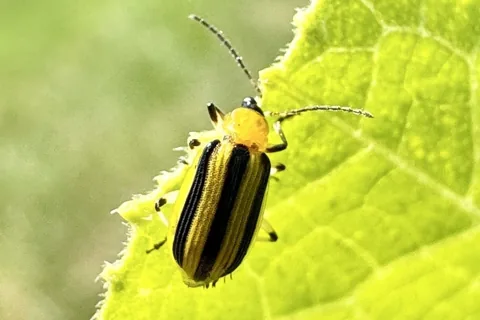 Striped Cucumber Beetle
Acalymma vittatum
Cucumber beetles are small yellow-and-black beetles that feed on squash, cucumbers, melons and other cucurbits. The striped cucumber beetle is the main concern because it can carry bacterial wilt into cucumbers and muskmelons.
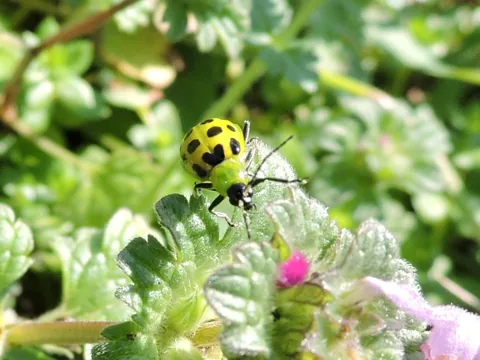 Spotted Cucumber Beetle
Diabrotica undecimpunctata
The spotted cucumber beetle, also called the southern corn rootworm, is a yellow-green beetle with 12 black spots. Adults feed on cucurbits and many other plants and can carry bacterial wilt into cucumbers and muskmelons.
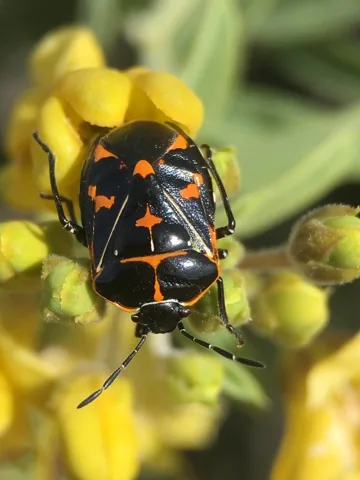 Harlequin Bug
Murgantia histrionica
The harlequin bug is a brightly colored stink bug that attacks cabbage, collards, kale, mustard and other cole crops. It sucks plant juices, and heavy infestations can wilt, brown and kill young plants or even whole fields.
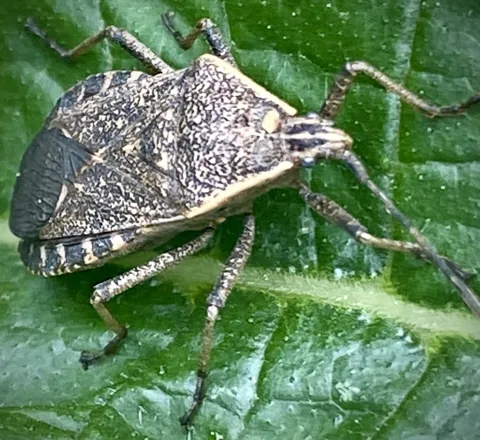 Squash Bug
Anasa tristis
The squash bug is a common vegetable garden pest that sucks sap from squash, pumpkins, melons and other cucurbits. Heavy feeding makes plants wilt and can kill young plants outright.
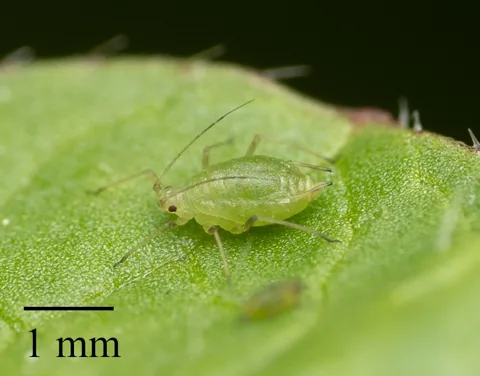 Aphids
Myzus persicae
Aphids are small, soft-bodied insects that pierce tender stems and leaves and suck out plant sap. Almost every plant hosts at least one aphid species, but established plants usually tolerate them, treating aphids for the plant's health is usually unnecessary, and natural enemies often bring numbers down.
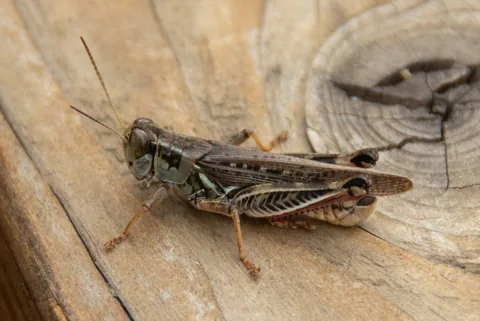 Migratory grasshopper
Melanoplus sanguinipes
The migratory grasshopper is a medium-sized, reddish-brown spur-throated grasshopper that causes more crop damage than any other grasshopper species in the United States, and Alberta calls it one of the most destructive pests in western Canada. Outbreaks that build on weedy rangeland and idle cropland can take off in swarms and land on crops, rangeland or city gardens miles away.
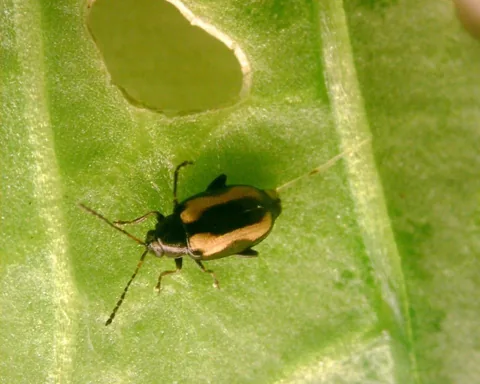 Flea Beetles
Phyllotreta striolata
Flea beetles are tiny, shiny beetles with enlarged hind legs that jump like fleas when disturbed. Adults chew small holes and pits in the leaves of radishes, cabbage and other crucifers, eggplant, potatoes, tomatoes and many other vegetables, and they do the most harm to seedlings in spring.
What the terms mean
Companion planting means growing different plant species close together so they offer identifiable benefits to one another. Sometimes the benefit runs mostly one way.[7]
A trap crop is a plant that attracts pests away from the plants you want to harvest. A research review in the Annual Review of Entomology defines it broadly: trap plants may be more attractive for egg-laying or feeding, or may act as a sink for insects or the plant diseases they carry.[4][1]
A review of companion plants for aphid control describes three ways they can work: drawing aphids away from the crop, disrupting how aphids find their host plant (mostly through plant odors), and attracting natural enemies by giving them shelter and food.[3]
Plant odors can repel or attract insects or mask the scent of other plants, and mixing plants of different heights, colors and textures may make it harder for pests to find their targets.[7]
What the research shows
A 2011 meta-analysis of 552 experiments in 45 published studies tested whether diversifying crops reduces plant-feeding insects or increases their natural enemies. It found extensive support for intercropping, adding flowering plants, and using plants that repel pests or pull them away from the crop: pest suppression, natural enemies and reduced crop damage were all significantly greater on diversified crops.[2]
The same analysis found a small but significant drop in crop yield, partly because intercrops and other plants replaced some of the main crop. The authors called for more experiments to design diversification schemes that also protect yield.[2]
Trap cropping is more knowledge-intensive than many other forms of pest management. Whether it works depends on the trap plant and the crop, how they're arranged in space and time, how the pest behaves and moves, and the practical demands of the planting.[1]
Field trials of perimeter trap crops for striped cucumber beetle are among the best documented. In commercial butternut squash fields in Massachusetts, a Blue Hubbard border cut insecticide use by up to 94% compared with conventional spraying, with no increase in feeding damage or beetle numbers, and a later study found buttercup squash worked as well as Blue Hubbard, with a 97% reduction in total insecticide use compared with fields without a border.[16][17]
Reviewers of companion plants for aphids concluded that many factors have to line up for a companion-plant strategy to succeed, and that it works best combined with other approaches.[3]
Science on specific companion pairings is limited. University of Arizona Extension notes that companion-plant studies are hard to control and repeat. In one Iowa State study it describes, marigolds planted around zucchini significantly reduced squash bug and striped cucumber beetle damage and nasturtiums had a similar effect on squash bug numbers, but the small study's results were considered indicative, not conclusive.[7]
Using a trap crop
- Cucumber beetles: plant a few highly attractive cucurbits, such as Blue Hubbard squash, a week or two before the rest of your cucurbits; the beetles tend to arrive in one early-season flush. Once they build up on the trap crop, treat them there with an effective pesticide so they don't move on to your crop. Cornell's vegetable IPM program agrees that Blue Hubbard and buttercup squash are particularly attractive and suggests planting them on the edges two weeks before the main crop.[4][9]
- UMass Extension's version for larger plantings: one or two rows of a Cucurbita maxima squash (such as buttercup or Hubbard) in an unbroken border, two rows near woods. Don't use a variety that is highly susceptible to bacterial wilt in the border, and kill the beetles there, then keep scouting both the border and the main crop.[10]
- Not every region has had the same results. The Pacific Northwest handbook says trap crops sometimes can draw beetles away from the main crop, but calls trap cropping an unproven control method in Oregon.[14]
- Squash bugs: University of Minnesota Extension says studies have shown perimeter plantings of Blue Hubbard squash can draw squash bugs out of crops. The trap crop still has to be managed by squashing eggs thoroughly or applying an insecticide.[12]
- Flea beetles: plant a highly favored crop such as radish before the main crop; adult flea beetles go to the tallest, earliest plants available. UMass adds that the trap crop should be established before the main crop or be at least as mature, and that direct-seeded trap crops can surround transplants if seeded 7 to 14 days earlier.[13][11]
- Keep a flea beetle trap crop healthy. If it gets too ragged, UMass says the beetles stop feeding on it and move back into the main crop.[11]
- Harlequin bugs: they cluster because of an aggregation pheromone and a strong preference for some mustard-family crops. Very early spring plantings of mustard or radish draw overwintered adults; in fall, a late-planted patch of kale or another Brassica collects adults that can then be mowed or treated. Cleome, a favorite host, also works.[5]
- In field trials by Virginia Tech researchers, mustard was the plant harlequin bugs chose most consistently over collards and was an effective trap crop for reducing feeding injury on collards. Arugula, rapeseed and rapini also drew more bugs than collards.[18]
- Leave a gap. A later study found that in greenhouse cages, females preferred to sit on mustard but moved to collards to lay their eggs. In fall field plantings, separating the mustard from the collards by two unplanted rows (2.3 meters) cut egg-laying on the collards fourfold and feeding damage about 2.5-fold compared with mustard planted right next to them.[19]
- Spring trap crops are preferable for harlequin bugs, and New Mexico State notes that research on the best timing and placement was still in progress.[5][19]
- Sources differ on adding a systemic insecticide to a harlequin bug trap crop. New Mexico State says neonicotinoids are frequently used on trap crops; in the Virginia Tech trials, treating the mustard with a systemic neonicotinoid gave no added control over 10 weeks in spring.[5][18]
- Manage trap crops intensively. If the pests that gather aren't removed diligently and routinely, the trap crop can increase their numbers.[5][12][10]
- If you spray a trap crop, mow or trim it so it doesn't flower, so you don't kill beneficial insects that visit for pollen and nectar.[5]
- Before you plant a trap crop, consider whether it could draw in a pest that hasn't been a problem in your garden before.[8]
Flowers for natural enemies
Many adult predators and parasites, including green lacewings, syrphid flies and parasitic wasps, feed only on pollen and nectar, and many do poorly without flowering plants to supplement their diet. UC IPM suggests planting a variety of species that flower at different times to provide nectar, pollen and shelter all season. Cornell's IPM program says the same of green lacewings: adults need nectar, honeydew or pollen before laying eggs, so plantings should include flowering plants.[6][15]
Grow a mix of plants suited to local conditions that can tolerate a few plant-feeding insects and mites, so predators always have something to eat. Cornell also says a low level of aphids should be tolerated to support lacewings.[6][15]
The 2011 meta-analysis found support for adding flowering plants as one of the diversification approaches that suppressed plant-feeding insects.[2]
UC IPM also advises cutting back on broad-spectrum, persistent insecticides. Carbamates, organophosphates and pyrethroids kill natural enemies present when you spray, and their residues kill those that arrive days or weeks later.[6]
Popular claims to treat with caution
- Marigolds and nematodes: UVM Extension says it isn't proven, though there's some scientific evidence, and that French marigold may help against several kinds of nematodes. University of Arizona Extension adds that the benefit comes after marigolds are grown as a cover crop and tilled into the soil.[8][7]
- Charts of plants that repel particular pests: University of Arizona Extension says companion planting rests on folklore and experimentation rather than proven science. UVM Extension's advice is that there's no magic formula; the goal is a healthy, diverse garden, so experiment with combinations.[7][8]
- Nasturtiums: University of Arizona Extension lists them as an excellent trap crop for flea beetles and aphids. UVM Extension calls them a magnet for aphids and says to plant them away from crops aphids target, such as cabbage and green beans.[7][8]
- Companion plants as a stand-alone fix: reviewers recommend combining them with other methods for lasting results.[3]
Common questions
- Do marigolds keep bugs out of the garden?
- The evidence is limited. An Iowa State study described by University of Arizona Extension saw less squash bug and cucumber beetle damage on zucchini ringed with marigolds, but the results were called indicative, not conclusive. Marigolds' best-known benefit, against nematodes, comes after they're grown as a cover crop and tilled in.[7]
- Can a trap crop make my pest problem worse?
- Yes. If the pests that gather on it aren't removed regularly, a trap crop can increase their numbers, and it may attract a pest you didn't have before.[5][8]
- Is companion planting worth trying?
- Adding flowering plants and mixing crops has research support for reducing pests and boosting natural enemies, though it can cost some yield. Use it alongside other methods rather than instead of them.[2][6][3]
- What is the best trap crop for cucumber beetles?
- Blue Hubbard squash is the standard, planted a week or two before your other cucurbits. Buttercup squash worked as well in Massachusetts trials, and Cornell lists both as particularly attractive. Kill the beetles that gather on the trap crop, or they'll move on to your plants.[4][9][17]
Photo credits
- Striped Cucumber Beetle: (c) L.J. Lamera, some rights reserved (CC BY) — via iNaturalist, CC BY 4.0
- Spotted Cucumber Beetle: (c) Sam Kieschnick, some rights reserved (CC BY) — via iNaturalist, CC BY 4.0
- Harlequin Bug: (c) Matt Berger, some rights reserved (CC BY) — via iNaturalist, CC BY 4.0
- Squash Bug: Anne P, public domain (CC0), via iNaturalist
- Aphids: Jesse Rorabaugh, public domain (CC0), via iNaturalist
- Migratory grasshopper: (c) Daniel Patterson, some rights reserved (CC BY) — via iNaturalist, CC BY 4.0
- Flea Beetles: 螯蝦, public domain (CC0), via iNaturalist
Sources
- Annual Review of Entomology, via PubMed, “Shelton and Badenes-Perez (2006), Concepts and applications of trap cropping in pest management, Annual Review of Entomology 51:285-308.” pubmed.ncbi.nlm.nih.gov/16332213/ (accessed 2026-11-11). Cited from the PubMed abstract.
- Ecological Applications, via PubMed, “Letourneau et al. (2011), Does plant diversity benefit agroecosystems? A synthetic review, Ecological Applications 21(1):9-21.” pubmed.ncbi.nlm.nih.gov/21516884/ (accessed 2026-11-11). Cited from the PubMed abstract.
- Insects, via PubMed, “Ben-Issa, Gomez and Gautier (2017), Companion Plants for Aphid Pest Management, Insects 8(4):112.” pubmed.ncbi.nlm.nih.gov/29053585/ (accessed 2026-11-11). Cited from the PubMed abstract.
- University of Minnesota Extension, “Cucumber beetles.” extension.umn.edu/garden-and-home/yard-and-garden/yard-and-garden-insects/cucumber-beetles (accessed 2026-11-11)
- New Mexico State University Cooperative Extension Service, “Harlequin Bug, Guide H-259.” pubs.nmsu.edu/_h/H259/ (accessed 2026-11-11)
- University of California Statewide IPM Program, “Pest Notes: Biological Control and Natural Enemies of Invertebrates, UC ANR Publication 74140 (Home and Landscape).” ipm.ucanr.edu/home-and-landscape/biological-control-and-natural-enemies-of-invertebrates/ (accessed 2026-11-11)
- University of Arizona Cooperative Extension, “The Art of Companion Planting (April 2023 presentation).” extension.arizona.edu/sites/default/files/attachment/CompanionPlantingApr2023.pdf (accessed 2026-11-11)
- University of Vermont Extension, “Creating a Biodiverse Vegetable Garden with Companion Plants (Nadie VanZandt, UVM Extension Master Gardener, April 2023).” www.uvm.edu/d10-files/documents/2024-10/Creating_a_Biodiverse_Vegetable_Garden.pdf (accessed 2026-11-11)
- Cornell Integrated Pest Management, “Striped Cucumber Beetle (Acalymma vittatum), Vegetable IPM Fact Sheet (N. Murray, B. Nault, M. Zuefle, 2025).” cals.cornell.edu/integrated-pest-management/outreach-education/fact-sheets/striped-cucumber-beetle-acalymma-vittatum-vegetable-ipm-fact-sheet (accessed 2026-11-11)
- UMass Amherst Center for Agriculture, Food, and the Environment, “Striped Cucumber Beetle (vegetable fact sheet).” www.umass.edu/agriculture-food-environment/vegetable/fact-sheets/striped-cucumber-beetle (accessed 2026-11-11)
- UMass Amherst Center for Agriculture, Food, and the Environment, “Brassica Flea Beetles (Vegetable Program fact sheet).” www.umass.edu/agriculture-food-environment/vegetable/fact-sheets/brassica-flea-beetles (accessed 2026-11-11)
- University of Minnesota Extension, “Squash bugs.” extension.umn.edu/yard-and-garden-insects/squash-bugs (accessed 2026-11-11)
- University of Minnesota Extension, “Flea beetles.” extension.umn.edu/yard-and-garden-insects/flea-beetles (accessed 2026-11-11)
- Pacific Northwest Pest Management Handbooks (Oregon State, Washington State and University of Idaho), “Cucumber-Cucumber beetle (Pacific Northwest Insect Management Handbook).” pnwhandbooks.org/insect/vegetable/vegetable-pests/hosts-pests/cucumber-cucumber-beetle (accessed 2026-11-11)
- Cornell Integrated Pest Management, “Common Green Lacewing Biocontrol Agent Factsheet.” cals.cornell.edu/integrated-pest-management/outreach-education/fact-sheets/common-green-lacewing-biocontrol-agent-factsheet (accessed 2026-11-11)
- Journal of Economic Entomology, via PubMed, “Cavanagh et al. (2009), Using trap crops for control of Acalymma vittatum reduces insecticide use in butternut squash, Journal of Economic Entomology 102(3):1101-1107.” pubmed.ncbi.nlm.nih.gov/19610425/ (accessed 2026-11-11). Cited from the PubMed abstract.
- Environmental Entomology, via PubMed, “Cavanagh et al. (2010), Buttercup squash provides a marketable alternative to blue hubbard as a trap crop for control of striped cucumber beetles, Environmental Entomology 39(6):1953-1960.” pubmed.ncbi.nlm.nih.gov/22182562/ (accessed 2026-11-11). Cited from the PubMed abstract.
- Journal of Economic Entomology, via PubMed, “Wallingford et al. (2013), Host plant preference of harlequin bug, and evaluation of a trap cropping strategy for its control in collard, Journal of Economic Entomology 106(1):283-288.” pubmed.ncbi.nlm.nih.gov/23448042/ (accessed 2026-11-11). Cited from the PubMed abstract.
- Journal of Economic Entomology, via PubMed, “Bier et al. (2021), Trap Cropping Harlequin Bug: Distance of Separation Influences Female Movement and Oviposition, Journal of Economic Entomology 114(2):848-856.” pubmed.ncbi.nlm.nih.gov/33704486/ (accessed 2026-11-11). Cited from the PubMed abstract.