On this page
How to identify it
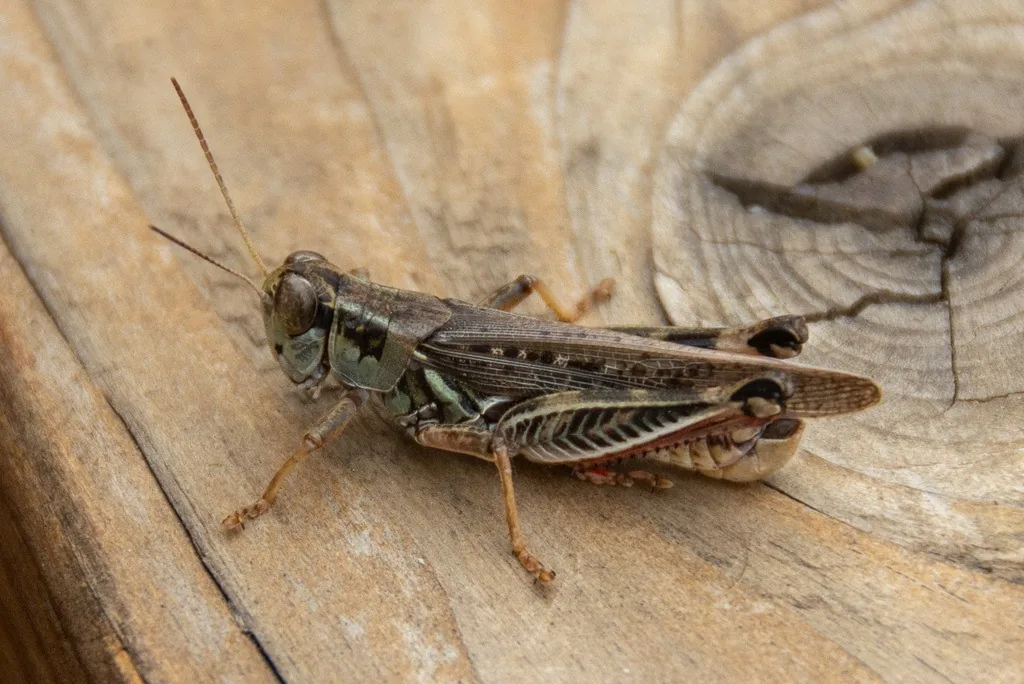
- Adults are about 1 inch long (Alberta gives 23 to 28 mm) and reddish brown to brownish or yellowish; females are slightly larger than males.[2][1][5]
- The hind tibiae, the lower segment of the jumping legs, are blue-green or red.[1]
- Look for dark bands just behind the eyes and a series of black bands on the hind legs. In young nymphs the dark bands run along the top of the thorax; in adults they sit on the sides.[5]
- It is one of the spur-throated grasshoppers, the group that includes the most injurious species.[2][1]
- Males are identified by the shape of the cerci at the tip of the abdomen, the notch in the subgenital plate, and a bump on the underside of the thorax between the middle legs.[1]
- Nymphs have a pale yellow crescent below each eye that continues onto the side of the pronotum, and a black stripe along the top of the hind femur broken in the middle by a light bar.[1]
Look-alikes
| Look-alike | How to tell them apart |
|---|---|
| Red-legged grasshopper | The red-legged grasshopper is also brown with red hind tibiae but runs 1 to 1 1/2 inches long; male migratory grasshoppers are told apart by the shape of the cerci and the notch of the subgenital plate.[2][1] |
| Twostriped grasshopper | The twostriped grasshopper is bigger, 1 1/4 to 2 inches, with a black band on the hind leg and two light yellow stripes down the back that meet in a triangle at the wing tips.[2] |
| Differential grasshopper | The differential grasshopper is larger, about 1 3/4 inches, shiny brownish yellow, with black chevrons on the hind legs.[2] |
Where it lives
Widely distributed in North America and found in many habitats, especially grasslands and meadows; Alberta calls it the most widely distributed Melanoplus species, adapted to every ecoregion of the Canadian grasslands and reaching as far south as Florida. It has adapted especially well to western agriculture, where introduced weeds, plowed sandy soils, overgrazed rangeland and abandoned cropland all favor it. GBIF's US records since 1990 come from coast to coast and Alaska, with by far the most from Colorado, then Wyoming and Utah.[1][5][6]
Biology and life cycle
It feeds on a mix of grasses and forbs and is usually eating several kinds of plants in its habitat; favored foods include dandelion, tumble and wild mustard, pepperweed, western ragweed, downy brome, Kentucky bluegrass, barley and wheat.[1]
It is an early-hatching species. On rangeland, hatching starts about a week after the bigheaded grasshopper begins, first on open south slopes, thinly vegetated ground and sandy soils.[1]
Hatching can be over in about three weeks when soil and vegetation are uniform and temperatures high, or stretch to six weeks with heavy clay soils, tall shading vegetation or cool weather.[1]
Nymphs pass through five or six instars and reach adulthood in about 35 days in warm spring weather, or up to 55 days when it is cool.[1]
Females mature their first 18 to 24 eggs over two to three weeks, then lay curved pods about 1 inch long among grass roots on rangeland, or around wheat stubble and alfalfa in cropland, with the middle of the clutch about 3/4 inch below the soil surface. Alberta puts a pod at about 25 eggs, laid in August and September.[1][5]
Most eggs of the first generation enter diapause and hatch the following year; in warmer parts of the West, such as Kansas, a smaller second generation is produced each year.[1]
In Alberta, eggs hatch between early May and mid-July depending on temperature and moisture, and like other Melanoplus eggs they can complete up to 85% of their development before winter.[5]
Adults migrate before they start to reproduce. Swarms take off on clear days near 80 F with gentle winds and fly with the wind at 10 to 12 miles per hour; marked adults have covered 30 miles in a day.[1]
Older nymphs can also travel in bands, usually less than 5 miles but sometimes as far as 10.[1]
Weather and food plants drive its population swings. Warm, dry springs favor grasshoppers, while cool, wet springs and heavy rains kill many young nymphs.[1][2]
Damage and signs
- High numbers damage and can destroy wheat, barley, oats, alfalfa, clover, corn, vegetables and ornamentals, and the grasshoppers also feed on the foliage, fruit and bark of vines, bushes and trees.[1][2]
- In wheat it can wipe out new seedlings, defoliate plants through the season, clip heads late in the season, and in late summer invade the edges of newly emerged winter wheat and eat the young plants to the ground.[1]
- On rangeland, dense populations deplete forage for livestock and wildlife by eating native forbs, weeds and valuable forage grasses.[1]
- Swarms that leave weedy rangeland or idle cropland can land miles away at 60 to 140 grasshoppers per square yard, wrecking the vegetation on rangeland, crops or urban gardens where they land.[1]
- In canola, Alberta field trials found it chews holes in the pods, cutting yield enough to justify treatment, though the twostriped grasshopper cost growers more.[5]
- Colorado State calls it often the most damaging species on cropland, and an early hatcher capable of long migration flights.[4]
Health risk
It is a plant feeder. USDA ARS, Utah State, Colorado State and UC IPM describe crop, forage and garden damage and no risk to people.[1][2][4][3]
Control
Prevention
ARS recommends integrated management: keep crops weed-free, eliminate weedy fence rows and roadside strips, plant thick stands of grass on idle cropland, restore depleted rangeland and protect healthy rangeland from overuse, and monitor grasshopper habitats every year.[1]
Scout early for 'hot spots' where egg-laying concentrates and outbreaks start. Treatments work best against young nymphs, before large populations grow and spread.[2][3]
Where grasshoppers invade a garden often, a border of tall grass or lush green plants can trap them and divert them from vegetables and flowers; don't mow it or let it dry out.[3]
Traps and physical control
In gardens, handpick grasshoppers when there are few of them, and protect plants with cones, screened boxes or covers. Hungry grasshoppers can chew through cloth or plastic row covers, so metal window screening holds up better.[3]
Biological control
Baits with Nosema locustae, a microsporidian that infects grasshoppers through feeding, weaken nymphs and cut their egg-laying, but they act slowly and work best when spread early over large areas. Beauveria bassiana, a fungus, is also labeled for grasshoppers.[2][3]
Pesticides
Carbaryl bait, wheat bran laced with carbaryl, kills grasshoppers and other insects that eat it and can be spread along pastures, fence rows and roadsides, or around a garden's edge before grasshoppers arrive. Carbaryl and pyrethroid sprays are very toxic to bees, natural enemies and aquatic life, while carbaryl bait is less hazardous to bees; in California, carbaryl products are restricted-use and require an applicator's license.[2][3]
When to call a professional
USDA APHIS runs grasshopper control on public lands. Utah State's 2008 fact sheet explains that when densities pass 8 per square yard over at least 10,000 contiguous acres of private rangeland, owners can join a cooperative state and federal rangeland grasshopper program.[2]
Older names
Older grasshopper literature calls this species Melanoplus mexicanus and, later, Melanoplus bilituratus.[1]
Where sources disagree
Generations per year: USDA ARS says warmer parts of the West such as Kansas produce a smaller second generation each year, while Alberta says its pest grasshoppers, this one included, have one generation a year.[1][5]
Eggs per pod: ARS says females mature their first 18 to 24 eggs, and Alberta puts a pod at about 25 eggs.[1][5]
Size: Utah State says adults are 1 inch long, and Alberta gives 23 to 28 mm (0.9 to 1.1 inches).[2][5]
Common questions
- Why did grasshoppers suddenly show up in my garden in midsummer?
- Migratory grasshoppers that build up on weedy rangeland, roadsides or idle cropland take flight when they run out of food, and swarms can land on gardens miles away. As vegetation dries up on fence rows and roadsides, grasshoppers that grew up there move into the crops next to them.[1][2]
- Will spraying my garden stop a grasshopper invasion?
- Not well. UC IPM notes that once grasshoppers have invaded, insecticides aren't very effective and must be reapplied every few days while the invasion lasts; bait around the garden edge before they arrive is the better bet.[3]
- How high do migratory grasshopper swarms fly?
- Some fly very high: pilots in grasshopper control programs have met swarms 1,000 feet above the ground, ferrying pilots at 2,000 to 3,000 feet, and commercial pilots at up to 13,000 feet above sea level.[1]
Sources
- USDA Agricultural Research Service, Northern Plains Agricultural Research Laboratory, “Migratory Grasshopper, Melanoplus sanguinipes (Fabricius): species fact sheet, Grasshoppers: Their Biology, Identification and Management.” www.ars.usda.gov/plains-area/sidney-mt/northern-plains-agricultural-research-laboratory/pest-management-research/pmru-docs/grasshoppers-their-biology-identification-and-management/id-tools-apps/fact-sheets/melanoplinae-subfamily/fs-migratory/ (accessed 2026-11-11)
- Utah State University Extension, “Grasshoppers (E. Evans and E. Hodgson, June 2008).” extension.usu.edu/planthealth/research/grasshoppers (accessed 2026-11-11)
- University of California Statewide IPM Program, “Grasshoppers (Home and Landscape).” ipm.ucanr.edu/home-and-landscape/grasshoppers/ (accessed 2026-11-11)
- Colorado State University Extension, “Grasshopper Control in Gardens and Small Acreages (Fact Sheet 5.536).” extension.colostate.edu/topic-areas/insects/grasshopper-control-in-gardens-small-acreages-5-536/ (accessed 2026-11-11)
- Government of Alberta, Agriculture and Irrigation, “Migratory grasshopper.” www.alberta.ca/migratory-grasshopper (accessed 2026-11-11)
- Global Biodiversity Information Facility (GBIF), “Melanoplus sanguinipes: US occurrence records since 1990 by state (GBIF occurrence search API).” api.gbif.org/v1/occurrence/search?taxonKey=1699194&country=US&hasGeospatialIssue=false&occurrenceStatus=PRESENT&year=1990%2C2026&facet=stateProvince&facetLimit=400&limit=0 (accessed 2026-11-11)
- iNaturalist, “Melanoplus sanguinipes taxon page (order and family).” www.inaturalist.org/taxa/129240 (accessed 2026-11-11)