On this page
How to identify it
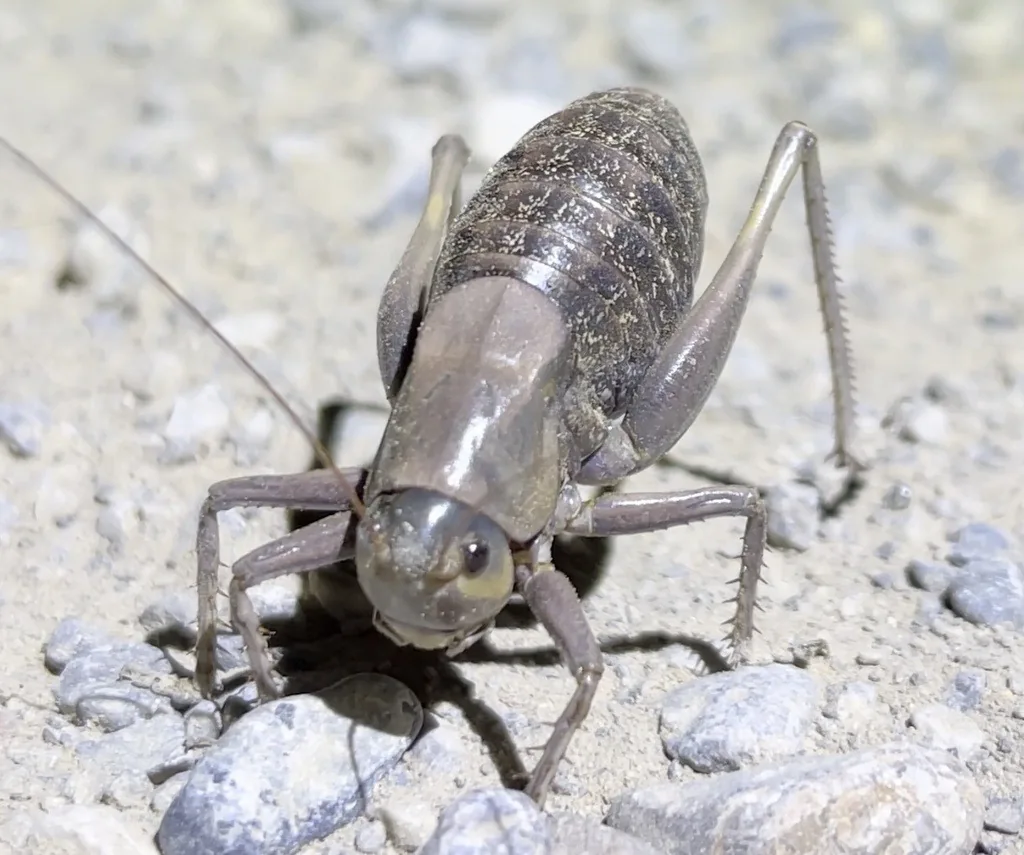
- Adults are 38 to 51 mm (1.5 to 2 inches) long, with antennae longer than the body and a smooth, shiny body that may be green, black, bronze or reddish, light gray, or mottled.[1]
- It has the enlarged pronotum (the shield over the thorax) that marks shield-backed katydids, and it cannot fly.[1][2]
- Females have a long, gently upcurved ovipositor (egg-laying tube) at the tip of the abdomen, and the male's cercus, an appendage at the tip of the abdomen, has two large teeth.[1]
- All nymphal stages have a white stripe on the thorax, and the first two stages are usually black.[1]
Look-alikes
| Look-alike | How to tell them apart |
|---|---|
| Jerusalem crickets | Black-and-white striping on the abdomen, chunky enlarged legs, no enlarged pronotum, and they don't hop.[1] |
| Field crickets | Usually black to brown, with fully developed wings they can fly with, and a straight ovipositor.[1] |
| Camel crickets | Hump-backed, with no enlarged pronotum.[1] |
| Other katydids | Many common katydids have working wings, which may look like leaves, and live in shrubs and bushes rather than on the ground.[1] |
| Plains lubber grasshopper | Also big, flightless and often seen hopping across rural roads in summer, but it is a true grasshopper with stubby wings and a colorful green, pink and brown body.[4] |
Where it lives
Outbreaks periodically threaten large parts of the western United States; the 1998 to 2012 outbreak included major infestations in Utah, Nevada, Idaho, Colorado, Wyoming, Oregon and Montana. Colorado State places it on the open sagebrush and grassland rangeland of the Colorado Plateau and Great Basin, at 6,500 to 11,000 feet.[1][4]
Biology and life cycle
Eggs are laid singly in the soil in summer and stay dormant through winter. They hatch in early spring once the soil reaches 40°F, generally mid-March to mid-April in Nevada; at higher elevations, where the soil stays cold, eggs may wait an extra year. In laboratory studies some eggs stayed dormant five years or more.[1][2]
Nymphs pass through seven stages and reach adulthood in 60 to 90 days, depending on temperature; in Nevada they generally become adults in late June. There is one generation a year.[1][2]
Mating begins 10 to 12 days after they become adults, and egg laying starts several weeks into adulthood. Each female lays about 80 to 100 eggs (an average of 86 in the ARS figures). Crickets are usually gone by early August, though some may last into fall.[1][2]
They feed on more than 400 kinds of plants and prefer succulent broadleaf plants, but also eat range grasses and many crops.[1][4]
Bands travel by walking and hopping, up to a mile a day, so a band can move into and out of an area within a couple of days.[1][2]
Damage and signs
- Migrating bands of nymphs or adults can completely destroy fields of sugarbeets, small grains and alfalfa, as well as garden vegetables.[1]
- Because a band seldom stays at one site more than three or four days, damage to rangeland is usually limited, except in drought or on sparse range, where the crickets compete with cattle for forage.[1]
- Most broadleaf plants and grasses recover from cricket feeding, depending on the plant and how much was eaten.[3]
- Nevada's joint state and federal program treats Mormon crickets to protect crops, rangeland forage, and public safety on roads and water supplies.[2]
Health risk
The Nevada Department of Agriculture says dead crickets, including treated ones, are not harmful to people or animals and do not carry diseases. Pets that eat large numbers of live or dead crickets may get gastrointestinal upset; call a veterinarian if symptoms are severe.[3]
Control
Keep them out
A cricket fence keeps bands out: a vertical barrier of heavy plastic 20 to 24 inches tall, sealed to the ground and staked every few feet. Mormon crickets can't fly and can't climb the slick plastic, so they go around. It can run along the outside of existing fences or buildings, but don't seal over vents.[3][2]
Don't wrap tree trunks or plants in plastic, which can harm or kill them; if plastic goes near plants, leave at least a foot of space.[2][3]
Sanitation
Collect large numbers of dead crickets and compost or bury them, since they can attract more crickets. In Nevada, report bands to the Department of Agriculture through its Mormon Cricket and Grasshopper Reporting Form.[3][2]
Pesticides
Newly hatched crickets do little damage, and temperature swings and predators may thin them out, so Nevada suggests waiting until hatching is complete before acting. If they need treating at that stage, use a contact insecticide labeled for home use or for the plants being eaten; young crickets are unlikely to take bait.[3]
Baits containing carbaryl are the most effective way to control crickets on a small scale, and sprays, granules and dusts work only on contact; all usually need repeating as more crickets move through. Bait draws crickets from only a couple of hundred feet, not from miles, so place it along property lines, away from homes and places where children or pets play, and follow the label.[2][3]
Insecticidal soap kills only crickets it hits directly. Home mixtures such as dish soap and vinegar are likely to damage landscaping and may harm pets.[3]
When to call a professional
Large infestations on farms and rangeland are treated by air with registered pesticides. In Nevada, the state and USDA APHIS treat public rangeland in blocks of 5,000 acres or more, using diflubenzuron by air and carbaryl baits on the ground, and private rangeland inside an aerial program area may qualify for cost-share treatment.[2][3]
Common questions
- Is a Mormon cricket really a cricket?
- No. Despite the name it is a flightless shield-backed katydid, a longhorned grasshopper related to katydids.[1][4]
- Will putting out bait draw more Mormon crickets onto my property?
- No. Bait attracts crickets from only a couple of hundred feet away, not from miles. Placing it along property lines, away from homes and play areas, generally works best.[2]
- Are dead Mormon crickets dangerous to my dog?
- Nevada's Department of Agriculture says dead crickets, even treated ones, are not harmful to people or animals, but a pet that eats a large number may get gastrointestinal upset. Call your veterinarian if symptoms are severe.[3]
Sources
- USDA Agricultural Research Service, Northern Plains Agricultural Research Laboratory, “Mormon Crickets: identification brochure (R. Srygley, July 2020).” www.ars.usda.gov/ARSUserFiles/40103/cricket%20ID.pdf (accessed 2026-11-08)
- Nevada Department of Agriculture, “Mormon Cricket Grasshopper Program FAQ.” agri.nv.gov/uploadedFiles/agrinvgov/Content/Plant/Entomology/mormon_cricket_FAQ.pdf (accessed 2026-11-08)
- Nevada Department of Agriculture, “Managing Crickets on Your Property (homeowner handout).” agri.nv.gov/uploadedFiles/agrinvgov/Content/Plant/Entomology/Homeowners_handout_draft_v6.pdf (accessed 2026-11-08)
- Colorado State University Extension, “Grasshopper Control in Gardens and Small Acreages, Fact Sheet 5.536.” extension.colostate.edu/topic-areas/insects/grasshopper-control-in-gardens-small-acreages-5-536/ (accessed 2026-11-08)
- iNaturalist, “Anabrus simplex taxon page (order and family).” www.inaturalist.org/taxa/143905 (accessed 2026-11-08)