On this page
How to identify it
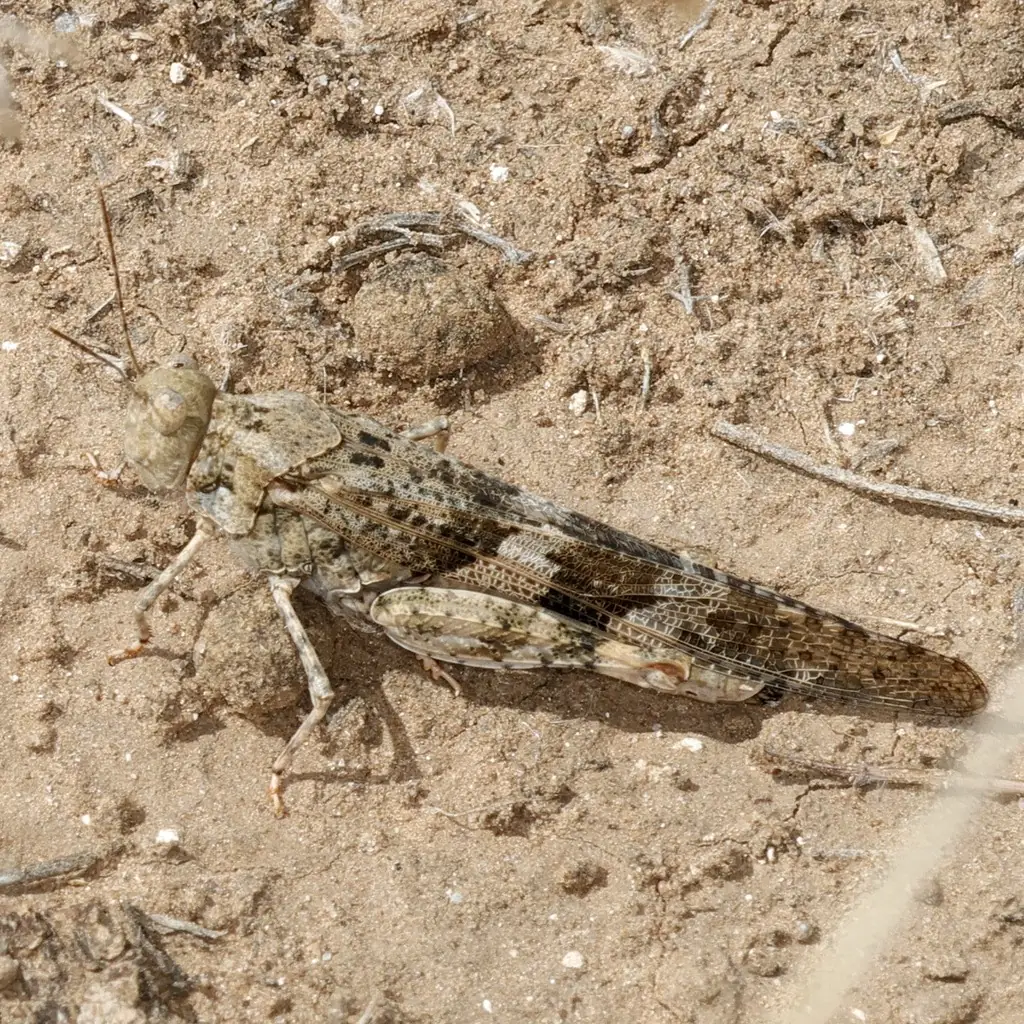
- Adults are moderately sized tan or gray grasshoppers. The Wyoming fact sheet gives body lengths of about 20.5 to 24 mm (about 0.8 to 0.9 inch) for males and 27 to 33 mm (about 1.1 to 1.3 inches) for females; the University of Arizona's backyard guide gives a looser 1 to 2 inches.[1][2]
- Each front wing has two dark bands running across its full width and many brown spots toward the tip.[1]
- The hind wing, visible in flight, has a white to pale yellow disk crossed by a fairly narrow but conspicuous black band, and a transparent tip.[1]
- The inner face of the hind femur is black with two yellow bars, the hind tibia is yellow, and the underside is cream to pale yellow.[1]
- Nymphs are tan spotted with brown, and from the third instar on their hind tibiae are yellow.[1]
- In Tucson it can turn up anywhere in summer, and it is easiest to see when it jumps.[2]
Look-alikes
| Look-alike | How to tell them apart |
|---|---|
| Carolina grasshopper | Carolina grasshopper hind wings are dark with a light band along the edge, while the pallid-winged grasshopper's hind wing is pale, white to pale yellow, with a narrow black band through the middle.[8][1] |
Where it lives
The Wyoming fact sheet says it ranges from southwestern Canada to Argentina, the widest distribution of any bandwinged grasshopper in the Americas. Genetic studies paint a more complicated picture: they treat it as a species complex with several lineages from North to South America, with populations in Peru and Argentina belonging to separate lineages. In North America its main habitats are western deserts with shrubs, forbs, grasses and a lot of bare ground, but it also does well in weedy city lots. Outbreaks have been recorded in the deserts of Arizona, New Mexico, Utah and California, and a population found on Oahu, Hawaii, in 1966 was probably carried there from western North America by the wind. GBIF holds about 16,000 U.S. records since 1990, most from California and Arizona.[1][3][4][5]
Biology and life cycle
Eggs spend the winter in the soil and hatch early in spring: from late February through March in south-central Arizona, and from late April in west-central Utah. Nymphs take about 42 to 48 days to mature in spring. Adults appear in mid-April in southern Arizona and in early June in Colorado, Utah and Wyoming.[1]
Southern Arizona gets a second generation that starts hatching in early June, and more can follow when moisture allows. Northern Arizona and states such as Colorado, Utah and Wyoming have only one generation a year.[1]
Females lay their eggs about an inch deep in bare soil, in slightly curved pods about an inch long that hold an average of 34 pale yellow eggs. Caged females averaged 386 eggs each, and one laid 27 pods holding 955 eggs.[1]
Rain matters for the eggs: at a Utah site with a moderate adult population in 1998, no eggs had hatched by 22 June 1999, apparently killed by drought.[1]
It eats a wide range of grasses and broadleaf plants. In early spring it feeds on lush annual grasses such as downy brome, then shifts to green perennial grasses and forbs as the annuals dry out; in choice tests adults preferred dandelion, kochia, downy brome, crested wheatgrass and needleandthread.[1]
It is a remarkably strong flier. Pilots near Phoenix have reported swarms at 3,000 to 5,000 feet, and grasshoppers flushed from the ground fly fast 2 to 3 feet up, often for more than 100 feet. Males make snapping sounds with their hind wings during frequent local flights.[1]
Desert heat limits it: a 1983 study found that it controls its body temperature by behavior, must restrict its activity for much of the day to avoid heat stress, and can easily overheat if it moves into sunlit areas.[6]
It may benefit from fire. After a June wildfire in New Mexico desert grassland, its activity was significantly higher in the burned area than in unburned grassland.[7]
In Arizona, outbreaks have followed above-normal, well-distributed rain in the preceding fall, winter and early spring. Outbreaks usually last one year, two at most, and between them, typically three to four years, the grasshopper is rare in desert habitats.[1]
Damage and signs
- Outbreak numbers damage rangeland forage. In Arizona in 1958, nymphs numbered from 50 to more than 100 per square yard along washes and low areas, then moved into irrigated crops: 25 to 50 adults per square yard defoliated wheat and cut off the heads, and 5 to 10 per square yard ate cotton seedlings to the ground, forcing some growers to replant twice.[1]
- Other crops damaged during Arizona and California outbreaks include carrots, sugarbeets, barley, milo, corn, safflower and grapes.[1]
- In towns the trouble is sheer numbers. On the night of April 19, 1998, swarms attracted to city lights landed along about 50 miles of west-central Arizona from Lake Havasu City to Bullhead City; grasshoppers crushed on streets and highways made cars and trucks skid, and they piled up 2 inches deep around buildings.[1]
Health risk
The Wyoming fact sheet describes forage and crop damage and nuisance swarms, not any health risk to people, and the University of Arizona says it can be picked up. The hazard the fact sheet reports is slippery roads where traffic crushes swarms.[1][2]
Control
Prevention
Surveys help anticipate problems: the number of grasshoppers in late summer and early fall can be a good indicator of trouble the next year, and spring checks for young nymphs show when eggs have hatched.[8]
Biological control
Weather is the biggest natural control on grasshoppers, especially around egg hatch. Blister beetle larvae develop on grasshopper egg pods, robber flies and parasitic flies attack grasshoppers, and birds such as horned larks and kestrels eat many of them. Colorado State also lists a Nosema locustae bait, which acts slowly and works only on young grasshoppers.[8]
Pesticides
Grasshoppers are hard to control because they move so much. When a local outbreak develops, Colorado State says sprays or baits work best on the young stages and at the sites where eggs were laid, and become less effective as grasshoppers grow and migrate. Carbaryl baits must be reapplied after rain.[8]
Outbreak grasshoppers that move into crops have been destroyed with insecticides or cultural practices.[1]
Why swarms die out in town
Swarms that land in cities evidently die for lack of food, while those that move into crops are destroyed with insecticides or cultural practices.[1]
The fact sheet credits favorable weather and the species' high egg output for how quickly populations grow.[1]
Common questions
- Why are there thousands of grasshoppers around the lights in town?
- Pallid-winged grasshoppers are strong fliers, and during outbreaks their night swarms are attracted to city lights and land in enormous numbers on streets, sidewalks and around buildings. These outbreaks are short, usually one year, and the grasshoppers that land in cities evidently die for lack of food.[1]
- Will the swarm come back next year?
- Possibly, but not for long: outbreaks usually last one year and at most two, and between them, typically three to four years, the species is rare in desert habitats. In Arizona, outbreaks have followed wet falls, winters and early springs.[1]
- Do pallid-winged grasshoppers bite or carry disease?
- None of the sources describe any health risk; the Wyoming fact sheet's concerns are crop and forage damage and slippery roads under crushed swarms.[1][2]
Sources
- University of Wyoming Agricultural Experiment Station (PDF hosted by USDA ARS), “Pallidwinged Grasshopper, Trimerotropis pallidipennis (Burmeister): Species Fact Sheet, Wyoming Agricultural Experiment Station Bulletin 912 (R. E. Pfadt, February 2002).” www.ars.usda.gov/ARSUserFiles/30320505/grasshopper/Extras/PDFs/Species%20Fact%20Sheets/PallidWg.pdf (accessed 2026-11-11)
- University of Arizona Cooperative Extension, “Backyard Bugs of Arizona (Insect Discovery, 2022).” extension.arizona.edu/sites/extension.arizona.edu/files/mblock/insect-discovery-backyardbugs2022.pdf (accessed 2026-11-11)
- PeerJ, via PubMed, “Unraveling the diversification history of grasshoppers belonging to the 'Trimerotropis pallidipennis' species group (Guzman et al. 2017).” pubmed.ncbi.nlm.nih.gov/28975055/ (accessed 2026-11-11)
- Molecular Ecology, via PubMed, “Stable inversion clines in a grasshopper species group despite complex geographical history (Guzman et al. 2022).” pubmed.ncbi.nlm.nih.gov/34862997/ (accessed 2026-11-11)
- Global Biodiversity Information Facility (GBIF), “Trimerotropis pallidipennis: U.S. occurrence records since 1990 by state (GBIF occurrence search).” api.gbif.org/v1/occurrence/search?taxonKey=1709239&country=US&hasGeospatialIssue=false&occurrenceStatus=PRESENT&year=1990%2C2026&facet=stateProvince&facetLimit=400&limit=0 (accessed 2026-11-11)
- Oecologia, via PubMed, “Metabolism and thermoregulation in desert and montane grasshoppers (Chappell 1983).” pubmed.ncbi.nlm.nih.gov/28310780/ (accessed 2026-11-11)
- Environmental Entomology, via PubMed, “Short-term effects of a summer wildfire on a desert grassland arthropod community in New Mexico (Parmenter et al. 2011).” pubmed.ncbi.nlm.nih.gov/22251717/ (accessed 2026-11-11)
- Colorado State University Extension, “Grasshopper Control in Gardens and Small Acreages, Fact Sheet 5.536.” extension.colostate.edu/topic-areas/insects/grasshopper-control-in-gardens-small-acreages-5-536/ (accessed 2026-11-11)
- iNaturalist, “Trimerotropis pallidipennis taxon page (order and family).” www.inaturalist.org/taxa/51493 (accessed 2026-11-08)