On this page
How to identify it
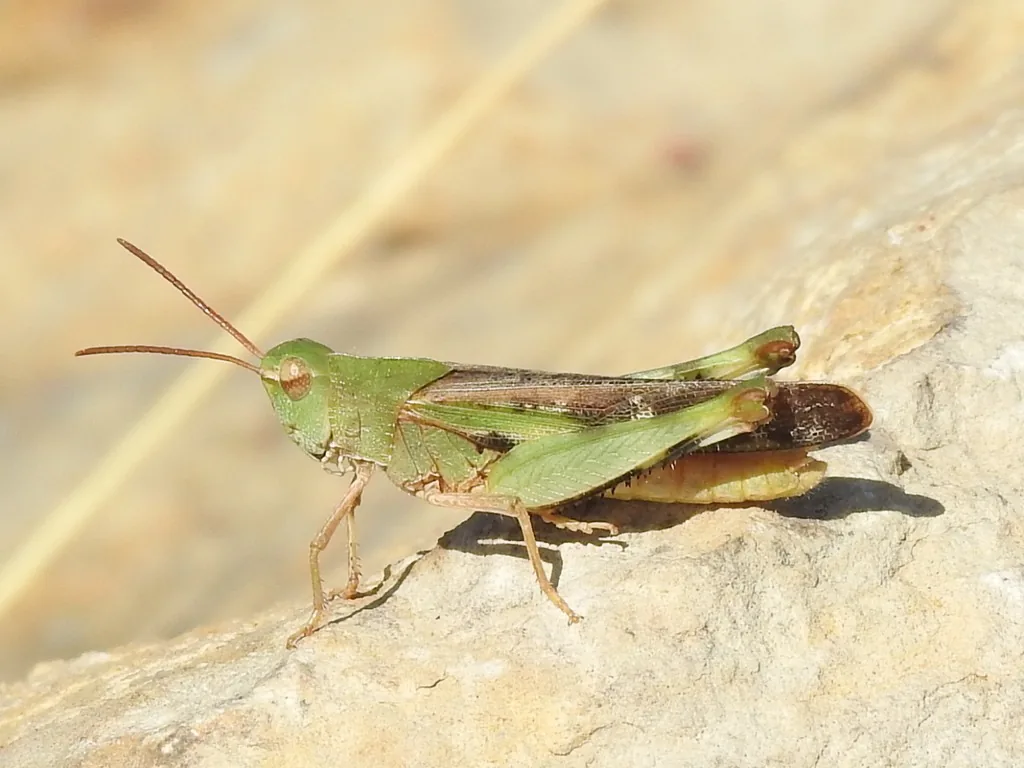
- Color ranges from gray or gray-brown to almost entirely green. Most females are green and most males brown, and green females are usually pinkish to purplish underneath.[1][2][3]
- Females are considerably larger than males. The Nebraska guide gives males 18 to 22 mm and females 24 to 30 mm; Animal Diversity Web gives larger figures, males 23 to 30 mm and females 28 to 38 mm.[1][2][3]
- The long wings reach 2 to 8 mm past the tip of the abdomen. The hind wings are pale greenish yellow at the base with a faded, incomplete dark band.[1][2]
- The hind tibiae vary: the ARS fact sheet describes them as bluish gray or red with a tan ring near the base, and the Nebraska guide as pale to dark brown, often blue to almost black in summer adults.[1][2]
- Summer adults often have spots on the forewings and dark marks on the outer face of the hind femur. Animal Diversity Web adds that southern populations are more boldly patterned, with darker smoky wing tips than northern ones.[2][3]
Where it lives
It ranges widely across North America and south into Central America. Animal Diversity Web describes a range from New Brunswick and Georgia west to Arizona, Saskatchewan and British Columbia, and south through Mexico as far as Costa Rica. It is one of the most abundant and widespread grasshoppers in the eastern United States, while in the West it is patchy, limited to small moist sites. GBIF holds about 17,000 U.S. records since 1990, the largest share from Texas.[1][3][4]
Biology and life cycle
It lives in somewhat moist grassy areas, especially near streams: swales, pond edges and stream banks, roadsides, hay meadows and pastures, and in the West stands of smooth brome under irrigation or next to irrigated crops and lawns.[2][1][3]
It feeds mainly on grasses and sedges and prefers succulent plants, especially Kentucky bluegrass; it occasionally eats forbs. A 2015 study that read plant DNA in grasshopper guts confirmed it as a grass specialist, but in ARS food tests it fed heavily on one forb, annual sowthistle, even when lush grasses were offered.[1][2][5]
In the northern part of its range there is one generation a year. In eastern Wyoming eggs hatch in mid-July; the nymphs grow slowly, and late-stage nymphs spend the winter; they are very cold hardy, become active in March and reach adulthood in early April.[1][3]
Its eggs have no resting stage, so hatching is spread over about two months. In a 1992 field study, nymphs that hatched late were smaller going into winter, died more often over winter and started breeding later the next year.[6]
In Nebraska, adults are most common from early or mid-April to early June, with a few adults around from mid-June to November; it isn't clear whether there are two generations there or one drawn-out one. In southern states there are two or more generations a year, and in Texas nymphs have been found year-round.[2][1][3]
One female in Indiana was seen laying eggs in damp sand at a pond's edge, and in the lab females readily lay in bare sandy loam, boring about 1 1/4 inches down; each pod holds about 25 light tan eggs.[1][3]
It is a strong flier. Startled adults make short escape flights, males 10 to 30 feet and females about twice as far, usually with a soft buzzing sound, and males make brief buzzing flights to attract females, which answer by flying and crackling back.[1][3]
On cold spring nights it shelters under plant litter and comes out to bask in the morning sun before feeding.[1]
Damage and signs
- Damage to rangeland forage is minimal and economically insignificant, and the Nebraska guide rates its economic importance as none. In the eastern United States, where it is abundant, it may cause some damage to pastures and hayfields.[1][2][3]
- ARS notes records from red clover and tobacco fields, but adds that it may actually have been eating weedy grasses growing in those crops.[1]
Health risk
It is a plant-feeding grasshopper; USDA ARS, the Nebraska guide and Animal Diversity Web describe no risk to people.[1][2][3]
Control
Prevention
No control is usually needed. Its populations don't build to outbreak levels, possibly because males use sound to space themselves out, and ARS calls its damage to rangeland forage economically insignificant.[1][2]
Why it never swarms
Pest managers call 25 or more adults per square yard a grasshopper outbreak, and ARS says green-striped grasshopper populations do not reach that level even in the East, where the species is common.[1]
In western states it is limited to small moist spots where adults number less than one per square yard, but such colonies can persist for years while the habitat stays favorable.[1]
One species or two?
The Nebraska guide notes that, by its structure, color and season, the green-striped grasshopper appears to blend into Chortophaga australior, a species of the southeastern United States, which may be a seasonal form rather than a separate species.[2]
Common questions
- Why do I see adult green-striped grasshoppers in April?
- In the North it spends the winter as a late-stage nymph and becomes an adult in early April; in Nebraska, adults are most common from early or mid-April to early June.[1][2][3]
- Are the green ones and the brown ones the same species?
- They can be. Most green-striped grasshopper females are green and most males are brown, and males are only rarely green.[1][2][3]
- Does the green-striped grasshopper cause much damage?
- Usually not. Its numbers stay low, ARS calls its damage to rangeland forage minimal, and the Nebraska guide gives it no economic importance, although in the East it may cause some damage to pastures and hayfields.[1][2]
Sources
- USDA Agricultural Research Service, Northern Plains Agricultural Research Laboratory, “Greenstriped Grasshopper, Chortophaga viridifasciata: species fact sheet, Grasshoppers: Their Biology, Identification and Management.” www.ars.usda.gov/plains-area/sidney-mt/northern-plains-agricultural-research-laboratory/pest-management-research/pmru-docs/grasshoppers-their-biology-identification-and-management/id-tools-apps/fact-sheets/oedipodinae-subfamily/fs-greenstriped/ (accessed 2026-11-11)
- University of Nebraska-Lincoln Extension, “The Grasshoppers (Orthoptera: Acrididae and Romaleidae) of Nebraska, EB3 (M. L. Brust, W. W. Hoback and R. J. Wright).” extensionpubs.unl.edu/publication/eb3/2009/pdf/view/eb3-2009.pdf (accessed 2026-11-11)
- Animal Diversity Web, University of Michigan Museum of Zoology, “Chortophaga viridifasciata (green-striped grasshopper).” animaldiversity.org/accounts/Chortophaga_viridifasciata/ (accessed 2026-11-11)
- Global Biodiversity Information Facility (GBIF), “Chortophaga viridifasciata: U.S. occurrence records since 1990 by state (GBIF occurrence search).” api.gbif.org/v1/occurrence/search?taxonKey=1711777&country=US&hasGeospatialIssue=false&occurrenceStatus=PRESENT&year=1990%2C2026&facet=stateProvince&facetLimit=400&limit=0 (accessed 2026-11-11)
- Ecology and Evolution, via PubMed, “Discrimination of grasshopper (Orthoptera: Acrididae) diet and niche overlap using next-generation sequencing of gut contents (McClenaghan et al. 2015).” pubmed.ncbi.nlm.nih.gov/26356479/ (accessed 2026-11-11)
- Evolution, via PubMed, “Seasonal declines in offspring fitness and selection for early reproduction in nymph-overwintering grasshoppers (Landa 1992).” pubmed.ncbi.nlm.nih.gov/28564957/ (accessed 2026-11-11)
- iNaturalist, “Chortophaga viridifasciata taxon page (order and family).” www.inaturalist.org/taxa/126600 (accessed 2026-11-08)