On this page
How to identify it
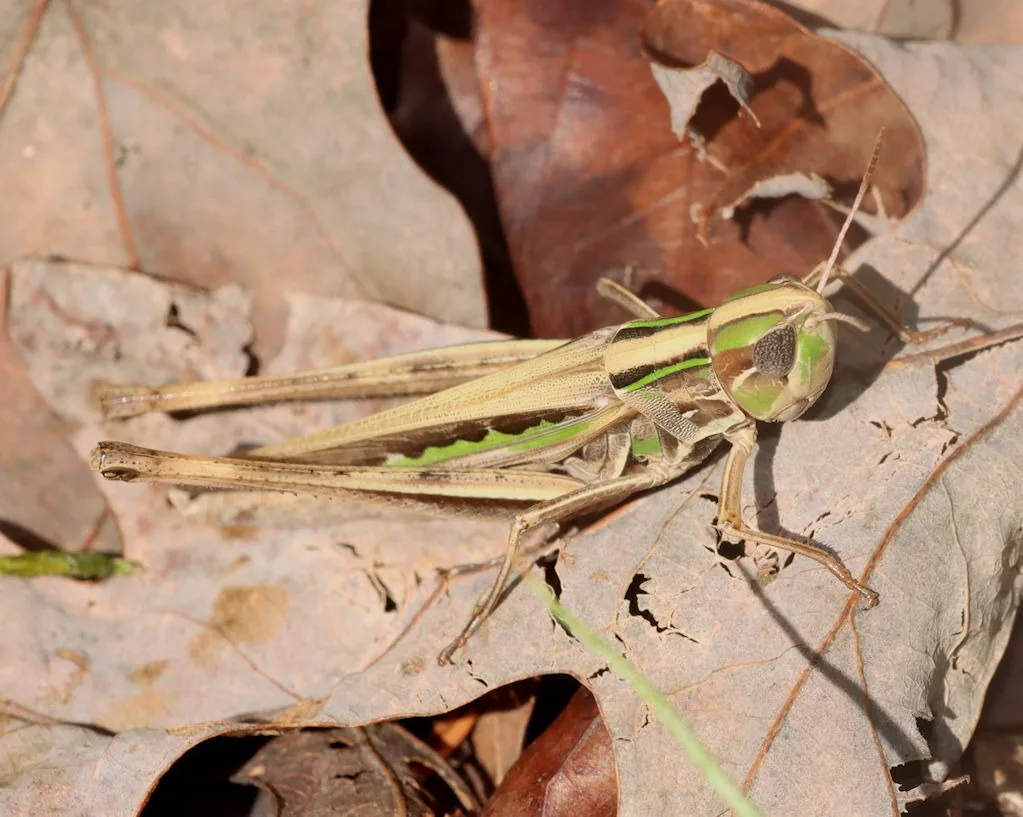
- Females are bright green and tan to light brown, with lighter and darker stripes.[1][2]
- Males are brown or tan to nearly blackish, with blackish and pale yellow markings or lighter stripes.[1][2]
- Both have a very slanted face, long slender hind legs and threadlike antennae; the male's antennae have enlarged, somewhat club-like tips.[1][2]
- A broad cream-colored stripe runs along the top of the head and pronotum, and the front edge of the forewing has a wavy, scalloped pattern that shows even when the wings are folded, especially on females.[2][1]
- Females are much bigger. MDC gives lengths of up to 1 1/2 inches for males and 2 1/4 inches for females; Nebraska specimens measured 20 to 31 mm for males and 31 to 39 mm for females.[1][2]
- Two lengthwise ridges run along the pronotum, a mark of the genus. The hind tibia is dark brown in males and light brown in females.[1][2]
- It also goes by handsome grasshopper and slant-faced grasshopper; researchers studying Ozark glade grasshoppers use the name handsome grasshopper.[1][3]
Look-alikes
| Look-alike | How to tell them apart |
|---|---|
| American bird grasshopper | Another long-bodied, ornate grasshopper, but not closely related. Look for the large creamy stripe from head to wings, a dark spot on each side of the pronotum split by a pale stripe, a white spot on each knee and spotted wings. Bird grasshoppers also have a small spine on the throat between the front legs, which slant-faced grasshoppers lack.[4][5] |
| Other slant-faced grasshoppers | Slant-faced grasshoppers share the pointed, slanted head, and many have big grass-green females and smaller brown males. Only one other grasshopper in the genus Syrbula lives north of Mexico, in the southwestern United States.[5][1] |
Where it lives
MDC reports it statewide in Missouri, and in Nebraska it occurs over the eastern two-thirds of the state, becoming less common to the west and north. It was one of three abundant grasshoppers in a study of Ozark glades. The only other grasshopper in its genus north of Mexico lives in the southwestern United States.[1][2][3]
Biology and life cycle
It lives in grassland habitats, especially dry, grassy, weedy and disturbed places.[2][1]
Adults and nymphs feed on a wide variety of grasses and on seeds. Recorded host grasses include big and little bluestem, blue and hairy grama, Japanese brome, buffalograss, junegrass, Scribner panicum, Kentucky bluegrass, indiangrass and tall dropseed.[1][2]
Nymphs appear in spring, and adults are most common from early August to October in Nebraska.[2]
Mating takes place in late summer or early fall, and females lay eggs in masses in the soil, where they spend the winter until hatching the next spring.[1]
Males are expert fliers, while females fly weakly and prefer to hop.[1]
Like other slant-faced grasshoppers, it makes sound by rasping a file on the inside of the hind femur against raised veins on the forewing.[5]
Grasshoppers like this one feed many birds, mammals, reptiles, amphibians and fish; adult black-and-yellow garden spiders are big enough to subdue adult admirable grasshoppers.[1]
In Ozark glades with and without predatory collared lizards, its body composition did not change significantly in response to the lizards, unlike two other common glade grasshoppers.[3]
It hosts its own gut parasites: a gregarine protozoan, Coronoepimeritus otoensis, was described in 2022 from the alimentary canal of admirable grasshoppers near Peru, Nebraska.[6]
Damage and signs
Health risk
It is a grass-feeding grasshopper; MDC and the Nebraska guide describe no risk to people.[1][2]
Control
Prevention
No control is usually needed: MDC notes it is rarely significantly destructive to crops, rangeland or gardens, and the Nebraska guide gives it no economic importance.[1][2]
Common questions
- Why do some admirable grasshoppers look green and others dark brown?
- Males and females look very different. Females are green and tan to light brown with stripes, while males are brown to nearly blackish with pale stripes.[1][2]
- Do admirable grasshoppers damage gardens?
- Rarely. MDC says they seldom do significant damage to crops, rangeland or gardens, since they feed on many kinds of grasses and seeds rather than particular plants and prefer disturbed areas.[1]
- When are admirable grasshoppers out?
- Nymphs hatch in spring, and adults are most common from early August to October in Nebraska. They mate in late summer or early fall, and the eggs spend the winter in the soil.[2][1]
- Is it the same as the handsome grasshopper?
- Yes. Handsome grasshopper and slant-faced grasshopper are other common names for Syrbula admirabilis.[1][3]
Sources
- Missouri Department of Conservation, “Admirable Grasshopper (Field Guide).” mdc.mo.gov/discover-nature/field-guide/admirable-grasshopper (accessed 2026-11-11)
- University of Nebraska-Lincoln Extension, “The Grasshoppers (Orthoptera: Acrididae and Romaleidae) of Nebraska, EB3 (M. L. Brust, W. W. Hoback and R. J. Wright).” extensionpubs.unl.edu/publication/eb3/2009/pdf/view/eb3-2009.pdf (accessed 2026-11-11)
- Oecologia, via PubMed, “Variable stoichiometric and macronutrient responses to lizard predation in Ozark glade grasshopper communities (2022).” pubmed.ncbi.nlm.nih.gov/35610326/ (accessed 2026-11-11)
- Missouri Department of Conservation, “Bird Grasshoppers (Field Guide group page).” mdc.mo.gov/discover-nature/field-guide/bird-grasshoppers (accessed 2026-11-11)
- Missouri Department of Conservation, “Short-Horned Grasshoppers field guide.” mdc.mo.gov/discover-nature/field-guide/short-horned-grasshoppers (accessed 2026-11-11)
- Journal of Parasitology, via PubMed, “Revision of Coronoepimeritus with description of Coronoepimeritus otoensis n. sp. infecting the admirable grasshopper Syrbula admirabilis (Clopton and Clopton 2022).” pubmed.ncbi.nlm.nih.gov/36302369/ (accessed 2026-11-11)
- iNaturalist, “Syrbula admirabilis taxon page (order and family).” www.inaturalist.org/taxa/129263 (accessed 2026-11-08)