On this page
How to identify it
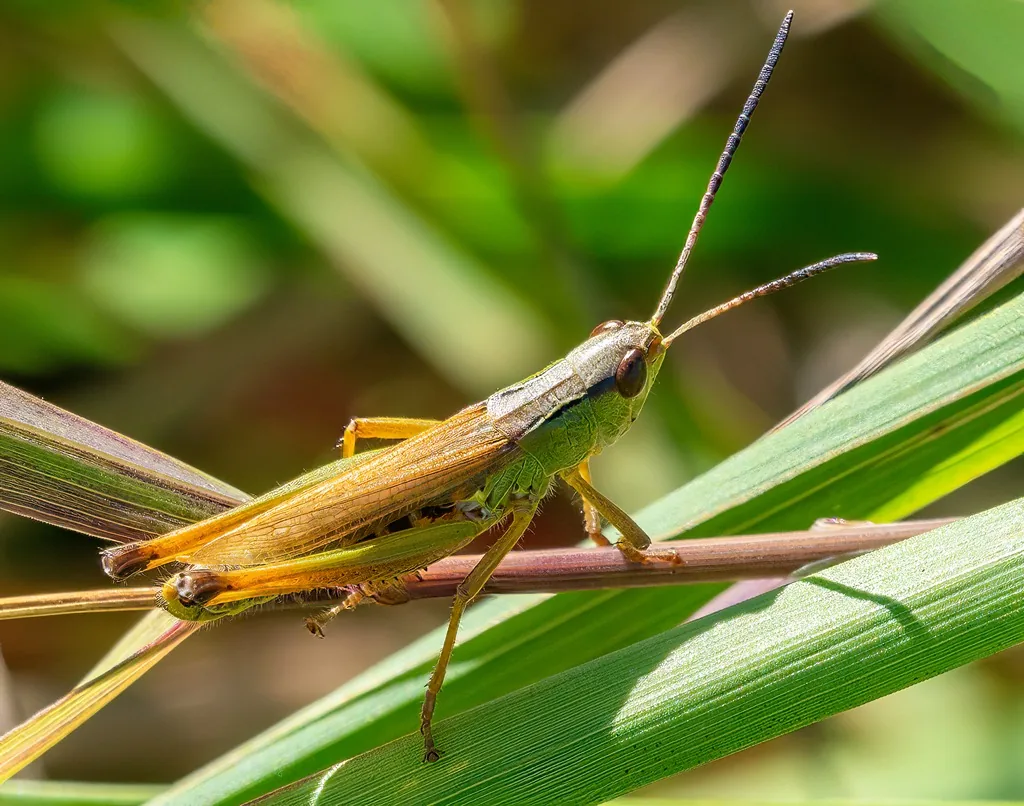
- A slender, medium-sized grasshopper, light green to light brown, with a strongly slanted face. Males are 12 to 18 mm long and females 21 to 27 mm.[1][2]
- Wing length differs by sex: the male's forewings reach nearly to the tip of the abdomen, while the female's cover only about half to three-quarters of it. The hind wings are clear.[1][2]
- The underside of the abdomen is yellowish, with a blackish patch on the side of each segment.[1][2]
- The antennae are threadlike, becoming slightly thicker and dark toward the tip. The hind thigh is tan or brown without bands and has a black knee; the hind shin is usually yellowish or light brown to greenish, sometimes orange or red.[1][2]
Look-alikes
| Look-alike | How to tell them apart |
|---|---|
| Club-horned grasshopper (Aeropedellus clavatus) | Easily confused with the meadow grasshopper and often found with it in mountain meadows. The club-horned grasshopper's antennae end in a distinct club of enlarged dark segments, while the meadow grasshopper's are threadlike.[2][3][1] |
Where it lives
Widespread in the northern and western United States and in Canada. It is very common across the northern states and Canada, but in Nebraska it is scarce and found mainly in low swales and moist meadows. In the Colorado mountains it lives in moist sedge and rush meadows up to about 11,000 feet.[1][2]
Biology and life cycle
It eats grasses and sedges. In the Midwest it favors little bluestem, big bluestem and Kentucky bluegrass; in Idaho its diet was mostly Idaho fescue with some western needlegrass and elk sedge. Adults climb grass and feed head-down, chewing a notch into the leaf edge and working down toward the base.[1][2]
Eggs spend the winter in the soil and hatch in late spring, about the same time as the red-legged grasshopper's. In mountain meadows the eggs can take as long as three years to hatch. Nymphs grow quickly and become adults in about 30 days, usually after four molts.[1]
Adults are most numerous from late June to mid-July in Nebraska. Males sing from grass blades to attract females, which answer with a softer song, and they have separate songs for courtship and for warning off other males.[1][2]
A female lays small clutches of four to six eggs about three-quarters of an inch deep in the soil. On the plains there is one generation a year.[1]
Most females have short wings and cannot fly; males fly short, low, silent hops of 2 to 3 feet. A small share of adults grow long wings and can travel farther, and long-winged females have turned up in city centers miles from where they bred.[1]
Damage and signs
- It feeds on valuable forage grasses but has not been reported causing significant damage, and Nebraska's grasshopper guide lists its economic importance as none. Where it is abundant it adds to the forage loss caused by mixed grasshopper populations.[1][2]
- Densities in a North Dakota sand prairie ranged from about 0.1 to 1.4 per square yard over ten years, while favorable Idaho mountain meadows have held up to ten per square yard.[1]
Health risk
It is a grass-feeding grasshopper, and the sources describe no health concerns for people.[1][2]
Control
Prevention
No control aimed at this species is normally needed. For any grasshopper problem on range or hay, weigh the value of the forage against the likely losses before treating.[1][2][4]
Biological control
Weather and natural enemies keep it in check; flooding soon after hatch killed many nymphs in one North Dakota study, and predators, parasites and diseases take grasshoppers every year.[1][4]
Common questions
- What grasshopper is making a soft buzzing song in my wet meadow?
- In northern states it is often the meadow grasshopper. Males sing from grass blades to call females, and their songs are clearly audible to people.[1]
- Why can't some meadow grasshoppers fly?
- Females normally have short wings that cover only part of the abdomen and cannot fly, so they escape by jumping. Males have longer wings and make short, low flights.[1][2]
Sources
- USDA Agricultural Research Service, Northern Plains Agricultural Research Laboratory, “Meadow Grasshopper, Chorthippus curtipennis (Harris): species fact sheet, Grasshoppers: Their Biology, Identification and Management.” www.ars.usda.gov/plains-area/sidney-mt/northern-plains-agricultural-research-laboratory/pest-management-research/pmru-docs/grasshoppers-their-biology-identification-and-management/id-tools-apps/fact-sheets/gomphocerinae-subfamily/fs-meadow/ (accessed 2026-11-09)
- University of Nebraska-Lincoln Extension, “The Grasshoppers (Orthoptera: Acrididae and Romaleidae) of Nebraska, EB3 (M. L. Brust, W. W. Hoback and R. J. Wright).” extensionpubs.unl.edu/publication/eb3/2009/pdf/view/eb3-2009.pdf (accessed 2026-11-09)
- USDA Agricultural Research Service, Northern Plains Agricultural Research Laboratory, “Clubhorned Grasshopper, Aeropedellus clavatus (Thomas): species fact sheet, Grasshoppers: Their Biology, Identification and Management.” www.ars.usda.gov/plains-area/sidney-mt/northern-plains-agricultural-research-laboratory/pest-management-research/pmru-docs/grasshoppers-their-biology-identification-and-management/id-tools-apps/fact-sheets/gomphocerinae-subfamily/fs-clubhorned/ (accessed 2026-11-09)
- Utah State University Extension, “Grasshoppers (E. Evans and E. Hodgson, June 2008).” extension.usu.edu/planthealth/research/grasshoppers (accessed 2026-11-09)
- iNaturalist, “Pseudochorthippus curtipennis taxon page (order and family).” www.inaturalist.org/taxa/458943 (accessed 2026-11-09)