On this page
How to identify it
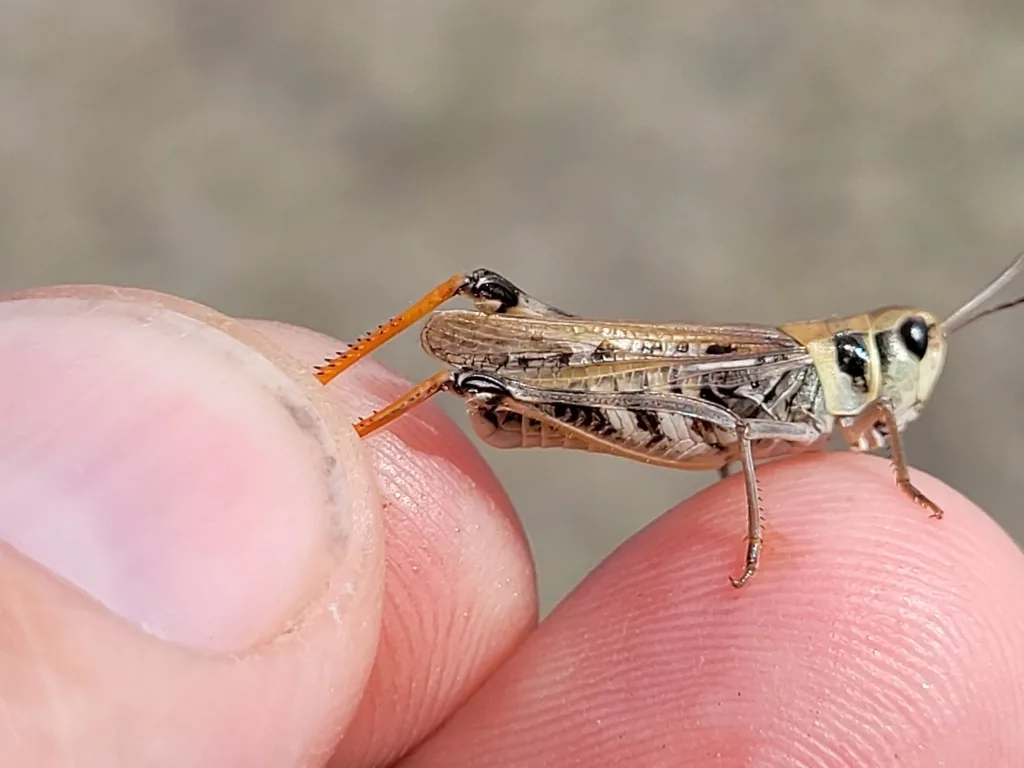
- A colorful, medium-sized grasshopper, gray-brown with a bold pattern of light and dark areas, a yellow abdomen and orange or red hind shins. Males are 14 to 17 mm long and females 18 to 23 mm.[1][2]
- The face slants slightly. An ivory band runs straight down the face from the base of each antenna to the mouthparts, and an ivory or pale tan streak runs back from the eye onto the side ridge of the pronotum.[1]
- The wings are long, reaching the end of the hind thigh or slightly beyond, and each forewing has prominent spots and an ivory streak near the front edge. The hind wings are clear.[1][2]
- The dark stripe along the upper hind thigh holds three light spots. Color varies, and some individuals, nymphs and adults alike, have a plain tan back from head to the tip of the abdomen.[1]
Where it lives
Hills and mountains of the northwestern United States, in mixed-grass and bunchgrass prairie, mountain meadows and parklands, and alpine tundra, at elevations from 1,600 to 11,100 feet. Small, local populations reach eastern North Dakota and southwestern Manitoba. In Nebraska, where it favors shortgrass prairie along the edges of ponderosa pine forest, the only recent records come from Monroe Canyon in northern Sioux County.[1][2]
Biology and life cycle
It feeds on grasses and sedges, picking from whatever grows in its meadow. In Wyoming mountain meadows it ate Idaho fescue, spikefescue, thickspike wheatgrass, needleandthread, rock sedge and threadleaf sedge, and in cage tests it preferred some grasses to others.[1][2]
To feed, it rears up on a plant, cuts a leaf about half an inch above the base, then holds the loose piece in its front feet and eats it from the cut end to the tip. It also nibbles on ground litter.[1]
Eggs hatch in June over about two weeks, with the date set by snow depth and snowmelt; in one Laramie Range meadow hatching began on June 11 in 1994 but not until June 30 in 1995. Nymphs pass through four stages in 40 to 46 days, and adults appear in July. Field observations suggest that in mountain meadows and northern grasslands the life cycle may take two years.[1]
In Montana egg laying starts about 18 days after the first adults appear and runs into late September. In mountain meadows an early heavy snowfall in August is lethal, but in a late fall some survive into early October. Caged females laid pods of 2 to 10 yellow eggs, angled into the soil with thick, strong walls.[1]
It spends the day on the ground and the night buried in grass litter; one nymph was found half an inch deep in litter at 35°F. Grasshoppers come out about two hours after sunrise and bask for about three hours before becoming active, then take cover again shortly before sunset.[1]
Damage and signs
- Outbreaks can be large. In 1920 it made up half of a grasshopper infestation that covered more than 2,000 square miles of southeastern British Columbia range and caused considerable damage to range grasses. During that August's drought the grasshoppers moved onto green vegetation, where this species reached 720 to 900 per square yard.[1]
- Most populations are small. In Wyoming's 1988 to 1994 surveys, 80 percent of the sites with this species had less than one grasshopper per square yard, though one mountain population reached 15. In Nebraska it has no economic importance.[1][2]
Health risk
A grass and sedge feeder of mountain range; the sources mention no bites, stings or disease.[1][2]
Control
Prevention
On range, checking grasshopper breeding grounds early in the season shows whether nymphs are numerous enough to justify treatment, and the range's forage value should be weighed against the likely damage.[3]
Pesticides
Sprays, dusts and baits are all used against rangeland grasshoppers; dusts must be reapplied often because they do not stick well to foliage. Use only a labeled product and follow its directions.[3]
Common questions
- Where does the Bruner slant-faced grasshopper live?
- It lives in the hills and mountains of the northwestern United States, from mixed-grass prairie and mountain meadows up into alpine tundra, at 1,600 to 11,100 feet.[1]
- Why can't I find these grasshoppers early in the morning?
- They spend the night hidden in ground litter and only come out onto the ground surface about two hours after sunrise.[1]
Sources
- USDA Agricultural Research Service, Northern Plains Agricultural Research Laboratory, “Bruner Slantfaced Grasshopper, Bruneria brunnea (Thomas): species fact sheet, Grasshoppers: Their Biology, Identification and Management.” www.ars.usda.gov/plains-area/sidney-mt/northern-plains-agricultural-research-laboratory/pest-management-research/pmru-docs/grasshoppers-their-biology-identification-and-management/id-tools-apps/fact-sheets/gomphocerinae-subfamily/fs-bruner-slantfaced/ (accessed 2026-11-09)
- University of Nebraska-Lincoln Extension, “The Grasshoppers (Orthoptera: Acrididae and Romaleidae) of Nebraska, EB3 (M. L. Brust, W. W. Hoback and R. J. Wright).” extensionpubs.unl.edu/publication/eb3/2009/pdf/view/eb3-2009.pdf (accessed 2026-11-09)
- Utah State University Extension, “Grasshoppers (E. Evans and E. Hodgson, June 2008).” extension.usu.edu/planthealth/research/grasshoppers (accessed 2026-11-09)
- iNaturalist, “Bruneria brunnea taxon page (order and family).” www.inaturalist.org/taxa/340676 (accessed 2026-11-09)