On this page
How to identify it
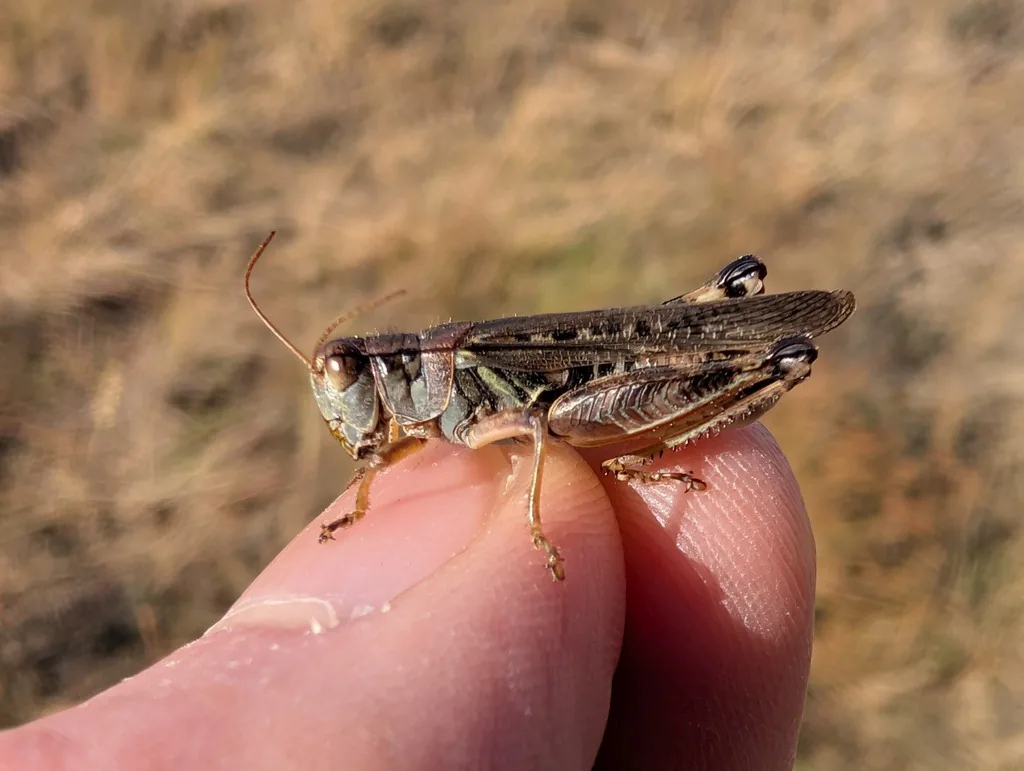
- A medium-sized, fully winged, pale to dark brown grasshopper with poorly developed markings, slightly larger than the migratory grasshopper. Males are 18 to 23 mm long and females 22 to 27 mm; the wings reach or just pass the tips of the hind thighs.[1][2]
- The hind shins are usually pink or red, less often pale greenish yellow, and the underside is usually bright yellow. The hind wing is clear.[1][2]
- The outer face of the hind thigh is almost entirely dark or carries a distinctive dark pattern.[1]
- In males, the cerci are large and flat, straight-sided at the base and curving upward at the tip, and the paired furculae above them are long, reaching at least halfway along the supra-anal plate and running parallel.[1][2]
- Nymphs are usually brown and tan with darker spots, but some males are mostly dark and some females are green. First-stage nymphs have a shiny black underside.[1]
Look-alikes
| Look-alike | How to tell them apart |
|---|---|
| Migratory grasshopper (Melanoplus sanguinipes) | Very similar, with similar male cerci, but its furculae are short, not reaching halfway along the supra-anal plate, and spread apart rather than running parallel.[2] |
| Northern grasshopper (Melanoplus borealis) | Shares mountain meadows with it but keeps to the wetter, lusher parts, while the Bruner spur-throated grasshopper lives on the drier upland next to them.[1] |
Where it lives
Widespread in North America: arctic tundra, the northern part of the western prairies, herb-grasslands of the Northeast and mountain meadows of the West, including the undergrowth of quaking aspen groves. In Nebraska it is known only from the original specimens collected in Sheridan County and described in 1897.[1][2]
Biology and life cycle
It eats many plants but prefers forbs such as lupines, Astragalus, cinquefoil, yarrow and dandelion; in lab tests adults chose dandelion over wheat, grasses, alfalfa and red clover. Its diet shifts through the summer as favored plants are eaten or dry up.[1][2]
Nymphs appear in the first two weeks of June in the mountains of Montana and Wyoming, later in a cool spring. In mountain meadows the eggs usually spend two years in the soil before hatching, and some take three; under warm lab conditions some hatched after one year.[1]
Nymphs develop in about 31 to 35 days through five instars, and adults appear in July or early August. Adults can survive into October but die with the first hard freeze.[1][2]
Females mature in about 16 days. Each curved pod, 1 to 1 1/4 inches long, holds 21 or 22 tan eggs. When a dense population runs out of food, adults that have already begun laying fly off and keep laying in new meadows, starting new populations.[1]
It lives on the ground, basking on bare soil in the morning and hiding overnight from mountain cold; in one Wyoming meadow two males were found clinging under dry cattle dung before sunrise.[1]
Damage and signs
- Outbreaks erupt at irregular intervals in western mountain meadows. Recorded examples include a Nevada sheep range in 1936-38 at about 20 adults per square yard and Utah's Fish Lake National Forest in 1959, 1961 and 1963, where it and the northern grasshopper exceeded 100 adults per square yard and devastated the meadows.[1]
- Dense populations eat out their preferred forbs by the end of the nymph stage and then feed heavily on forage grasses. In Montana's Crazy Mountains in 1954, after the grasshoppers had stripped the lupine Lupinus sericeus, prolonged feeding on timothy badly damaged the grass.[1]
- It has also damaged seed crops of alsike clover, timothy and alfalfa in British Columbia and oats in Alberta, and occasionally infests alfalfa in Saskatchewan.[1]
Health risk
It is a plant-feeding grasshopper, and the sources describe no health concerns for people.[1][2]
Control
Prevention
Weedy meadows with dandelion, brome and patches of bare ground support the largest populations, while well-vegetated meadows in the same Wyoming mountains held under one per square yard. Watching those weedy sites helps catch a buildup early.[1]
Biological control
Weather can end an outbreak: a large Nevada population was wiped out by a midsummer hailstorm in 1938. Cool conditions also favor fungal diseases of grasshoppers.[1][3]
Pesticides
Mountain outbreaks have been treated with bait, including 4,000 acres in Utah in 1963. Baits only work if the grasshoppers eat them, and sprays work better against nymphs than adults. Follow the label.[1][3]
Common questions
- Why do grasshoppers suddenly appear in high mountain meadows?
- The Bruner spur-throated grasshopper erupts at irregular intervals in western mountain meadows, especially weedy ones. Its eggs can take two or more years to hatch there, and adults fly between meadows, starting new populations.[1]
- Is the Bruner spur-throated grasshopper always harmful?
- No. In small numbers it mostly eats forbs, many of them toxic to livestock, and ARS researchers consider it beneficial at those levels. Large numbers turn to forage grasses and can devastate a meadow.[1]
Sources
- USDA Agricultural Research Service, Northern Plains Agricultural Research Laboratory, “Bruner Spurthroated Grasshopper, Melanoplus bruneri Scudder: species fact sheet, Grasshoppers: Their Biology, Identification and Management.” www.ars.usda.gov/plains-area/sidney-mt/northern-plains-agricultural-research-laboratory/pest-management-research/pmru-docs/grasshoppers-their-biology-identification-and-management/id-tools-apps/fact-sheets/melanoplinae-subfamily/fs-bruner-spurthroated/ (accessed 2026-11-09)
- University of Nebraska-Lincoln Extension, “The Grasshoppers (Orthoptera: Acrididae and Romaleidae) of Nebraska, EB3 (M. L. Brust, W. W. Hoback and R. J. Wright).” extensionpubs.unl.edu/publication/eb3/2009/pdf/view/eb3-2009.pdf (accessed 2026-11-09)
- Utah State University Extension, “Grasshoppers (E. Evans and E. Hodgson, June 2008).” extension.usu.edu/planthealth/research/grasshoppers (accessed 2026-11-09)
- iNaturalist, “Melanoplus bruneri taxon page (order and family).” www.inaturalist.org/taxa/224621 (accessed 2026-11-09)