On this page
How to identify it
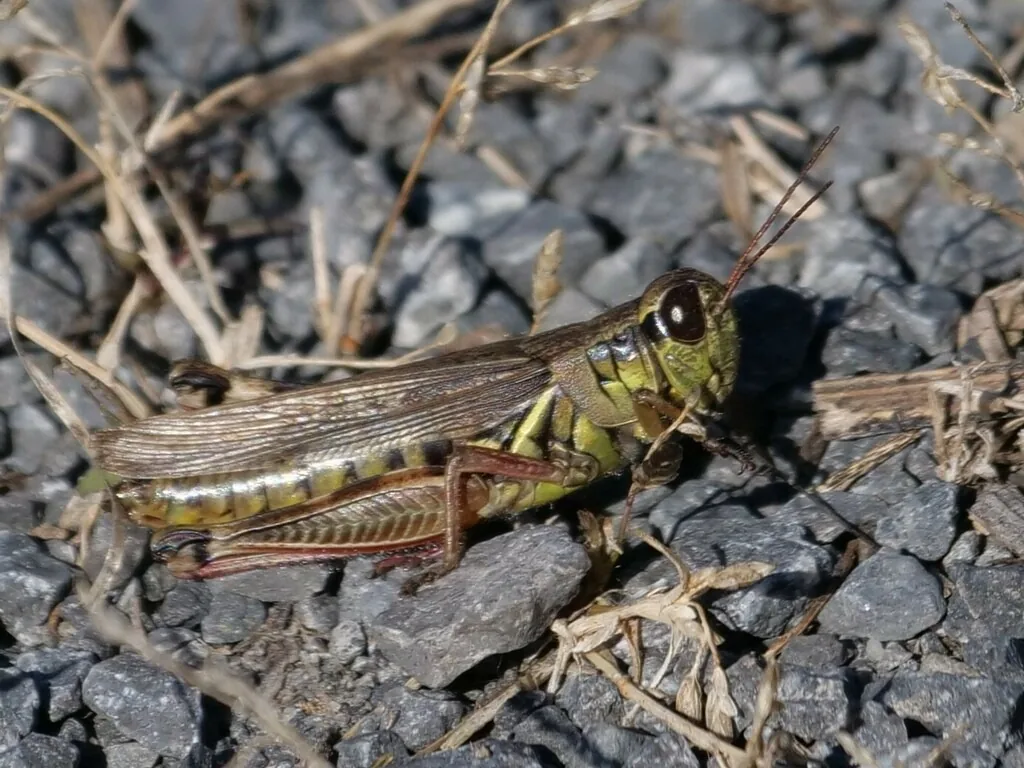
- A dark, medium-sized spur-throated grasshopper, brownish mixed with green and black. Males are 18 to 22 mm long and females 20 to 28 mm.[1][2]
- A prominent black bar runs back from the eye along the side of the pronotum, which is largely greenish.[2]
- The hind shins are red, sometimes paler. The hind thigh shows red or orange: one description gives a usually black outer face with a red (sometimes yellow) lower edge, while Nebraska specimens have an unmarked orange to reddish outer face.[1][2]
- Wing length varies. Males' wings fall slightly short of or slightly past the tip of the hind thigh, and females' usually cover about three-quarters of the abdomen; in Nebraska the wings are nearly always shorter than the abdomen.[1][2]
- Newly hatched nymphs are distinctively black, with a narrow brown stripe down the back and a pale crescent on the side of the head and pronotum.[1]
Where it lives
Widespread across the north of North America, from lowlands to mountains, including Alaska and mountain meadows in Montana, Wyoming, Utah, Idaho and Oregon. South of that it is local: in Nebraska it is known only from a few cool, spring-fed wetlands in the Sandhills and was first recorded there between 2005 and 2008.[1][2]
Biology and life cycle
It feeds mainly on forbs, especially lupine and loco in mountain meadows, and dandelion, clover, thistle, cinquefoil, goldenrod and western ragweed elsewhere. It also eats some grasses (Kentucky bluegrass made up about half its diet in one North Dakota sand prairie) and will feed on other insects, probably dead or dying grasshoppers.[1][2]
Eggs need two winters in the soil before they hatch. In Wyoming's Big Horn Mountains hatching starts between June 1 and July 1 depending on snowmelt and elevation; near Fairbanks, Alaska, eggs hatched only after being soaked in meltwater.[1]
Nymphs grow fast, reaching adulthood in about a month. Adults appear from early July to early August, and some survive into mid-September. In an Alaska study the adults matured about three weeks after their final molt, and females laid pods of 12 to 16 eggs from mid-August to about October 1.[1][2]
It lives mostly on the ground and basks on patches of bare soil. When half of an Alaska meadow was mowed, the adults moved into the warmer mowed half within about two weeks.[1]
Damage and signs
- In mountain meadows of Montana and Wyoming it has reached 60 young adults per square yard. In 1955 a related subspecies at about 50 per square yard destroyed a reseeded meadow on Utah's Fishlake National Forest, and in 1995 a 100-acre Big Horn Mountains meadow with about 20 per square yard was 90 percent grazed by early August, by cattle and grasshoppers together.[1]
- Because of the two-year egg stage, a meadow may be heavily infested one year and nearly free the next. In Nebraska it is too rare to have any economic importance.[1][2]
Health risk
It is a plant-feeding grasshopper, and the sources describe no health concerns for people.[1][2]
Control
Prevention
Expect populations to swing between years. Because the eggs take two years to hatch, eggs already in the soil can reinfest a meadow the year after it was treated. Weigh the forage value of the meadow against the likely loss before treating.[1][3]
Biological control
Weather and snowmelt timing drive much of its hatching and survival, and predators, parasites and diseases take a share of grasshoppers every year.[1][3]
Common questions
- Why did the grasshoppers come back the year after we treated the meadow?
- With the northern grasshopper, eggs spend two winters in the soil. Eggs laid before treatment can hatch a year later, which is how entomologists in the 1950s first suspected its two-year life cycle.[1]
- What does the northern grasshopper eat?
- Mostly broadleaf plants such as lupine, loco, dandelion and clover. Given a choice, caged adults ate dandelion long before they touched grasses like western wheatgrass or Idaho fescue.[1][2]
Sources
- USDA Agricultural Research Service, Northern Plains Agricultural Research Laboratory, “Northern Grasshopper, Melanoplus borealis borealis (Fieber): species fact sheet, Grasshoppers: Their Biology, Identification and Management.” www.ars.usda.gov/plains-area/sidney-mt/northern-plains-agricultural-research-laboratory/pest-management-research/pmru-docs/grasshoppers-their-biology-identification-and-management/id-tools-apps/fact-sheets/melanoplinae-subfamily/fs-northern/ (accessed 2026-11-09)
- University of Nebraska-Lincoln Extension, “The Grasshoppers (Orthoptera: Acrididae and Romaleidae) of Nebraska, EB3 (M. L. Brust, W. W. Hoback and R. J. Wright).” extensionpubs.unl.edu/publication/eb3/2009/pdf/view/eb3-2009.pdf (accessed 2026-11-09)
- Utah State University Extension, “Grasshoppers (E. Evans and E. Hodgson, June 2008).” extension.usu.edu/planthealth/research/grasshoppers (accessed 2026-11-09)
- iNaturalist, “Melanoplus borealis taxon page (order and family).” www.inaturalist.org/taxa/224619 (accessed 2026-11-09)