On this page
How to identify it
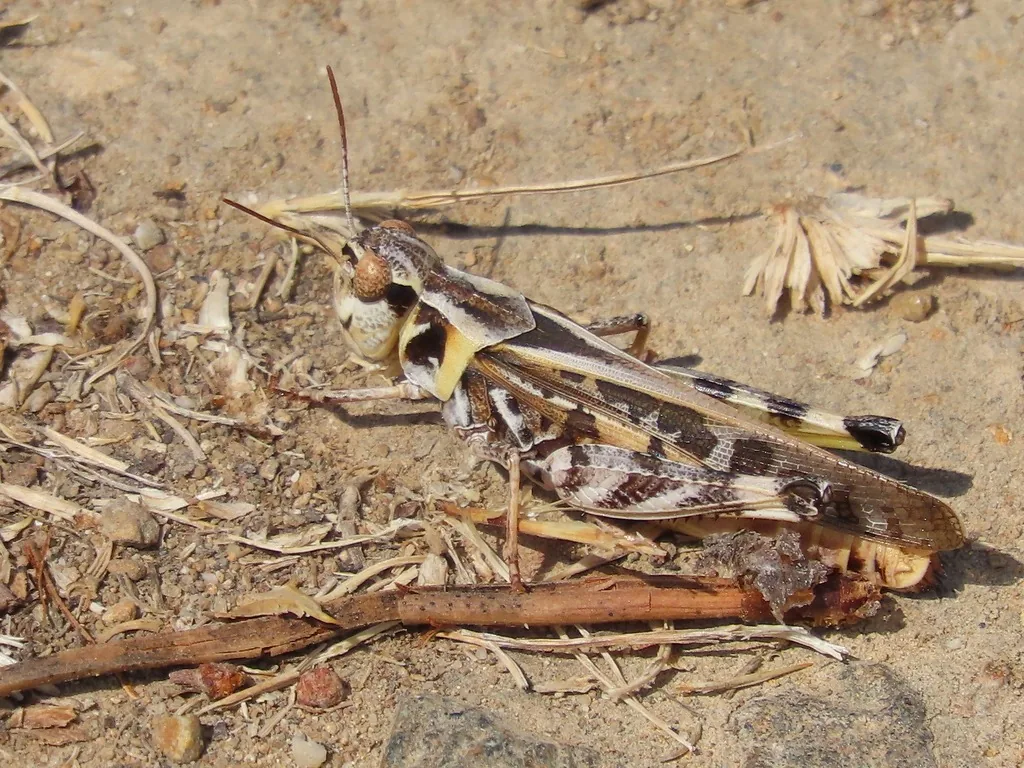
- Adults are yellow to brown, with mottled forewings and variable dark brown to blackish spots and markings.[1][2]
- The hind wings are transparent, and the forewings reach beyond the end of the abdomen.[1][2]
- Light stripes run along the angles of the forewings and converge near the middle of the back when the wings are closed.[1]
- The hind tibiae are light brown to nearly orange.[2]
- Males are noticeably smaller than females; Nebraska specimens measured 19 to 22 mm for males and 22 to 26 mm for females.[1][2]
- Color shifts with age: young adults are dark brownish gray and lighten as they mature, and adults that are sexually active on the breeding grounds turn bright yellow.[1]
- First-stage nymphs are strikingly patterned in cream, tan and black. Nymphs usually have a dark bar crossing the front of the head below the antennal sockets and running across the lower part of the eyes.[1]
Where it lives
It is distributed widely in North America, in grasslands that include the northern mixedgrass prairie, bunchgrass prairie and mountain meadows; one resident population lives at 10,800 feet in Colorado, just below timberline. In Nebraska it is comparatively rare, recorded from only four counties in the northern half of the state, where it keeps to low, moist grassland.[1][2]
Biology and life cycle
It feeds mainly on grasses. It prefers succulent western wheatgrass, reed canarygrass, barley and wheat, and also feeds heavily on fescues, bluegrasses, wheatgrasses, bromes and slender hairgrass. In natural habitat it eats small amounts of forbs such as fireweed and some legumes.[1][2]
Females gather to lay eggs on egg beds that range from a few square yards to 20 acres or more, and a bed may hold 3,000 to 100,000 eggs per square foot. Each clutch averages 28 eggs (range 10 to 38), laid in the top inch of soil.[1]
Eggs develop about halfway in the summer they are laid and then stop in diapause. Winter cold breaks the diapause, development resumes when spring soil warms past 55°F, and hatching starts once the soil reaches about 80°F and the air 65°F.[1]
It is an early-hatching species. A whole bed can finish hatching within 12 days, so nymphs seem to appear all at once, although cool, dry weather can delay hatching by a month and stretch it out for a month or longer.[1]
Crowding and food shortage push young nymphs off the egg beds toward the nearest green vegetation, and older nymphs march in cohesive bands. Nymphs reach adulthood in about 26 days when it is warm and food is good, and in 40 days or more under poorer conditions.[1]
Adults can migrate long distances in huge flying swarms, but in recent years only small swarms making short flights have been seen, typically on hot, sunny afternoons and over one hundred to several hundred yards. Not every population moves: in one Minnesota pasture, nymphs matured and adults laid eggs close to where they had hatched.[1]
During egg-laying, females fly back and forth between feeding grounds and egg beds, while males stay on the egg beds, where they eventually die.[1]
There is one generation a year. In field cages at Saskatoon, Saskatchewan, females lived about 60 days as adults and laid 8 pods, or about 180 eggs, each.[1]
In Nebraska, nymphs occur from spring to early summer and adults are most common from early July to September.[2]
Populations swing between extremes. The species can stay virtually unseen for five to ten years, build over three to four years and then peak for two to three more; above-normal spring and summer temperatures with enough rain to keep fescue, bluegrass and wheat green favor these outbreaks, which consist almost entirely of this one species.[1]
Dense populations crash after epidemics of the fungus Entomophaga grylli, during droughts that starve nymphs or adults, in cool springs and summers, or after cold winter soils kill eggs, sometimes all of them.[1]
It is active by day. It spends the night in sheltered spots, then crawls out to bask in the morning sun on bare soil, clods and dried cattle dung before feeding.[1]
Damage and signs
- It is a severe pest of small grains and grasses and does the most harm early in the season, when it often completely destroys spring wheat. Nymphs that leave native sod and invade fields of young wheat cause extensive crop damage.[1]
- Rangeland outbreaks can devastate grass forage over areas as large as 2,000 square miles. On British Columbia rangelands, 20 adults per square yard will consume the entire available yield of forage grasses.[1]
- Swarms sometimes invade vegetable crops, where they feed preferentially on onions, lettuce, cabbage and peas.[1]
- The Nebraska guide says it can be highly destructive to rangeland at higher latitudes and altitudes and is common and economically important across much of its range, but it is comparatively rare in Nebraska and does not appear to be economically important there.[2]
Health risk
It is a plant feeder. The USDA ARS fact sheet and the Nebraska guide discuss crop and range losses only and describe no risk to people.[1][2]
Control
Prevention
Check breeding grounds early in the season. Utah State advises scouting for 'hot spots' where egg-laying is concentrated and outbreaks first appear, and treating in years when nymphs are extremely numerous; the clear-winged grasshopper hatches early, from crowded egg beds.[3][1]
Biological control
Baits containing Nosema locustae, a microsporidian that infects grasshoppers that eat it, can kill 50 to 70 percent of a population under ideal conditions at peak nymph emergence; infected survivors are weakened, feed less and lay fewer eggs.[3]
Pesticides
Insecticide sprays work better on nymphs than on adults. Carbaryl bait (wheat bran laced with carbaryl) is an alternative to spraying in pastures, fence rows, wasteland and along roadsides, and baits work best when host plants are scarce, small or dried up. Follow the product label.[3]
When to call a professional
A homeowner or small rancher treating alone usually gets only temporary relief, because grasshoppers keep moving in from untreated land, so area-wide treatment works better than spot treatment. For serious rangeland infestations, USDA-APHIS works with private landowners on area-wide management programs.[3]
Common questions
- Why do clear-winged grasshoppers seem to appear all at once?
- Females lay their eggs together in egg beds that can hold 3,000 to 100,000 eggs per square foot, and a bed can finish hatching within 12 days, so the nymphs seem to appear en masse. Crowding then sends them out toward the nearest green plants.[1]
- Do clear-winged grasshoppers damage vegetable gardens?
- They mainly eat grasses and small grains, but swarms sometimes invade vegetable crops and feed preferentially on onions, lettuce, cabbage and peas.[1]
- Why are some clear-winged grasshoppers bright yellow?
- Their color changes with age. Young adults are dark brownish gray and lighten as they mature, and once they become sexually active on the breeding grounds they turn bright yellow.[1]
Sources
- USDA Agricultural Research Service, Northern Plains Agricultural Research Laboratory, “Clearwinged Grasshopper, Camnula pellucida (Scudder): species fact sheet, Grasshoppers: Their Biology, Identification and Management.” www.ars.usda.gov/plains-area/sidney-mt/northern-plains-agricultural-research-laboratory/pest-management-research/pmru-docs/grasshoppers-their-biology-identification-and-management/id-tools-apps/fact-sheets/oedipodinae-subfamily/fs-clearwinged/ (accessed 2026-11-08)
- University of Nebraska-Lincoln Extension, “The Grasshoppers (Orthoptera: Acrididae and Romaleidae) of Nebraska, EB3 (M. L. Brust, W. W. Hoback and R. J. Wright).” extensionpubs.unl.edu/publication/eb3/2009/pdf/view/eb3-2009.pdf (accessed 2026-11-08)
- Utah State University Extension, “Grasshoppers (E. Evans and E. Hodgson, June 2008).” extension.usu.edu/planthealth/research/grasshoppers (accessed 2026-11-08)
- iNaturalist, “Camnula pellucida taxon page (order and family).” www.inaturalist.org/taxa/155274 (accessed 2026-11-08)