On this page
How to identify it
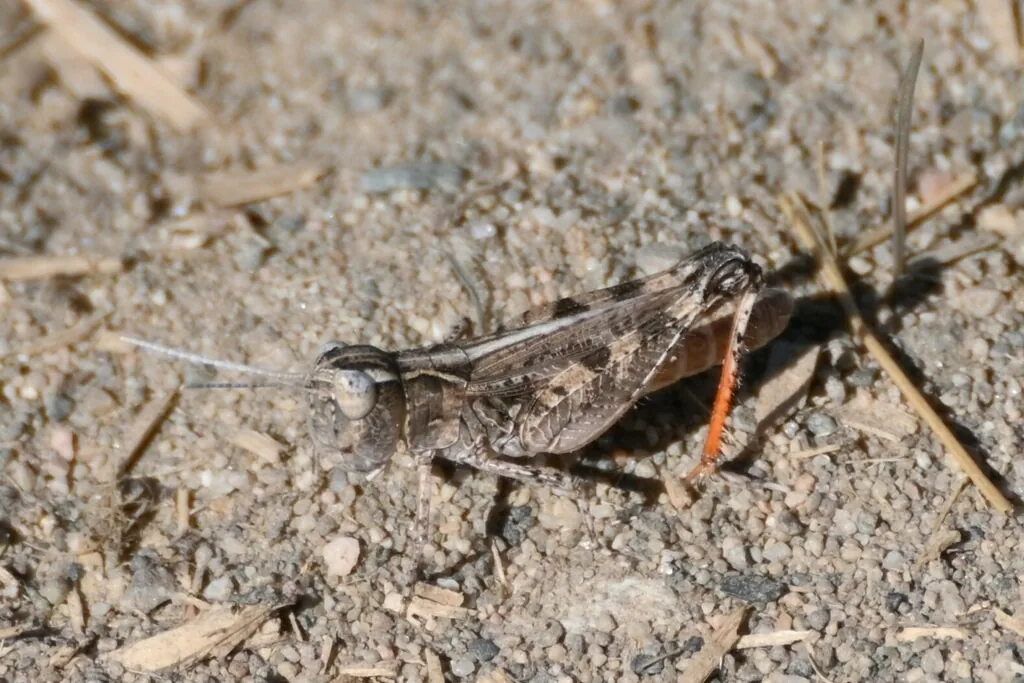
- A small to medium, brown to reddish-brown grasshopper with many dark markings and speckled brown forewings. Males are 15 to 17 mm long and females 20 to 24 mm.[1][2]
- The antennae are light gray or whitish on top, the feature behind the common name.[1][2]
- The hind shins (tibiae) are red to orange, usually black at the base, and the hind knees are black. The upper edge of the hind thigh has three dark marks, the middle one triangular.[1][2]
- Nymphs have pale-ringed antennae, cream bands along the edges of the back that continue onto the head, and bold black on the sides of the head, thorax and abdomen.[1]
Look-alikes
| Look-alike | How to tell them apart |
|---|---|
| Bigheaded grasshopper | The bigheaded grasshopper shares the same grasslands, hatches at the same time and also clips grass. It is larger and grayer, with blue hind shins and an X-shaped pattern behind the head; the whitewhiskered grasshopper weighs little more than half as much.[1][4] |
Where it lives
Widespread in North American grasslands, with the highest numbers in mixedgrass and bunchgrass prairie. In Colorado it is common in plains grassland up to about 5,750 feet and does not live above about 7,500 feet. It occurs statewide in Nebraska and is extremely abundant in the Sandhills.[1][2]
Biology and life cycle
It is an early-hatching species. Eggs start developing in the summer they are laid, rest through winter and finish developing in spring; hatching lasts four to six weeks. Nymphs need 40 to 48 days and usually five stages to mature, and adults are most common from early July to late August. There is one generation a year.[1][2]
Females lay their first eggs at about 14 days old and then a pod every three days or so. Each pod holds three to five eggs and lies flat just under the surface, usually in blue grama or buffalograss sod. In the wild a female lives about 23 days and lays about 12 eggs.[1]
It eats many grasses and some sedges roughly in proportion to how common they are, and it also feeds on litter on the ground: fallen leaves, seeds, livestock dung and dead insects. Late-summer regrowth of western wheatgrass may be eaten to the ground.[1][2]
It favors grassland with some bare patches and is most abundant on sandy soils. Adults fly low and straight for a few feet when disturbed and sometimes turn up on city sidewalks and parking lots, but migrating swarms have not been recorded.[2][1]
Damage and signs
- In outbreaks it can reach 25 adults per square yard and make up half or more of all the grasshoppers present. In Nebraska's Sandhills, adult densities often top 20 per square yard in some areas.[1][2]
- It eats grass leaves and often cuts them off the plant. Because it is small, each grasshopper is thought to do less than half the damage of a bigheaded grasshopper, though its exact pest role has not been measured experimentally.[1]
- Numbers typically rise 1.5- to 3-fold a year for about four years, then jump about sixfold into an outbreak that can last three to five years or more before crashing. Weather and natural enemies strongly affect its numbers.[1]
Health risk
The sources describe it only as a rangeland grasshopper; they mention no harm to people.[1][2]
Control
Prevention
Before paying for control, weigh the range's condition and forage value against the expected grasshopper damage. Check breeding areas early in the season for 'hot spots' where outbreaks start.[3]
Biological control
Birds, rodents, spiders and predatory insects eat many nymphs and adults, and birds, rodents, beetles and bee flies eat the shallow egg pods.[1]
Pesticides
Sprays are more effective against nymphs than adults, and Nosema locustae bait applied at peak nymph emergence can kill 50 to 70 percent of grasshoppers under ideal conditions. Follow label directions.[3]
When to call a professional
Grasshoppers move in from untreated land, so area-wide programs work better than spot treatment; a small rancher treating alone usually gets only temporary relief. USDA APHIS assists private landowners.[3]
Common questions
- What is the little brown grasshopper with white antennae in my pasture?
- Likely the whitewhiskered grasshopper. Look for antennae that are whitish on top and red to orange hind shins on a brown, speckled grasshopper under an inch long.[1][2]
- When are whitewhiskered grasshoppers most noticeable?
- Adults are most common from early July to late August, after nymphs hatch from mid-spring.[2]
Sources
- USDA Agricultural Research Service, Northern Plains Agricultural Research Laboratory, “Whitewhiskered Grasshopper, Ageneotettix deorum (Scudder): species fact sheet, Grasshoppers: Their Biology, Identification and Management.” www.ars.usda.gov/plains-area/sidney-mt/northern-plains-agricultural-research-laboratory/pest-management-research/pmru-docs/grasshoppers-their-biology-identification-and-management/id-tools-apps/fact-sheets/gomphocerinae-subfamily/fs-whitewhiskered/ (accessed 2026-11-09)
- University of Nebraska-Lincoln Extension, “The Grasshoppers (Orthoptera: Acrididae and Romaleidae) of Nebraska, EB3 (M. L. Brust, W. W. Hoback and R. J. Wright).” extensionpubs.unl.edu/publication/eb3/2009/pdf/view/eb3-2009.pdf (accessed 2026-11-09)
- Utah State University Extension, “Grasshoppers (E. Evans and E. Hodgson, June 2008).” extension.usu.edu/planthealth/research/grasshoppers (accessed 2026-11-09)
- USDA Agricultural Research Service, Northern Plains Agricultural Research Laboratory, “Bigheaded Grasshopper, Aulocara elliotti (Thomas): species fact sheet, Grasshoppers: Their Biology, Identification and Management.” www.ars.usda.gov/plains-area/sidney-mt/northern-plains-agricultural-research-laboratory/pest-management-research/pmru-docs/grasshoppers-their-biology-identification-and-management/id-tools-apps/fact-sheets/gomphocerinae-subfamily/fs-bigheaded/ (accessed 2026-11-09)
- iNaturalist, “Ageneotettix deorum taxon page (order and family).” www.inaturalist.org/taxa/155249 (accessed 2026-11-09)