On this page
How to identify it
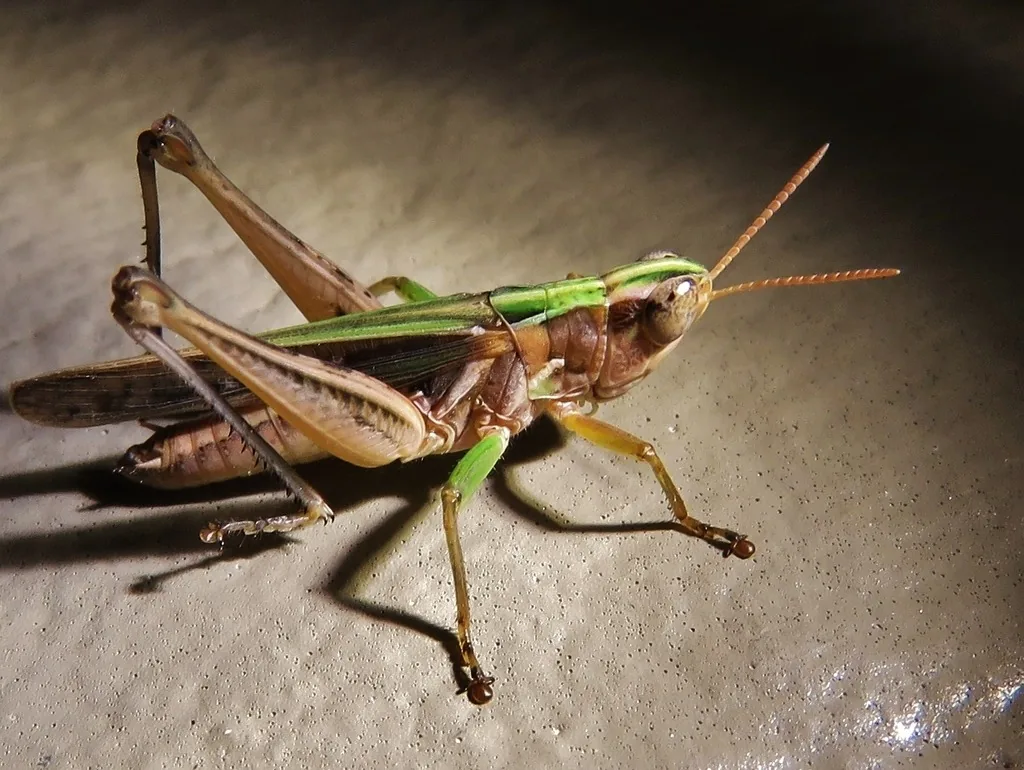
- A small slant-faced grasshopper. Males are 13 to 19 mm long and females 17 to 23 mm.[2]
- Color varies: some are mostly green, others tan and brown, and most are spotted and marked with brown and black. A broad dark band runs back from each eye, with a thin black line and a pale, often ivory, line above it.[1][2]
- The face slopes back strongly and the antennae are thread-like. The hind wings are clear and the hind shins light brown to green.[1][2]
- The side ridges on top of the pronotum are each cut by a single groove, and the wings rarely reach past the tip of the hind thigh.[1][2]
Look-alikes
| Look-alike | How to tell them apart |
|---|---|
| Marsh slant-faced grasshopper (Orphulella pelidna) | Easily confused with it. The marsh slant-faced grasshopper is a bit larger, its pronotal side ridges are cut by two or three grooves instead of one, and its wings always extend past the hind thigh. It lives in wetter places such as marshes and swales, while the slant-faced pasture grasshopper prefers drier grassland.[1][2] |
Where it lives
North American grasslands from east of the Rocky Mountains to the Atlantic coast, and from southern Canada to northern Mexico. Its stronghold is the tallgrass prairie, where it is often the most numerous grasshopper; in eastern states it lives mainly in dry upland and hilly pastures on sandy loam. In Nebraska it is found statewide but less commonly in the Panhandle.[1][2]
Biology and life cycle
It eats a wide range of grasses, roughly in proportion to what grows around it: blue grama, sideoats grama, Kentucky bluegrass and the bluestems in Kansas, with traces of sedges, fungi and a few forbs.[1][2]
It favors short grass. In one Kansas pasture, a patch of blue grama and buffalograss held 14 adults per square yard while the surrounding tall grass held fewer than one, and in Oklahoma and South Dakota large numbers have moved onto freshly mowed roadsides.[1]
Eggs laid in summer spend the winter in the soil and hatch in late spring, from mid-May in the Kansas Flint Hills to late June in eastern Montana. Hatching can stretch over four to six weeks. Nymphs pass through five stages in about six to seven weeks.[1]
Adults appear in July, or August in Montana, and are most common from late July into October. Males court with a faint ticking song. Each egg pod holds 10 to 13 eggs.[1][2]
Its long wings let it disperse; adults have come to electric lights at night in Lincoln, Nebraska, and populations have swarmed in New England.[1]
Damage and signs
- It is about half the weight of the whitewhiskered grasshopper, so each one presumably eats less. Nebraska's guide notes it can be quite numerous on rangeland without being known to cause damage.[1][3][2]
- In outbreaks it adds to the damage of grass-feeding grasshopper populations. In western Iowa in the mid-1930s it and the whitewhiskered grasshopper reached 30 to more than 100 per square yard and ate bluegrass pastures to the ground by early July.[1][3]
Health risk
It is a grass-feeding grasshopper, and the sources describe no health concerns for people.[1][2]
Control
Prevention
Watch short-grass, mowed and heavily grazed areas during a series of dry years, when populations climb. Before treating range or pasture, weigh the forage value against the expected losses.[1][4]
Biological control
Predators, parasites and diseases take a share of grasshoppers every year, and adult numbers drop steeply after their August peak.[1][4]
Common questions
- Why are there so many little grasshoppers on the mowed roadside?
- Slant-faced pasture grasshoppers prefer short, green grass and have been seen moving in large numbers onto freshly mowed roadsides.[1]
- How do I tell it from the marsh slant-faced grasshopper?
- Look at the side ridges on top of the pronotum: one groove cuts them on the slant-faced pasture grasshopper, two or three on the marsh slant-faced grasshopper. Habitat helps too, since the marsh species lives in wet swales.[1][2]
Sources
- USDA Agricultural Research Service, Northern Plains Agricultural Research Laboratory, “Slantfaced Pasture Grasshopper, Orphulella speciosa (Scudder): species fact sheet, Grasshoppers: Their Biology, Identification and Management.” www.ars.usda.gov/plains-area/sidney-mt/northern-plains-agricultural-research-laboratory/pest-management-research/pmru-docs/grasshoppers-their-biology-identification-and-management/id-tools-apps/fact-sheets/gomphocerinae-subfamily/fs-slantfaced-pasture/ (accessed 2026-11-09)
- University of Nebraska-Lincoln Extension, “The Grasshoppers (Orthoptera: Acrididae and Romaleidae) of Nebraska, EB3 (M. L. Brust, W. W. Hoback and R. J. Wright).” extensionpubs.unl.edu/publication/eb3/2009/pdf/view/eb3-2009.pdf (accessed 2026-11-09)
- USDA Agricultural Research Service, Northern Plains Agricultural Research Laboratory, “Whitewhiskered Grasshopper, Ageneotettix deorum (Scudder): species fact sheet, Grasshoppers: Their Biology, Identification and Management.” www.ars.usda.gov/plains-area/sidney-mt/northern-plains-agricultural-research-laboratory/pest-management-research/pmru-docs/grasshoppers-their-biology-identification-and-management/id-tools-apps/fact-sheets/gomphocerinae-subfamily/fs-whitewhiskered/ (accessed 2026-11-09)
- Utah State University Extension, “Grasshoppers (E. Evans and E. Hodgson, June 2008).” extension.usu.edu/planthealth/research/grasshoppers (accessed 2026-11-09)
- iNaturalist, “Orphulella speciosa taxon page (order and family).” www.inaturalist.org/taxa/226628 (accessed 2026-11-09)