On this page
How to identify it
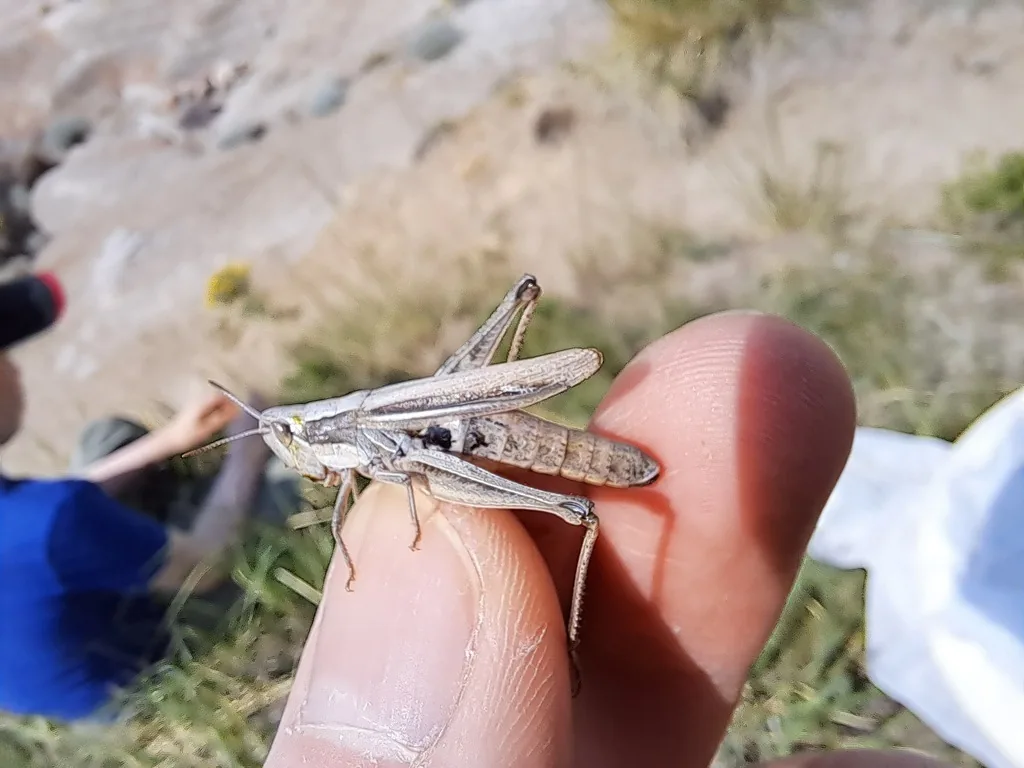
- A smallish slant-faced grasshopper: males are 14 to 19 mm long and females 22 to 29 mm. Color varies a lot, from tan or light brown to gray or green, with brown or green markings.[1][3]
- The top of the pronotum has white or cream side ridges, pinched in near the middle, usually with a dark brown, velvet-like band along each one and a wide tan or gray band between them.[1][3]
- The top of the head carries three lengthwise ridges, a feature ARS calls diagnostic. The antennae are thread-like but look almost clubbed.[1][3]
- Hind wings are clear and hind shins are pale to light brown. The female's wings fall just short of the abdomen tip, while the male's reach slightly past it.[1][3]
Look-alikes
| Look-alike | How to tell them apart |
|---|---|
| Obscure grasshopper (Opeia obscura) | Shares its habitat and is easily confused with it. The obscure grasshopper has flattened, sword-shaped antennae, and the top of its pronotum is plain, without the dark velvet bands.[2][3] |
| Orphulella slant-faced grasshoppers | The velvet-striped grasshopper's nearly clubbed antennae separate it from Orphulella species.[3] |
Where it lives
It has two centers of distribution: a large one in the Great Plains and a smaller one in the Appalachian Mountains and their eastern slopes. In the West it is most abundant in tallgrass prairie and reaches drier prairie types only in moist swales and drainages. It has been recorded throughout Nebraska, though few records come from the eastern third, where it may have disappeared with the loss of grassland.[1][3]
Biology and life cycle
Eggs hatch late, from the latter part of July in eastern Wyoming, over about a month. Nymphs grow for roughly 100 days through summer and fall and go into winter in the third and fourth stages, sheltering under litter. They tolerate freezing, surviving temperatures as low as -15 degrees C, and may move about in warm spells.[1]
Nymphs finish growing in April and May, so the nymphal stage lasts about nine months. Adults peak in May and are scarce by July; in Nebraska they are most common from mid-April to mid-June.[1][3]
It feeds almost only on grasses and sedges. Spring nymphs eat cool-season plants such as bluegrasses, downy brome, junegrass and sedges; adults switch to warm-season grasses, especially blue grama, which is often the only plant found in their crops.[1][3]
Nymphs lose water quickly in dry air, which probably explains why western populations are confined to moist sites.[1]
Courting males rock from side to side and then chirp with one hind leg at a time. Females lay about 18 eggs in a fragile pod about an inch long in bare ground.[1]
Damage and signs
- As a grass feeder it is potentially damaging, but numbers are usually below one per square yard, and it develops in spring when range plants have enough moisture, so populations are normally harmless.[1][3]
- High numbers have been recorded in the sand prairie of the Sheyenne National Grassland in eastern North Dakota, where it was the dominant grasshopper in three of ten years and peaked at about seven per square yard in 1960. It has also been numerous recently in central Nebraska and the Pine Ridge area.[1][3]
Health risk
The sources treat it as a grass-feeding grasshopper and report no effects on people.[1][3]
Control
Prevention
No treatment is normally needed: populations are usually sparse and feed while spring forage is lush. Where numbers do build, judge the condition and forage value of the range before paying for control.[1][4]
Common questions
- Why do I see adult grasshoppers in April?
- Some species, including the velvet-striped grasshopper, spend the winter as partly grown nymphs and become adults in spring, peaking in May.[1][3]
- How do I tell a velvet-striped grasshopper from an obscure grasshopper?
- Check the antennae and the top of the thorax. The velvet-striped grasshopper has thread-like antennae and dark velvety bands beside pale ridges on the pronotum; the obscure grasshopper has flat, sword-shaped antennae and a plain pronotum.[1][2][3]
Sources
- USDA Agricultural Research Service, Northern Plains Agricultural Research Laboratory, “Velvetstriped Grasshopper, Eritettix simplex (Scudder): species fact sheet, Grasshoppers: Their Biology, Identification and Management.” www.ars.usda.gov/plains-area/sidney-mt/northern-plains-agricultural-research-laboratory/pest-management-research/pmru-docs/grasshoppers-their-biology-identification-and-management/id-tools-apps/fact-sheets/gomphocerinae-subfamily/fs-velvetstriped/ (accessed 2026-11-09)
- USDA Agricultural Research Service, Northern Plains Agricultural Research Laboratory, “Obscure Grasshopper, Opeia obscura (Thomas): species fact sheet, Grasshoppers: Their Biology, Identification and Management.” www.ars.usda.gov/plains-area/sidney-mt/northern-plains-agricultural-research-laboratory/pest-management-research/pmru-docs/grasshoppers-their-biology-identification-and-management/id-tools-apps/fact-sheets/gomphocerinae-subfamily/fs-obscure/ (accessed 2026-11-09)
- University of Nebraska-Lincoln Extension, “The Grasshoppers (Orthoptera: Acrididae and Romaleidae) of Nebraska, EB3 (M. L. Brust, W. W. Hoback and R. J. Wright).” extensionpubs.unl.edu/publication/eb3/2009/pdf/view/eb3-2009.pdf (accessed 2026-11-09)
- Utah State University Extension, “Grasshoppers (E. Evans and E. Hodgson, June 2008).” extension.usu.edu/planthealth/research/grasshoppers (accessed 2026-11-09)
- iNaturalist, “Eritettix simplex taxon page (order and family).” www.inaturalist.org/taxa/129132 (accessed 2026-11-09)