On this page
How to identify it
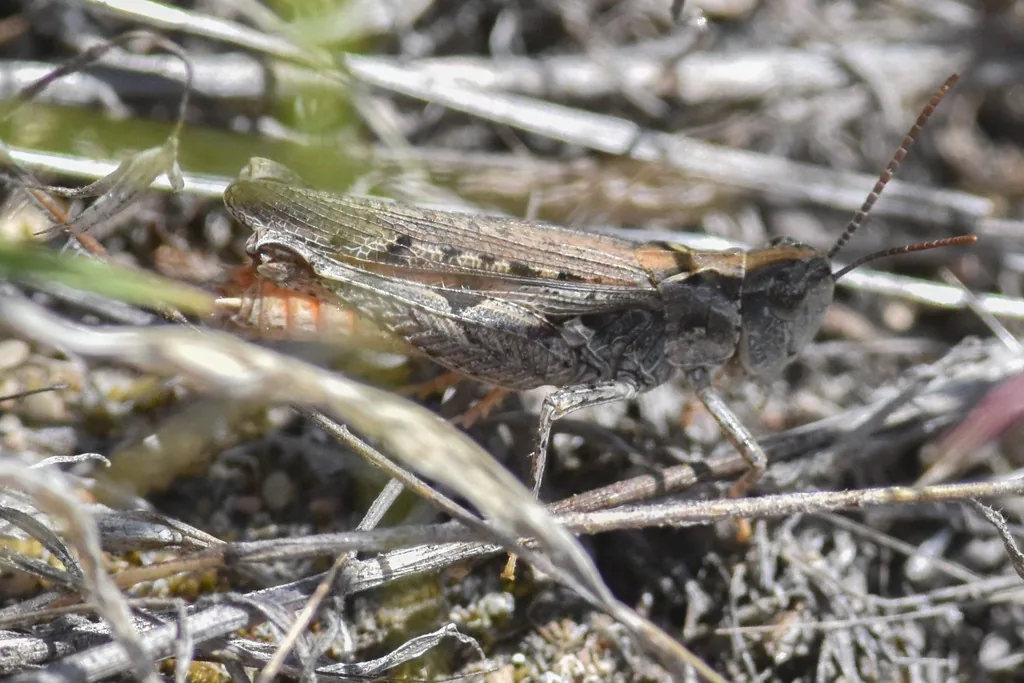
- Small and dull gray to gray-brown, marked with dark brown spots. Males are 12 to 17 mm long and females 16 to 23 mm, and the male's abdomen is yellow to orange.[1][3]
- The hind shins are orange, at least toward the tip, with pale gray and brown spots near the knee. The upper edge of the hind thigh carries a triangular dark mark.[1][3]
- Seen from above, the side ridges of the pronotum pinch inward, are cut deeply across, and dip into a distinct pit at the cut. On the side of the pronotum a broad ridge runs diagonally upward, with a smaller, often ivory ridge below it angled the other way.[1][3]
- The face is only slightly slanted. Nymphs are pale tan to brown with dark brown marks and a light band down the back from the head nearly to the tip of the abdomen, and they darken as they grow.[1]
- The wings are long, reaching past the end of the abdomen. When flushed it flies silently in a weaving path for 5 to 9 feet, then turns sharply and drops to the ground.[1]
Look-alikes
| Look-alike | How to tell them apart |
|---|---|
| Texas spotted range grasshopper (Psoloessa texana) | Also adult in spring. The male's abdomen is salmon-red to yellow, the hind shins are pale rather than orange, and the side ridges of the pronotum lack the pit. It lives in sandy, sparsely vegetated areas such as the Nebraska Sandhills.[3] |
| Obscure grasshopper (Opeia obscura) | Young nymphs of the two often turn up together and look alike, but brown-spotted nymphs have a nearly upright face while obscure grasshopper nymphs have a strongly slanted one. Obscure grasshoppers also start hatching about a month earlier.[2] |
Where it lives
Grasslands of the western states and provinces: desert, shortgrass, mixed-grass and bunchgrass prairie, and western desert shrubland where grasses grow sparsely underneath. It stays out of mountain grassland but reaches foothills as high as 8,076 feet. In Nebraska it occurs over the western two-thirds of the state and is most common in the panhandle.[1][3]
Biology and life cycle
In northeastern Colorado's Pawnee National Grassland, eggs start hatching in early July and nymphs grow slowly through summer and fall, about 120 days. By November they are mostly in their last two stages, and they shelter under litter and dig shallowly into the soil for winter. They wake in April and become adults in April and May.[1][3]
Farther north the cycle is longer. In outdoor cages in central Saskatchewan the eggs sat unhatched through their first summer and hatched in the second, so the life cycle took two years. In the south of its range, eggs seem to hatch the same summer they are laid.[1]
Spring nymphs feed mostly on needleleaf and threadleaf sedges, which green up very early, plus cool-season grasses such as western wheatgrass, downy brome and sixweeks grass. As adults they move on to warm-season grasses, especially blue grama and sand dropseed. They cut a leaf and eat it from the cut end to the tip, either clinging to the plant or picking up the fallen piece from the ground.[1][3]
Pairs mate in the morning in June and early July. A courting male stridulates two to four times as he approaches, and an unwilling female answers with a ticking sound made by kicking her hind shins against the tips of her forewings. The female bores more than an inch into bare soil and lays about 18 yellow eggs under a three-quarter-inch froth plug.[1]
On cold spring nights nymphs shelter under grass litter and come out two to three hours after sunrise to bask, sometimes for three or four hours. On hot days adults move into the shade of small shrubs or grass clumps and rest with their hind legs spread wide.[1]
Damage and signs
- Normal numbers are 0.5 to 1 adult per square yard, which does no significant damage. In outbreaks on mixed-grass prairie adults reach 25 to 30 per square yard, sometimes over areas as large as four square miles, and can stay at high density for three or more years. When adults are abundant in spring, they cause some of the first grasshopper damage to range.[1]
- It belongs to the smallest size class of rangeland grasshoppers, and its damage has never been measured. Nebraska's guide rates it as a minor early-season rangeland pest.[1][3]
Health risk
A small grass and sedge feeder; the sources raise no health concerns about it.[1][3]
Control
Prevention
Adults are most common from April to mid-June, so check grasshopper breeding grounds early in the season. Weigh the range's forage value against the likely damage before spending money on control.[1][4]
Common questions
- Why are there grasshoppers on the range in April?
- On western prairies the early ones are often brown-spotted grasshoppers. They spend the winter as nymphs and become adults in April and May, and when they are abundant they cause some of the first grasshopper damage of the year.[1][3]
- Can brown-spotted grasshoppers show up in town?
- Rarely. One female was collected on a lawn in Laramie, Wyoming, a mile from the nearest rangeland, which suggests they do disperse.[1]
Sources
- USDA Agricultural Research Service, Northern Plains Agricultural Research Laboratory, “Brownspotted Grasshopper, Psoloessa delicatula (Scudder): species fact sheet, Grasshoppers: Their Biology, Identification and Management.” www.ars.usda.gov/plains-area/sidney-mt/northern-plains-agricultural-research-laboratory/pest-management-research/pmru-docs/grasshoppers-their-biology-identification-and-management/id-tools-apps/fact-sheets/gomphocerinae-subfamily/fs-brownspotted/ (accessed 2026-11-09)
- USDA Agricultural Research Service, Northern Plains Agricultural Research Laboratory, “Obscure Grasshopper, Opeia obscura (Thomas): species fact sheet, Grasshoppers: Their Biology, Identification and Management.” www.ars.usda.gov/plains-area/sidney-mt/northern-plains-agricultural-research-laboratory/pest-management-research/pmru-docs/grasshoppers-their-biology-identification-and-management/id-tools-apps/fact-sheets/gomphocerinae-subfamily/fs-obscure/ (accessed 2026-11-09)
- University of Nebraska-Lincoln Extension, “The Grasshoppers (Orthoptera: Acrididae and Romaleidae) of Nebraska, EB3 (M. L. Brust, W. W. Hoback and R. J. Wright).” extensionpubs.unl.edu/publication/eb3/2009/pdf/view/eb3-2009.pdf (accessed 2026-11-09)
- Utah State University Extension, “Grasshoppers (E. Evans and E. Hodgson, June 2008).” extension.usu.edu/planthealth/research/grasshoppers (accessed 2026-11-09)
- iNaturalist, “Psoloessa delicatula taxon page (order and family).” www.inaturalist.org/taxa/229239 (accessed 2026-11-09)