On this page
How to identify it
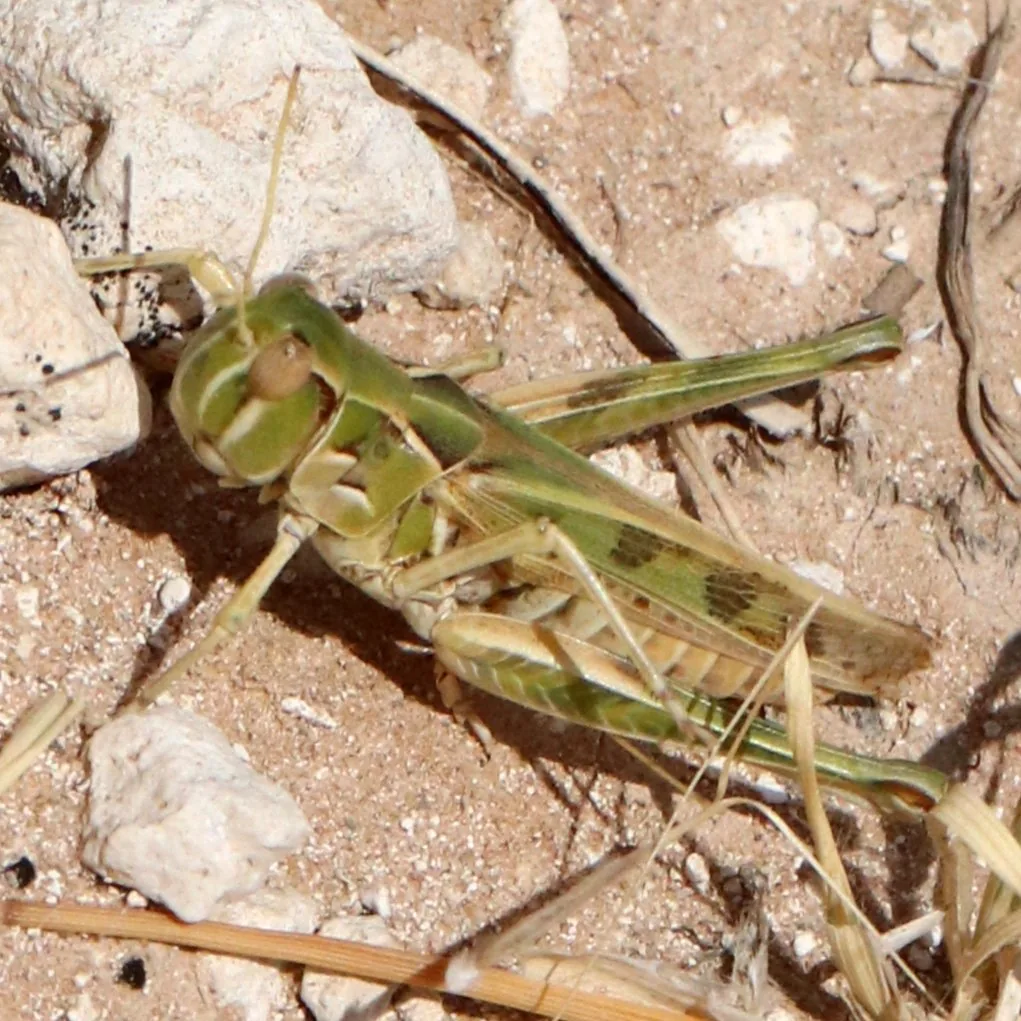
- A medium-sized, strikingly marked grasshopper, grayish or greenish with bold dark markings. Males are 14 to 20 mm long and females 19 to 27 mm.[1][2]
- Each forewing carries four large dark spots, the feature that names it.[1][2]
- A vertical ivory stripe runs down the side of the head below the eye. The hind thigh is crossed by two or three dark slanting bands, and the hind shins are orange to reddish orange.[1][2]
- The side ridges on top of the pronotum are distinct and pinch inward at the middle; in nymphs they are ivory, and the nymph's head is relatively large with a moderately slanted face.[1]
- Wings vary in length, from slightly short of the abdomen tip to a few millimeters beyond it; longer-winged individuals are common in the south, for example in Texas.[1]
Where it lives
Western grasslands, including shortgrass, mixed-grass, desert and bunchgrass prairie, wherever blue grama and other short grasses dominate; in mixed-grass prairie it keeps to the short-grass patches. In Nebraska it occurs across the western two-thirds of the state.[1][2]
Biology and life cycle
It eats green grass leaves almost exclusively, and blue grama makes up 89 to 100 percent of its diet in most samples. Buffalograss is its other favorite, and in a Texas desert prairie buffalograss, blue grama and burrograss made up most of its food. Given a choice of blue grama or western wheatgrass, caged adults ate only the blue grama.[1][2]
It climbs a blue grama leaf and feeds toward the base, or eats a leaf from its tip downward while sitting on the plant. It wastes little, clipping far less grass than the bigheaded grasshopper.[1]
Eggs hatch 15 to 25 days after those of the bigheaded grasshopper, usually in the first half of June in eastern Wyoming and eastern Colorado. Nymphs take about 48 days to mature (33 to 55), and adults appear in late July.[1][2]
Males chase moving females, then court them by tipping their hind legs and stridulating; unreceptive females fend them off with a vibrating stridulation or by shaking their hind legs. Females lay 6 to 14 eggs in a tough pod about an inch long, up to an inch deep beside buffalograss in western South Dakota. There is one generation a year.[1]
It lives on the ground, spending the night on small bare patches among blue grama and sedges. When the soil heats past about 100°F it stands tall on straightened legs, and when it gets hotter it climbs a few inches into blue grama and faces the sun.[1]
Damage and signs
- Because it feeds mainly on blue grama, a forage grass livestock prefer, it can become a serious pest during outbreaks. Each one eats an estimated 1.4 grams of grass over its life, less than the 2.0 grams of a bigheaded grasshopper, and it rarely reaches the same densities.[1]
- It usually runs at 0.2 to 1.5 young adults per square yard and up to about 5 where it is the dominant species. In a 1991 survey of eastern Wyoming mixed-grass prairie it turned up at 22 percent of sites and dominated only five of them. Nebraska's guide rates the damage as minor.[1][2]
Health risk
It is a grass-feeding grasshopper, and the sources describe no health concerns for people.[1][2]
Control
Prevention
Nebraska's guide notes that large numbers of this grasshopper may indicate overgrazed land, so treat a buildup as a prompt to check range condition. Weigh forage value against likely losses before paying for control.[2][3]
Biological control
Flesh fly larvae parasitized 12 percent of adults in north-central Colorado, although the grasshoppers killed most of the parasite larvae inside them.[1]
Pesticides
Bait is a poor fit: in cage tests only 6 percent of four-spotted grasshoppers fed on bran bait. Spraying does knock it out; a treated 840-acre Wyoming site had virtually none for three years until dispersing adults recolonized it. Follow the label.[1][3]
Common questions
- What grasshopper has four dark spots on its wings?
- On western shortgrass range, a medium-sized grayish or greenish grasshopper with four large dark spots on each forewing and orange hind shins is the four-spotted grasshopper.[1][2]
- Does a lot of four-spotted grasshoppers mean my pasture is overgrazed?
- It can. Nebraska's guide notes that the species is often common in overgrazed areas and that large numbers may indicate overgrazed land.[2]
Sources
- USDA Agricultural Research Service, Northern Plains Agricultural Research Laboratory, “Fourspotted Grasshopper, Phlibostroma quadrimaculatum (Thomas): species fact sheet, Grasshoppers: Their Biology, Identification and Management.” www.ars.usda.gov/plains-area/sidney-mt/northern-plains-agricultural-research-laboratory/pest-management-research/pmru-docs/grasshoppers-their-biology-identification-and-management/id-tools-apps/fact-sheets/gomphocerinae-subfamily/fs-fourspotted/ (accessed 2026-11-09)
- University of Nebraska-Lincoln Extension, “The Grasshoppers (Orthoptera: Acrididae and Romaleidae) of Nebraska, EB3 (M. L. Brust, W. W. Hoback and R. J. Wright).” extensionpubs.unl.edu/publication/eb3/2009/pdf/view/eb3-2009.pdf (accessed 2026-11-09)
- Utah State University Extension, “Grasshoppers (E. Evans and E. Hodgson, June 2008).” extension.usu.edu/planthealth/research/grasshoppers (accessed 2026-11-09)
- iNaturalist, “Phlibostroma quadrimaculatum taxon page (order and family).” www.inaturalist.org/taxa/227841 (accessed 2026-11-09)