On this page
How to identify it
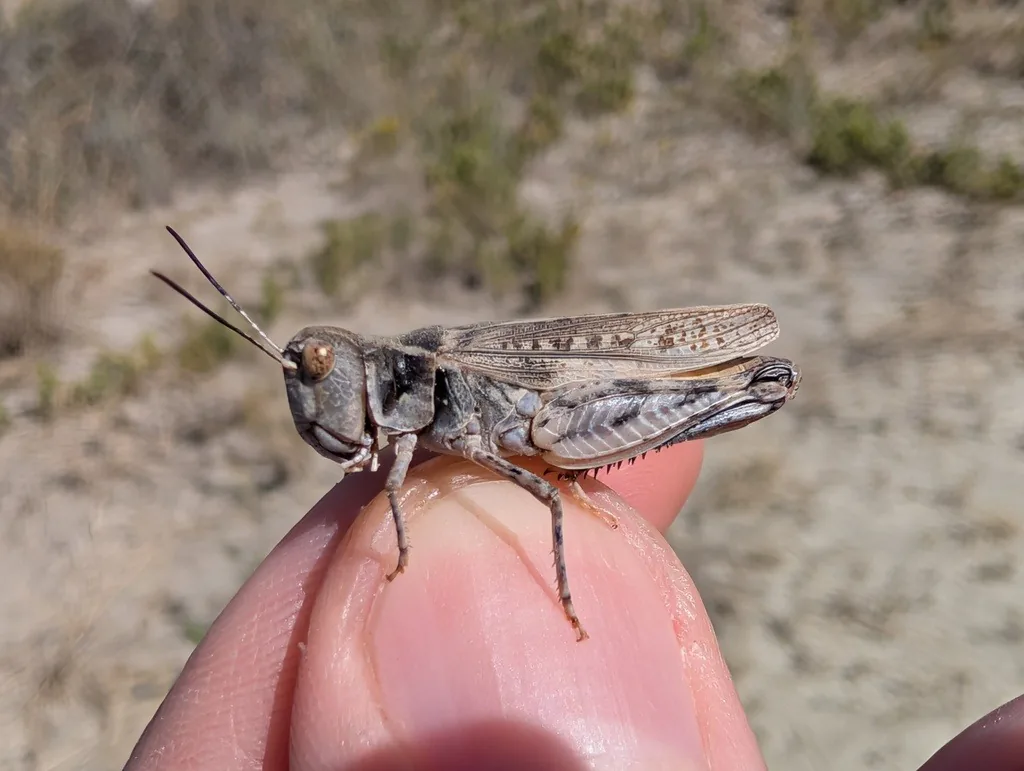
- A medium-sized, gray to gray-brown grasshopper with a relatively large head and a slightly slanted face. Males are 16 to 20 mm long and females 20 to 26 mm.[1][2]
- Light lines on top of the shield behind the head (the pronotum) usually form an X, though other patterns occur in every population.[1]
- The hind shins (tibiae) are blue, the abdomen is largely yellowish, and the spotted forewings reach to or slightly past the tip of the abdomen. The hind wings are clear.[1][2]
- Nymphs are drab gray and tan with darker markings and show the same X pattern on the pronotum; their hind shins are blue with three dark rings.[1]
Look-alikes
Where it lives
Widespread in western North America, from southern Canada to central Mexico, in desert, mixedgrass, shortgrass and bunchgrass prairie. In Nebraska, recent records come only from the western half of the state.[1][2]
Biology and life cycle
It hatches early. Eggs laid in early summer develop halfway before winter, and nymphs emerge in mid-spring over three to four weeks. They reach adulthood in about 36 to 42 days; males usually go through four stages and females five. There is one generation a year.[1]
Adults are most common from early July to mid-August. Females start laying eggs at 12 to 20 days old, placing pods of seven to nine eggs in the top half inch of soil in bare patches.[2][1]
In the wild, adults live about 20 days on average and lay about 15 eggs each. Birds, rodents, beetles, bee flies and other predators eat many eggs, and egg numbers drop by more than half (54 percent) between fall and spring.[1]
It feeds mainly on green leaves of grasses and sedges, especially blue grama, western wheatgrass, needleandthread, sedges and crested wheatgrass. It also picks up cut leaves, seeds and dead grasshoppers from the ground.[1][2]
Numbers can double each year for three or four years and then jump three- or fourfold into an outbreak that may last five years or more before crashing. Adults usually stay where they hatched, but migrants have been recorded traveling one to seven miles.[1]
Damage and signs
- It climbs a grass blade, turns head down and chews into the leaf, often cutting it so it drops. In field cage tests in Montana and Wyoming, one grasshopper per square yard cost about 20 pounds of dry forage per acre, on ground that grows about 600 pounds per acre a year.[1]
- Outbreaks can reach 20 grasshoppers per square yard in mixedgrass prairie and 40 in desert grassland, enough to ruin grazing and even strip the ground bare, leaving it open to wind and water erosion.[1]
- In Nebraska high densities are local, mainly in the panhandle; it is more destructive on rangeland in states to the west and north.[2]
Health risk
The sources describe it only as a rangeland grasshopper; they mention no harm to people.[1][2]
Control
Prevention
Weigh the condition and forage value of the range against the expected grasshopper damage before deciding whether control is worth the cost. Scout early in the season for 'hot spots' where egg laying and outbreaks start.[3]
Biological control
Naturally occurring diseases such as Nosema can wipe out populations. Nosema locustae bait, applied at peak nymph emergence under ideal conditions, kills 50 to 70 percent of grasshoppers.[1][3]
Pesticides
Insecticide sprays work best against nymphs rather than adults, and insecticide treatment can push bigheaded grasshopper numbers well below economic levels. Follow label directions.[3][1]
When to call a professional
Area-wide treatment works better than spot spraying, because grasshoppers move in from untreated land. A small rancher acting alone usually gets only temporary relief; USDA APHIS helps private landowners with large rangeland programs.[3]
Common questions
- Why does the grass look clipped where these grasshoppers are thick?
- The bigheaded grasshopper often chews through a grass blade partway up and lets the cut piece fall, then keeps feeding on the stub. That clipping wastes forage on top of what it eats.[1]
- How bad does an outbreak get?
- Densities of 20 to 40 per square yard have been recorded, enough to destroy the range for grazing. Outbreaks can last five years or more before populations crash.[1]
Sources
- USDA Agricultural Research Service, Northern Plains Agricultural Research Laboratory, “Bigheaded Grasshopper, Aulocara elliotti (Thomas): species fact sheet, Grasshoppers: Their Biology, Identification and Management.” www.ars.usda.gov/plains-area/sidney-mt/northern-plains-agricultural-research-laboratory/pest-management-research/pmru-docs/grasshoppers-their-biology-identification-and-management/id-tools-apps/fact-sheets/gomphocerinae-subfamily/fs-bigheaded/ (accessed 2026-11-09)
- University of Nebraska-Lincoln Extension, “The Grasshoppers (Orthoptera: Acrididae and Romaleidae) of Nebraska, EB3 (M. L. Brust, W. W. Hoback and R. J. Wright).” extensionpubs.unl.edu/publication/eb3/2009/pdf/view/eb3-2009.pdf (accessed 2026-11-09)
- Utah State University Extension, “Grasshoppers (E. Evans and E. Hodgson, June 2008).” extension.usu.edu/planthealth/research/grasshoppers (accessed 2026-11-09)
- iNaturalist, “Aulocara elliotti taxon page (order and family).” www.inaturalist.org/taxa/214638 (accessed 2026-11-09)