On this page
How to identify it
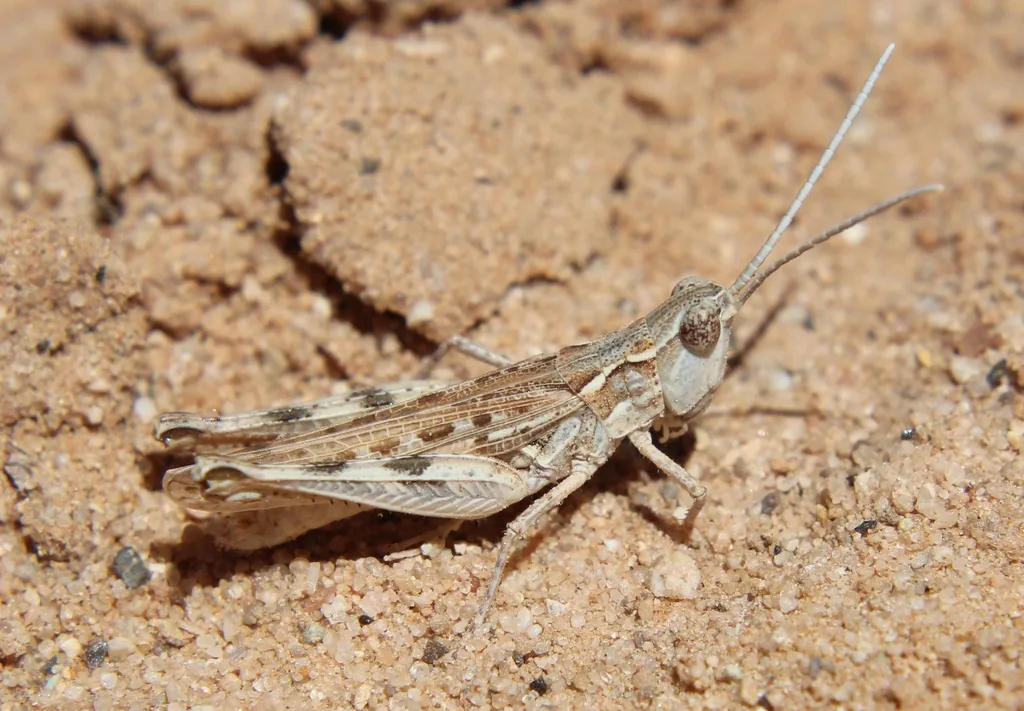
- A slim, rather fragile-looking grasshopper, tan and gray to red-brown with white or ivory markings. Males are 15 to 21 mm long and females 22 to 27 mm.[1][2]
- The forewings are spotted with brown, which gives the species its name, and carry an ivory streak above the base of the hind leg. The hind wings are clear and the hind shins pale orange.[1][2]
- A dark brown stripe starts behind the middle of the eye and runs along the side of the head onto the side of the pronotum. The low side ridges on top of the pronotum are picked out in ivory.[1]
- The face is strongly slanted and the antennae are slightly flattened, like a narrow sword blade.[1]
Look-alikes
| Look-alike | How to tell them apart |
|---|---|
| Crenulate-winged grasshopper (Cordillacris crenulata) | Smaller (males 11 to 14 mm, females 14 to 21 mm), with a different forewing pattern. Its white patch on the side of the pronotum reaches up beside the back of the head; in the spotted-winged grasshopper it does not.[2] |
Where it lives
Grasslands of western North America, including mixed-grass, shortgrass, desert and bunchgrass prairie. It is most common on sandy to loamy soils and scarce or absent where soils are heavier. In Nebraska it occurs across the western two-thirds of the state.[1][2]
Biology and life cycle
It eats green grass leaves, mostly blue grama, needleandthread, western wheatgrass, sand dropseed, downy brome and threadleaf and needleleaf sedges. It climbs a stem and feeds facing downward, holding the leaf with its front feet, and rarely touches forbs.[1][2]
It is one of the first grasshoppers to hatch in spring, about five to seven days ahead of the bigheaded grasshopper, and hatching spreads over about four weeks. Adults are most common from late June to mid-August.[1][2]
Males attract females with a stridulating song and then signal by raising and lowering their antennae and tipping their hind legs. Mating and egg laying usually happen in the morning.[1]
The egg pod is shaped like a tiny test tube, about three-eighths of an inch long, and holds only two or three eggs. Pods sit in the top half inch of soil, where the eggs survive summer heat and drought but are dug up by birds, rodents, beetles and bee flies.[1]
Adults bask flat on the ground in the morning. When midsummer air rises above about 90°F they climb small shrubs such as fringed sagebrush and rest in the shade a few inches up, then feed again later in the afternoon.[1]
Damage and signs
- It is a pest of range grasses. At one to five per square yard, the usual level on mixed-grass and shortgrass prairie, it adds to the damage done by the dominant species.[1][2]
- On sandy loam its numbers can double each year for three years and then jump three- or fourfold. In a 1974 eastern Wyoming outbreak it was the leading species at 20 per square yard, ahead of the whitewhiskered, bigheaded and striped grasshoppers.[1]
Health risk
It is a grass-feeding grasshopper, and the sources describe no health concerns for people.[1][2]
Control
Prevention
Watch range on sandy loam soils, where it builds to outbreak numbers. Before spending money on treatment, compare the value of the forage at stake with the losses you expect.[1][3]
Biological control
Birds, rodents, spiders, insect predators and parasites prey on adults, and ARS researchers suspect changes in predation of adults help explain its sudden increases.[1]
Pesticides
There is no information on whether it feeds on bran bait, and a bait only works on grasshoppers that eat it. Follow any product label.[1][3]
Common questions
- What is the small grasshopper with spotted wings and a dark stripe behind the eye?
- On western grassland it is likely the spotted-winged grasshopper. Look for brown spots on the forewings, a brown stripe from behind the eye onto the side of the thorax, and pale orange hind shins.[1]
- Is the spotted-winged grasshopper a serious pest?
- It can be on sandy loam range, where it sometimes leads outbreaks. Because it weighs about half as much as a bigheaded grasshopper and feeds the same way, each one is assumed to do about half the damage.[1]
Sources
- USDA Agricultural Research Service, Northern Plains Agricultural Research Laboratory, “Spottedwinged Grasshopper, Cordillacris occipitalis (Thomas): species fact sheet, Grasshoppers: Their Biology, Identification and Management.” www.ars.usda.gov/plains-area/sidney-mt/northern-plains-agricultural-research-laboratory/pest-management-research/pmru-docs/grasshoppers-their-biology-identification-and-management/id-tools-apps/fact-sheets/gomphocerinae-subfamily/fs-spottedwinged/ (accessed 2026-11-09)
- University of Nebraska-Lincoln Extension, “The Grasshoppers (Orthoptera: Acrididae and Romaleidae) of Nebraska, EB3 (M. L. Brust, W. W. Hoback and R. J. Wright).” extensionpubs.unl.edu/publication/eb3/2009/pdf/view/eb3-2009.pdf (accessed 2026-11-09)
- Utah State University Extension, “Grasshoppers (E. Evans and E. Hodgson, June 2008).” extension.usu.edu/planthealth/research/grasshoppers (accessed 2026-11-09)
- iNaturalist, “Cordillacris occipitalis taxon page (order and family).” www.inaturalist.org/taxa/174211 (accessed 2026-11-09)