On this page
How to identify it
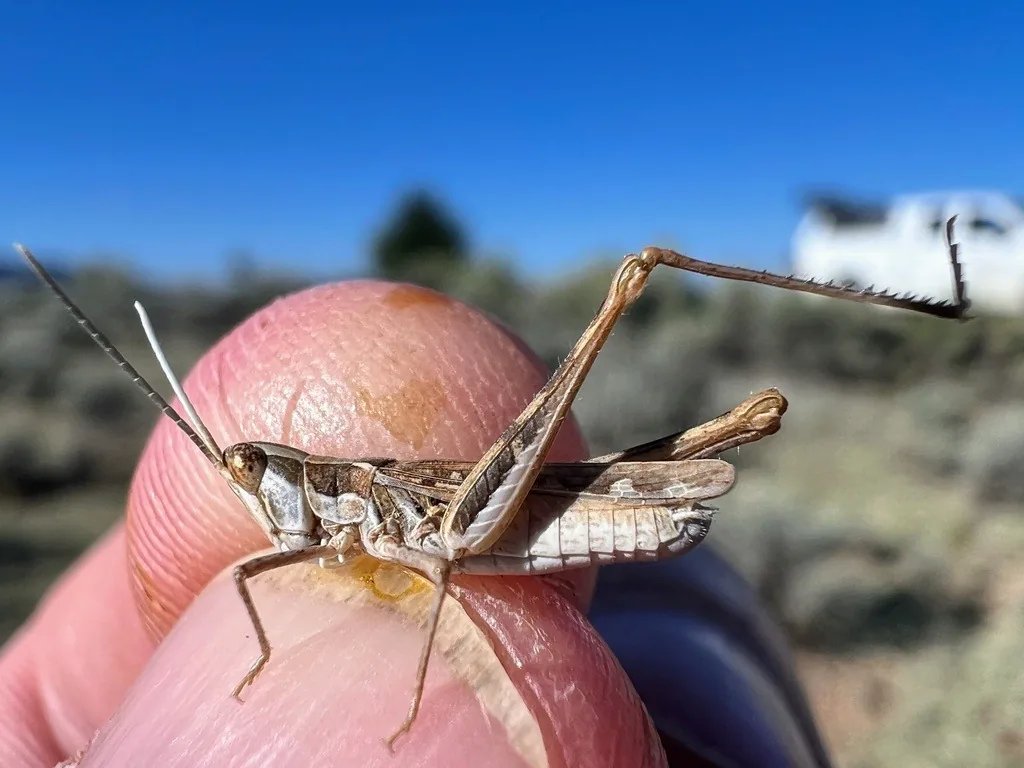
- Small, slender and fragile-looking, cream to brown or red-brown with brown and whitish stripes. Males are 11 to 14 mm long and females 14 to 21 mm.[1][2]
- Each forewing has a wide brown stripe with a scalloped (crenulate) edge, the mark that names it. The hind wings are clear.[1][2]
- A triangular brown stripe runs back from each eye. The side of the pronotum is brown above and cream below, and a cream wedge reaches up its front edge to separate the stripe behind the eye from the brown of the pronotum.[1][2]
- The hind shins are pale gray to yellowish with a dark ring near the end. Nymphs have a strongly slanted face, and in the first three stages their antennae are slightly flattened like a sword blade.[1]
Look-alikes
| Look-alike | How to tell them apart |
|---|---|
| Spotted-winged grasshopper (Cordillacris occipitalis) | Its close relative is larger, its forewing markings form spots rather than a scalloped stripe, and the white patch on the lower side of its pronotum does not reach up beside the back of the head. It also hatches three to four weeks earlier.[1][2] |
Where it lives
Western grasslands: most abundant in shortgrass and desert prairie and on heavily grazed upland mixed-grass sites, extending west through bunchgrass prairie and shrub-grass country to Nevada and California. It needs short stands of grass, usually blue grama with bare ground between plants, and stays out of tallgrass prairie and dense mid grasses. In Nebraska it is scarce, recorded from six counties in the panhandle and southwest.[1][2]
Biology and life cycle
Blue grama is its main food. In eastern Colorado shortgrass prairie it made up over 99 percent of what nymphs had eaten and over 96 percent for adults. In Montana it also feeds heavily on threadleaf sedge, and where blue grama is missing it gets by on other grasses; in a southwest Texas desert prairie its diet also included hairy grama, buffalograss, burrograss and a little flax.[1][2]
A hungry one wanders the ground waving its antennae and shaking its hind legs, tasting blue grama leaves until it finds one it likes. It climbs a short way up, turns head down, and eats from just below the tip toward the base, leaving a thin strip of leaf to cling to.[1]
Eggs probably start developing as soon as they are laid in summer, reach an advanced stage by fall, and spend the winter in the top half inch of soil. Hatching comes in mid May in Arizona desert prairie and in the first half of June in eastern Wyoming and north-central Colorado. Nymphs take 30 to 43 days, usually through four stages, and adults appear in July.[1]
Females lay only two or three eggs at a time and make no pod around them. Both females that were watched laying bored into old crowns of blue grama. The eggs are pale yellow and 5 to 5.5 mm long.[1]
It spends the night in blue grama crowns or in litter under the grass and starts basking about 90 minutes after sunrise. When the soil surface gets very hot it climbs a quarter inch to an inch up a grass leaf, head up, or perches on top of the blue grama facing the sun.[1]
Damage and signs
- It eats the green leaves of blue grama, a forage grass livestock prefer, so it adds slightly to the damage when it is part of an outbreak. It made up 1 to 4 percent of some outbreak populations on the northern mixed-grass prairie and occasionally becomes the most abundant species, at up to eight adults per square yard.[1]
- It has caused considerable damage to threadleaf sedge in Montana, and in Arizona it was seen destroying young grass on newly seeded range. Because it is small and usually sparse, at 0.05 to 1 young adult per square yard, it is seldom a serious pest, and in Nebraska it is probably of no economic importance.[1][2]
Health risk
This small grasshopper feeds only on grasses and sedges, and none of the sources report any danger to people.[1][2]
Control
Prevention
On its own it is seldom a serious pest. Judge any grasshopper control by weighing the forage value of the land against the damage the whole grasshopper population is likely to do.[1][3]
Biological control
Heavy, repeated insecticide use can backfire: Utah State's guide cites Wyoming evidence that outbreaks became more frequent where spraying was most intensive, possibly because it disrupts the grasshoppers' natural enemies.[3]
Common questions
- What is the grasshopper with wavy stripes on its wings?
- On western shortgrass range, a small, slender cream and brown grasshopper with a wide, scalloped brown stripe along each forewing is the crenulate-winged grasshopper.[1][2]
- Does the crenulate-winged grasshopper lay egg pods?
- No. Unlike most grasshoppers, the female lays just two or three eggs at a time without a protective pod; females that were watched laid in old crowns of blue grama.[1]
Sources
- USDA Agricultural Research Service, Northern Plains Agricultural Research Laboratory, “Crenulatewinged Grasshopper, Cordillacris crenulata (Bruner): species fact sheet, Grasshoppers: Their Biology, Identification and Management.” www.ars.usda.gov/plains-area/sidney-mt/northern-plains-agricultural-research-laboratory/pest-management-research/pmru-docs/grasshoppers-their-biology-identification-and-management/id-tools-apps/fact-sheets/gomphocerinae-subfamily/fs-crenulatewinged/ (accessed 2026-11-09)
- University of Nebraska-Lincoln Extension, “The Grasshoppers (Orthoptera: Acrididae and Romaleidae) of Nebraska, EB3 (M. L. Brust, W. W. Hoback and R. J. Wright).” extensionpubs.unl.edu/publication/eb3/2009/pdf/view/eb3-2009.pdf (accessed 2026-11-09)
- Utah State University Extension, “Grasshoppers (E. Evans and E. Hodgson, June 2008).” extension.usu.edu/planthealth/research/grasshoppers (accessed 2026-11-09)
- iNaturalist, “Cordillacris crenulata taxon page (order and family).” www.inaturalist.org/taxa/174213 (accessed 2026-11-09)