On this page
How to identify it
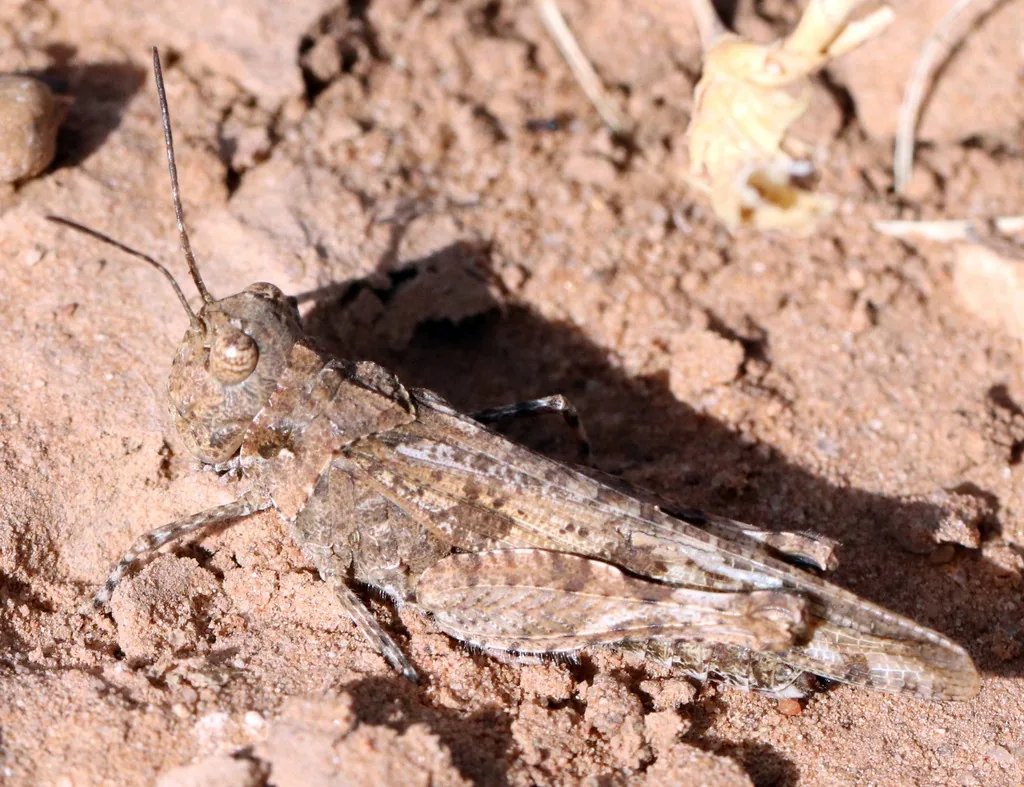
- Medium-sized, mottled gray, brown and black. Males are 14 to 20 mm long and females 19 to 26 mm, and the hind shins are light blue.[1][2]
- The upper edge of the hind thigh rises in a high keel, the fin that names it, and the inner face of the thigh is mostly black with a single light crossbar.[1]
- The hind wing is pale yellowish with a large dark band covering most of its outer half, often reaching the tip.[1][2]
- Nymphs are short and robust, brown with black markings, with a nearly vertical face. The eye is dark on its lower third and tan with three dark diagonal stripes above, and first-stage nymphs have a strikingly black outer hind thigh.[1]
Look-alikes
| Look-alike | How to tell them apart |
|---|---|
| Kiowa grasshopper (Trachyrhachys kiowa) | Its hind wing is mostly clear, the inner hind thigh has two light bars instead of one, the keel on the thigh is low, and the lower rear corner of the pronotum's side is pointed and drawn down rather than square. Its nymphs hatch about four weeks earlier.[1][2] |
Where it lives
Shortgrass prairie from Wyoming and Nebraska south to central Mexico, and to a lesser extent desert prairie and the western edge of mixed-grass prairie. It is spotty in the north, often confined to a few acres of favorable blue grama, and widespread but sparse in New Mexico. In Nebraska it has been collected in several panhandle counties.[1][2]
Biology and life cycle
It eats blue grama almost exclusively. In Colorado 12 of 13 adults examined had eaten only blue grama, and in cage tests it chose blue grama over western wheatgrass, red threeawn, downy brome and threadleaf sedge. It eats a green leaf from tip to base, and when it clips a piece off it holds on and finishes it, dropping only the dry tip.[1][2]
In north-central Colorado eggs hatch over 7 to 10 days starting in the first week of July. Nymphs take 47 to 58 days, and adults appear in the last two weeks of August and live through October.[1][2]
Females make no egg pod. Caged females laid loose clutches of 12 to 18 eggs, lightly coated with froth, a quarter inch to an inch and a quarter deep in small bare spots between grama plants. They laid only when given short days, which suggests that shortening late-summer days trigger egg development.[1]
It handles heat poorly. On clear days it stands up on its legs once the ground reaches about 115°F, then climbs about an inch onto grama and faces the sun, staying inactive from late morning to late afternoon. One female was seen feeding after sunset.[1]
It is a stay-at-home species: flushed adults fly only 3 to 4 feet, and populations stay in the same favorable patches of range year after year.[1]
Damage and signs
- Because it eats blue grama, a key livestock forage, it adds to grass losses during grasshopper outbreaks even when it is a minor member of the population. ARS estimated that one young adult per square yard would remove about 20 pounds of dry forage per acre in a year.[1]
- It rarely gets that numerous. Densities in Colorado ran from about a quarter to three-quarters of a young adult per square yard, and the Cooperative Economic Insect Survey, which recorded damaging Kiowa grasshopper numbers in 19 years between 1951 and 1980 never mentioned the finned grasshopper. Nebraska's guide calls it unlikely to damage range.[1][2]
Health risk
A blue grama feeder that keeps to open range; none of the sources describe any health hazard.[1][2]
Control
Prevention
It is seldom abundant and has no known outbreaks, so it does not call for control on its own. When a mixed grasshopper population builds up, weigh the forage value of the range against the expected damage before deciding to treat.[1][2][3]
Common questions
- How do I tell a finned grasshopper from a Kiowa grasshopper?
- Spread the hind wing: the finned grasshopper's has a large dark band, while the Kiowa's is mostly clear. The finned grasshopper also has a tall keel on top of the hind thigh and only one light bar on the inner thigh.[1][2]
- Why do I only see finned grasshoppers in late summer?
- In Colorado it hatches in July and does not become adult until late August, then lives into October. Because the adults appear so late in the season, it can be overlooked by anyone looking for grasshoppers earlier in the year.[1][2]
Sources
- USDA Agricultural Research Service, Northern Plains Agricultural Research Laboratory, “Finned Grasshopper, Trachyrhachys aspera Scudder: species fact sheet, Grasshoppers: Their Biology, Identification and Management.” www.ars.usda.gov/plains-area/sidney-mt/northern-plains-agricultural-research-laboratory/pest-management-research/pmru-docs/grasshoppers-their-biology-identification-and-management/id-tools-apps/fact-sheets/oedipodinae-subfamily/fs-finned/ (accessed 2026-11-09)
- University of Nebraska-Lincoln Extension, “The Grasshoppers (Orthoptera: Acrididae and Romaleidae) of Nebraska, EB3 (M. L. Brust, W. W. Hoback and R. J. Wright).” extensionpubs.unl.edu/publication/eb3/2009/pdf/view/eb3-2009.pdf (accessed 2026-11-09)
- Utah State University Extension, “Grasshoppers (E. Evans and E. Hodgson, June 2008).” extension.usu.edu/planthealth/research/grasshoppers (accessed 2026-11-09)
- iNaturalist, “Trachyrhachys aspera taxon page (order and family).” www.inaturalist.org/taxa/232777 (accessed 2026-11-09)