On this page
How to identify it
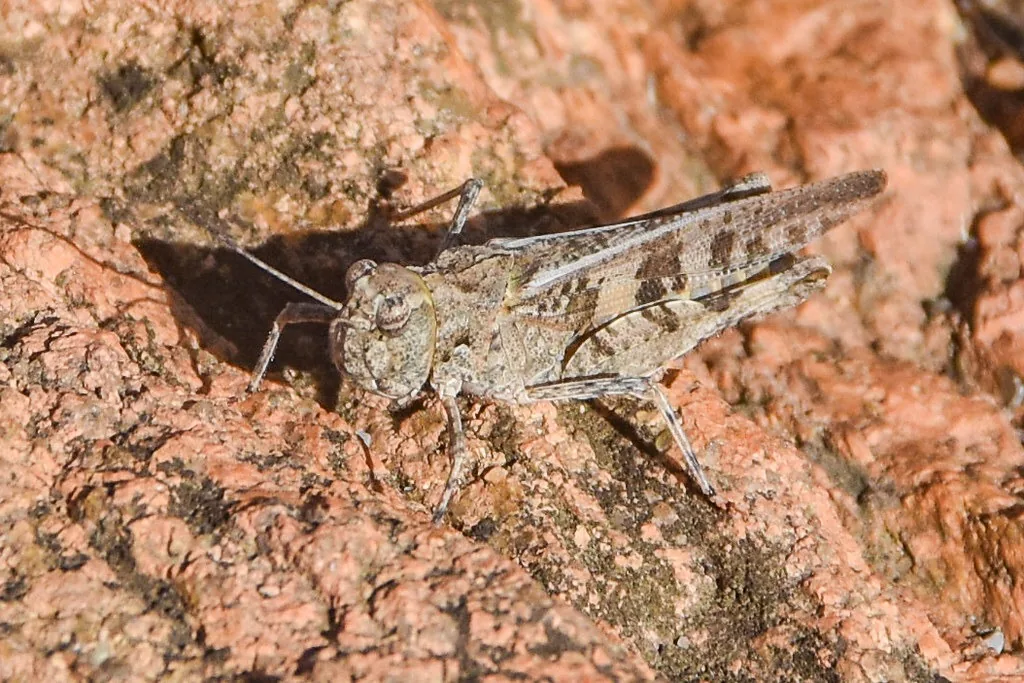
- A medium-sized grasshopper, tan to gray-brown (occasionally pale green) with darker patches. Males are 14 to 21 mm long and females 20 to 26 mm.[1][3]
- Each forewing has two or three large dark brown blotches in the middle and many small spots at both ends. The hind wing is nearly clear, usually with no more than a trace of a dark band.[1][3]
- The lower edge of the hind thigh has a fringe of long hairs, 3 to 5 mm long. The inner face of the thigh is dark with two pale yellow bands, and the hind shin is blue.[1][3]
- Seen from the side, the lower rear corner of the pronotum is drawn down into a sharp point.[1]
Look-alikes
| Look-alike | How to tell them apart |
|---|---|
| Finned grasshopper (Trachyrhachys aspera) | Often lives in the same places and looks very similar. The finned grasshopper has a large black band on the hind wing, a right-angled (not drawn-down) lower rear corner on the pronotum, and only one light bar on the mostly black inner hind thigh.[2] |
Where it lives
Widespread in North America wherever grassland is short and sparse, especially where blue grama dominates. The largest populations are in mixedgrass, shortgrass and desert prairie; in tallgrass country it is found on hilltops and on overgrazed or disturbed ground. It occurs over nearly all of Nebraska but becomes rare in the east.[1][3]
Biology and life cycle
Blue grama is its main food, making up 84 to 100 percent of the diet in mixedgrass and shortgrass prairie. It also eats western wheatgrass, needleandthread, Kentucky bluegrass and several sedges.[1][3]
Eggs hatch in the first half of June in eastern Wyoming and eastern Colorado, about two weeks after the bigheaded grasshopper, and hatching lasts two to four weeks. Nymphs take 37 to 53 days to mature, and adults are most common from mid-July to September.[1][3]
Females lay eggs in bare ground close to plants. The pods are small, about an inch and a quarter long with only 8 to 10 eggs.[1]
It spends its life on the ground, basking in the morning and climbing just half an inch to an inch up grass stems when the soil surface heats to about 130 degrees F.[1]
Its long wings make it a wanderer: a migrating swarm was recorded flying over Overton, Nebraska, in July 1936.[1]
Damage and signs
- It feeds on high-quality forage grasses and often forms part of the grasshopper outbreaks that damage mixedgrass prairie. Numbers can stay low for five years or more, then jump three- to sevenfold in a single year together with species such as the bigheaded and whitewhiskered grasshoppers.[1][3]
- Large numbers of Kiowa grasshoppers can be a sign that land is overgrazed.[3]
Health risk
The sources describe a grass-feeding range grasshopper and give no health concerns for people.[1][3]
Control
Pesticides
Skip bran bait for this species: laboratory and field evidence show that the Kiowa grasshopper does not eat it.[1]
Grasshoppers move readily, so where an outbreak needs treatment, coordinated area-wide programs generally work better than spot treatments. Follow label directions.[4]
Common questions
- Will grasshopper bait work on Kiowa grasshoppers?
- Bran bait will not. ARS reports laboratory and field evidence that this species does not feed on it.[1]
- How do I tell a Kiowa grasshopper from a finned grasshopper?
- Look at the hind wing in flight: mostly clear in the Kiowa, broadly banded with black in the finned grasshopper. The Kiowa also has two light bars on the inner hind thigh where the finned has one.[1][2]
Sources
- USDA Agricultural Research Service, Northern Plains Agricultural Research Laboratory, “Kiowa Grasshopper, Trachyrhachys kiowa (Thomas): species fact sheet, Grasshoppers: Their Biology, Identification and Management.” www.ars.usda.gov/plains-area/sidney-mt/northern-plains-agricultural-research-laboratory/pest-management-research/pmru-docs/grasshoppers-their-biology-identification-and-management/id-tools-apps/fact-sheets/oedipodinae-subfamily/fs-kiowa/ (accessed 2026-11-09)
- USDA Agricultural Research Service, Northern Plains Agricultural Research Laboratory, “Finned Grasshopper, Trachyrhachys aspera Scudder: species fact sheet, Grasshoppers: Their Biology, Identification and Management.” www.ars.usda.gov/plains-area/sidney-mt/northern-plains-agricultural-research-laboratory/pest-management-research/pmru-docs/grasshoppers-their-biology-identification-and-management/id-tools-apps/fact-sheets/oedipodinae-subfamily/fs-finned/ (accessed 2026-11-09)
- University of Nebraska-Lincoln Extension, “The Grasshoppers (Orthoptera: Acrididae and Romaleidae) of Nebraska, EB3 (M. L. Brust, W. W. Hoback and R. J. Wright).” extensionpubs.unl.edu/publication/eb3/2009/pdf/view/eb3-2009.pdf (accessed 2026-11-09)
- Utah State University Extension, “Grasshoppers (E. Evans and E. Hodgson, June 2008).” extension.usu.edu/planthealth/research/grasshoppers (accessed 2026-11-09)
- iNaturalist, “Trachyrhachys kiowa taxon page (order and family).” www.inaturalist.org/taxa/232779 (accessed 2026-11-09)