On this page
How to identify it
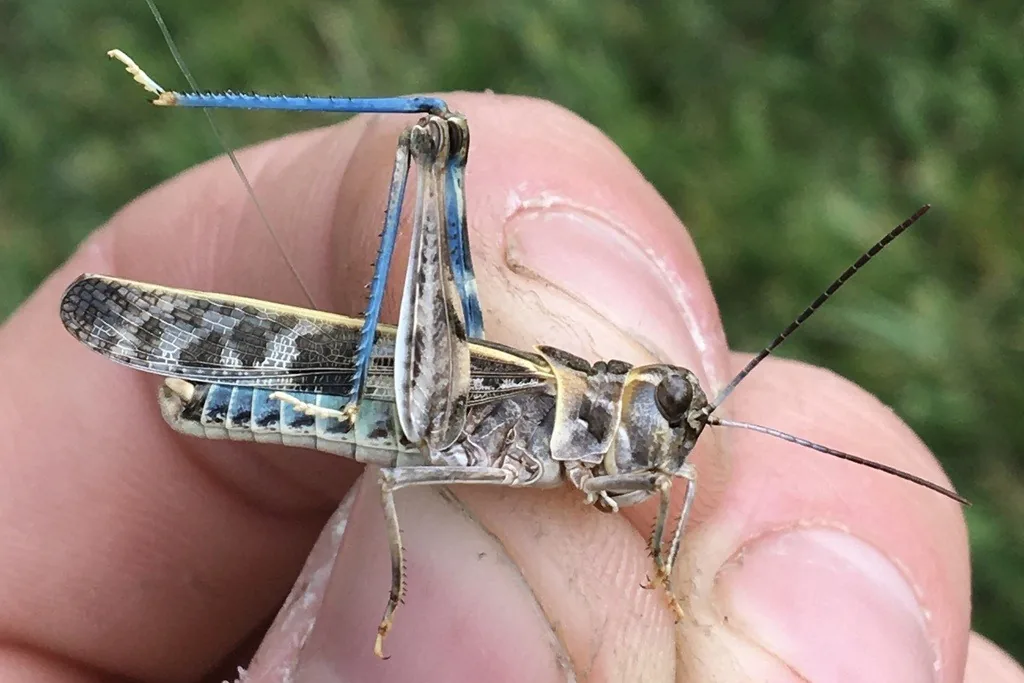
- A large tan, gray-brown and brown grasshopper with many dark spots. Males are 24 to 37 mm long and females 30 to 44 mm; on northern mixed-grass prairie, live females averaged nearly three times the weight of males.[1][2]
- The inner face of the hind thigh has alternating light and dark blue bands, and the hind shins are blue. Males often have a blue tinge on the top and sides of the abdomen; the underside of the abdomen is yellow.[1][2]
- The hind wings are yellow, orange or red at the base with a wide dark band toward the edge.[1][2]
- Each forewing has a pale streak along its upper edge, and when the wings are folded the two streaks come together toward the rear. The lower rear corner of the pronotum's side lobe is sharply pointed and drawn downward.[1][2]
- Nymphs are dark brown overall. A pale band runs diagonally back from near the top of each eye across the back of the head; the two bands converge but do not meet.[1]
Look-alikes
| Look-alike | How to tell them apart |
|---|---|
| Kiowa grasshopper (Trachyrhachys kiowa) | Kiowa nymphs carry a thick fringe of hairs along the lower edge of the hind thigh; blue-legged nymphs have only sparse hairs there.[1] |
Where it lives
Western North America, in shortgrass, mixed-grass, bunchgrass, desert and tallgrass prairie. Its highest numbers are on northern mixed-grass prairie where western wheatgrass dominates. In Nebraska it has been collected in every panhandle county and two central counties, scattered but fairly common where it occurs.[1][2]
Biology and life cycle
It eats grasses and sedges almost exclusively, including western wheatgrass, bluebunch wheatgrass, needleandthread, green needlegrass, sand dropseed, junegrass and blue grama. It also nibbles dry grass litter, dry cattle droppings and a small mat-forming lichen, which can make it look as if it is eating soil.[1][2]
Its way of feeding is unusual. An adult climbs a grass plant, cuts off the top 3 to 4 inches of a leaf, drops to the ground after it, and eats the piece from end to end while holding it in its front feet.[1]
Eggs hatch two to three weeks after those of the bigheaded grasshopper, in June on the northern plains. Nymphs pass through five instars in about 36 days, and adults are most common from early July into September.[1][2]
A female pushes her abdomen about 2 inches into bare or litter-covered soil and lays a clutch of about 14 large reddish brown eggs, then tamps and brushes the hole closed. There is one generation a year.[1]
Adults are strong fliers and wander; stray individuals have turned up in Colorado's mountains as high as 11,400 feet. When drought dried a Wyoming wheatgrass flat in July 1989, the blue-legged grasshoppers left while bigheaded grasshoppers stayed. In Montana older nymphs and adults gather in groups.[1]
Damage and signs
- It feeds heavily on native grasses, especially western wheatgrass. A Montana study put the loss at roughly 100 pounds of air-dry grass per acre for each grasshopper per square yard, though the ARS authors consider that figure unusually high.[1]
- Usual densities in its favored habitat are one to four adults per square yard, sometimes ten, and it typically does its damage alongside the bigheaded or whitecrossed grasshopper. Nebraska's guide lists no economic importance there, where it is localized.[1][2]
Health risk
It is a grass-feeding grasshopper, and the sources describe no health concerns for people.[1][2]
Control
Prevention
Because it concentrates in western wheatgrass flats, playas and valley bottoms, check those spots first when scouting range. Compare the value of the forage with the expected loss before treating.[1][3]
Biological control
A parasitic fly, the tangle-veined fly Trichopsidea clausa, infests up to 80 percent of females in some years. Its larva eats the female's eggs and soft tissues, so she cannot reproduce, and she dies when the larva leaves.[1]
Pesticides
Bran bait is a poor choice: a population treated with carbaryl bran bait dropped by only 2 percent, even though the grasshopper feeds on litter at ground level. A bait only works on grasshoppers that eat it.[1][3]
Common questions
- What grasshopper has blue legs and red or yellow wings?
- On western prairie, a large mottled grasshopper with blue inner thighs and shins and a red, orange or yellow hind wing with a dark band is likely the blue-legged (pard) grasshopper.[1][2]
- Does grasshopper bait work on blue-legged grasshoppers?
- No. In a treated population, carbaryl bran bait reduced numbers by only 2 percent.[1]
Sources
- USDA Agricultural Research Service, Northern Plains Agricultural Research Laboratory, “Bluelegged Grasshopper, Metator pardalinus (Saussure): species fact sheet, Grasshoppers: Their Biology, Identification and Management.” www.ars.usda.gov/plains-area/sidney-mt/northern-plains-agricultural-research-laboratory/pest-management-research/pmru-docs/grasshoppers-their-biology-identification-and-management/id-tools-apps/fact-sheets/oedipodinae-subfamily/fs-bluelegged/ (accessed 2026-11-09)
- University of Nebraska-Lincoln Extension, “The Grasshoppers (Orthoptera: Acrididae and Romaleidae) of Nebraska, EB3 (M. L. Brust, W. W. Hoback and R. J. Wright).” extensionpubs.unl.edu/publication/eb3/2009/pdf/view/eb3-2009.pdf (accessed 2026-11-09)
- Utah State University Extension, “Grasshoppers (E. Evans and E. Hodgson, June 2008).” extension.usu.edu/planthealth/research/grasshoppers (accessed 2026-11-09)
- iNaturalist, “Metator pardalinus taxon page (order and family).” www.inaturalist.org/taxa/224992 (accessed 2026-11-09)