On this page
How to identify it
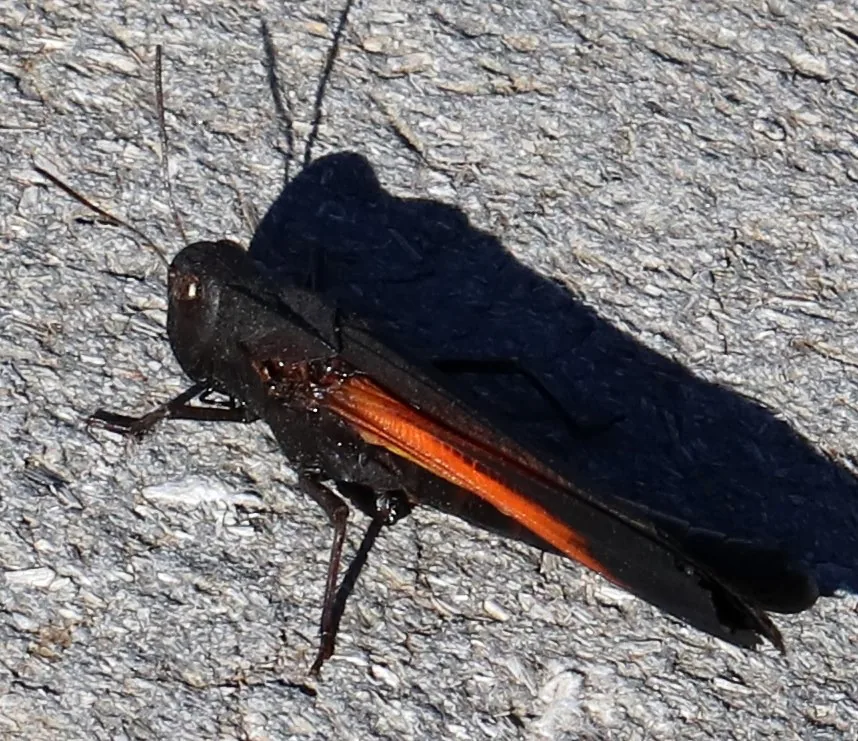
- A large, dark grasshopper, brown to nearly black, with darkly speckled forewings that match the body. Males are 17 to 24 mm long and females 25 to 35 mm.[1][3]
- The hind wings are scarlet red (rarely orange) with a broad black band along the outer edge. In Michigan, Wisconsin and Minnesota some local populations have yellow wings instead; farther west all have bright red wings.[1][3]
- The hind shins are dark brown to black with a pale yellow ring near the base. The outer face of the hind thigh is dark, often crossed by three tan bands.[1][3]
- Young nymphs are black with a large, rounded head; older nymphs are dull brown and black with a shiny black underside.[1]
Look-alikes
| Look-alike | How to tell them apart |
|---|---|
| Speckle-winged grasshopper (Arphia conspersa) | Its western relative with similar coloring is an adult in spring, while red-winged grasshopper adults are out in late summer and fall, so the two are separated by season.[2][1] |
| Arphia xanthoptera | Another Arphia species that can be confused with it; the Nebraska guide separates them by how strongly the crest on the pronotum is developed.[3] |
Where it lives
Widespread in North American grass and grass-shrub habitats and most abundant in mixedgrass prairie. In the east and north of its range it keeps to dry sandy or gravelly uplands and hilltops; in the west and southwest it lives in moister grassland. It occurs statewide in Nebraska, most commonly in the northern half.[1][3]
Biology and life cycle
Eggs appear to spend the winter about half developed and finish developing in spring. Hatching starts in late May in southern Idaho, around June 11 in western South Dakota and June 13 to 19 in eastern Wyoming and north-central Colorado, and lasts about two weeks.[1]
Nymphs go through five stages over 42 to 56 days. Adults appear from mid to late July and live a long time, staying in mixedgrass prairie from early August until late October.[1][3]
It feeds on at least 20 grasses and four sedges, mainly blue grama, western wheatgrass, buffalograss and needleleaf sedge, and occasionally a little of forbs such as cudweed sagewort.[1][3]
On sunny days males make display flights, rising nearly straight up about 4 feet and fluttering down with red wings flashing and a loud crackle. These flights bring the sexes together for mating.[1]
Females lay pods about 1 5/8 inches long in bare soil, each holding roughly 24 to 36 eggs.[1]
Damage and signs
- ARS rates it a minor pest of western grasslands, and the Nebraska guide gives it no economic importance. Numbers usually stay below one young adult per square yard and are not known to reach outbreak levels.[1][3]
- Because it is a large grasshopper, it adds to overall forage loss during general rangeland outbreaks. In fall, adults move into winter wheat fields near their grassland habitat and add to grasshopper damage there.[1]
Health risk
It is a grass- and sedge-feeding grasshopper; the sources describe no risk to people.[1][3]
Control
Prevention
No control aimed at this species is normally needed; it occurs at low numbers and is not known to reach outbreak densities.[1]
Where winter wheat borders native grassland, watch the field edges in fall, when adults wander in from nearby range.[1]
Biological control
Predators, parasites and diseases help hold grasshopper numbers down every year.[4]
Common questions
- What is the dark grasshopper that flashes red wings and crackles when it flies?
- In late summer and fall grasslands it is very likely the red-winged grasshopper. Its dark body hides it on the ground, and its scarlet, black-bordered hind wings and loud crackle show only in flight.[1][3]
- Why did I find one on a sidewalk in town?
- Adults sometimes stray out of nearby range. ARS records them on a downtown Cheyenne sidewalk and on the University of Wyoming and Colorado State University campuses.[1]
Sources
- USDA Agricultural Research Service, Northern Plains Agricultural Research Laboratory, “Redwinged Grasshopper, Arphia pseudonietana (Thomas): species fact sheet, Grasshoppers: Their Biology, Identification and Management.” www.ars.usda.gov/plains-area/sidney-mt/northern-plains-agricultural-research-laboratory/pest-management-research/pmru-docs/grasshoppers-their-biology-identification-and-management/id-tools-apps/fact-sheets/oedipodinae-subfamily/fs-redwinged/ (accessed 2026-11-09)
- USDA Agricultural Research Service, Northern Plains Agricultural Research Laboratory, “Specklewinged Grasshopper, Arphia conspersa Scudder: species fact sheet, Grasshoppers: Their Biology, Identification and Management.” www.ars.usda.gov/plains-area/sidney-mt/northern-plains-agricultural-research-laboratory/pest-management-research/pmru-docs/grasshoppers-their-biology-identification-and-management/id-tools-apps/fact-sheets/oedipodinae-subfamily/fs-specklewinged/ (accessed 2026-11-09)
- University of Nebraska-Lincoln Extension, “The Grasshoppers (Orthoptera: Acrididae and Romaleidae) of Nebraska, EB3 (M. L. Brust, W. W. Hoback and R. J. Wright).” extensionpubs.unl.edu/publication/eb3/2009/pdf/view/eb3-2009.pdf (accessed 2026-11-09)
- Utah State University Extension, “Grasshoppers (E. Evans and E. Hodgson, June 2008).” extension.usu.edu/planthealth/research/grasshoppers (accessed 2026-11-09)
- iNaturalist, “Arphia pseudonietana taxon page (order and family).” www.inaturalist.org/taxa/1566795 (accessed 2026-11-09)