On this page
How to identify it
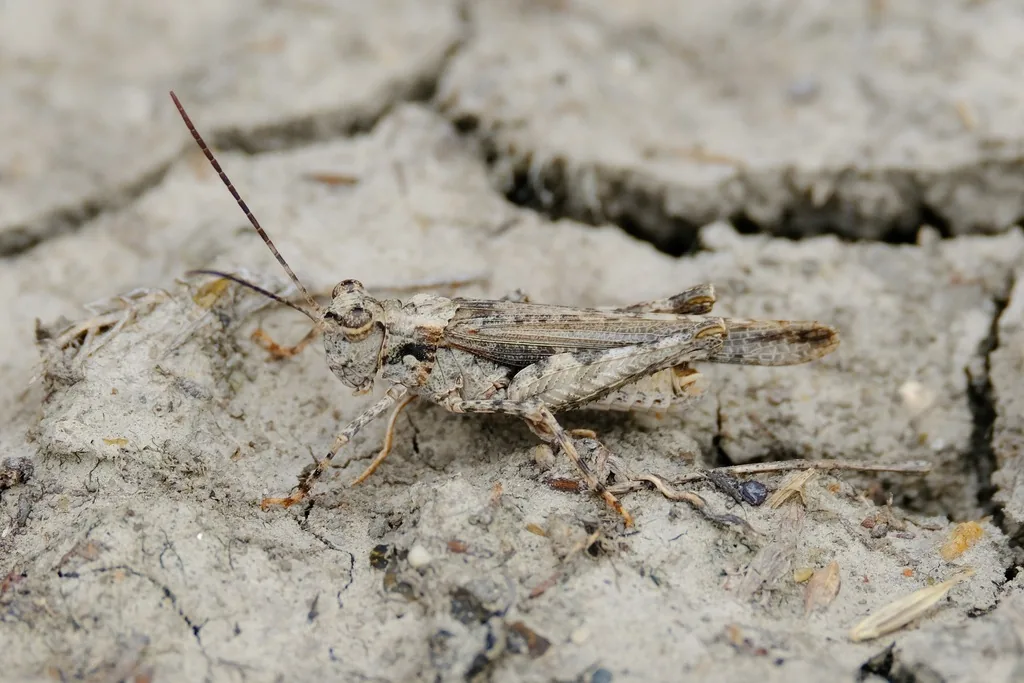
- A medium-sized, tan, brown or gray-brown grasshopper with noticeably bulging eyes. Males are 14 to 20 mm long and females 21 to 26 mm.[1][2]
- The forewings are covered with dark spots. The hind wings are red, pinkish or yellow at the base with a broad blackish band running from the front edge to the rear edge.[1][2]
- The top of the pronotum is rough with ridges and small knobs, its center ridge is notched twice, and its rear edge comes to an angle. The antennae are threadlike, and the hind shins are pale.[1][2]
- Young nymphs are distinctive: the first instar has four shiny black knobs on the front of the head and two on the pronotum, a black patch behind each eye and a pale band around the head. The knobs fade by the third molt. Older nymphs have a cream or tan underside with a pair of rust-colored spots on each segment.[1]
Look-alikes
| Look-alike | How to tell them apart |
|---|---|
| Longhorned band-winged grasshopper (Psinidia fenestralis) | Similar, but its antennae are not plain and threadlike, and the dark band on its hind wing has a different shape.[2] |
| Platte range grasshopper (Mestobregma plattei) | Easily confused with the Hayden grasshopper, but larger (males 19 to 32 mm, females 26 to 39 mm), with light blue hind shins; it lives in rocky spots in shortgrass prairie.[2] |
Where it lives
Western North America, in mixed-grass, shortgrass, desert and bunchgrass prairie, where it occupies patches with lots of bare soil. In Nebraska it is found throughout the panhandle and east to Thomas and Hitchcock Counties, on adobe flats and dry gravelly ground near sandbars.[1][2]
Biology and life cycle
It prefers forbs. On Colorado's Pawnee Grassland its crop contents were mostly plains bahia, with scarlet globemallow, needleleaf sedge and fringed sagebrush. In lab tests it chose dandelion over grasses, knotweed and Russian thistle, though it ate downy brome nearly as readily, and in Montana it has been seen eating purslane.[1][2]
It feeds from the ground, on dry plant litter and on green leaves lying flat.[1]
It hatches late, four to five weeks after the bigheaded grasshopper, in June in eastern Colorado and Wyoming. Nymphs take about 40 days and five molts, and because hatching is spread out, three different nymph stages can be present at once. Adults appear at the end of July and are active through August and September.[1][2]
Courtship is brief: the male tips his hind legs, stridulates one to three times and mounts. In the lab, females lay readily in bare soil, taking about an hour; each curved, inch-long pod holds 16 or 17 pale yellow eggs. There is one generation a year.[1]
It spends its whole day on the ground, basking in the morning and evening and moving into shade when the soil surface reaches about 120°F. Disturbed adults fly 2 to 6 feet, sometimes turning sharply in midair or dropping abruptly to the ground.[1]
Damage and signs
Health risk
It is a plant-feeding grasshopper, and the sources describe no health concerns for people.[1][2]
Control
Prevention
Treatment aimed at this species is not normally needed, since it is seldom found in large numbers and does little harm to forage. For grasshopper problems in general, weigh the value of the plants at risk against likely losses before treating.[1][2][3]
Common questions
- What is the grasshopper with red wings and big eyes in my vacant lot?
- In the western plains it may be the Hayden grasshopper, a band-winged species that favors bare, disturbed ground and has bulging eyes and red or yellow hind wings with a dark band.[1][2]
- Is the Hayden grasshopper a pest?
- No. It mostly eats forbs and stays at low numbers, so it does little damage to rangeland.[1][2]
Sources
- USDA Agricultural Research Service, Northern Plains Agricultural Research Laboratory, “Hayden Grasshopper, Derotmema haydeni (Thomas): species fact sheet, Grasshoppers: Their Biology, Identification and Management.” www.ars.usda.gov/plains-area/sidney-mt/northern-plains-agricultural-research-laboratory/pest-management-research/pmru-docs/grasshoppers-their-biology-identification-and-management/id-tools-apps/fact-sheets/oedipodinae-subfamily/fs-hayden/ (accessed 2026-11-09)
- University of Nebraska-Lincoln Extension, “The Grasshoppers (Orthoptera: Acrididae and Romaleidae) of Nebraska, EB3 (M. L. Brust, W. W. Hoback and R. J. Wright).” extensionpubs.unl.edu/publication/eb3/2009/pdf/view/eb3-2009.pdf (accessed 2026-11-09)
- Utah State University Extension, “Grasshoppers (E. Evans and E. Hodgson, June 2008).” extension.usu.edu/planthealth/research/grasshoppers (accessed 2026-11-09)
- iNaturalist, “Derotmema haydenii taxon page (order and family).” www.inaturalist.org/taxa/759029 (accessed 2026-11-09)