On this page
How to identify it
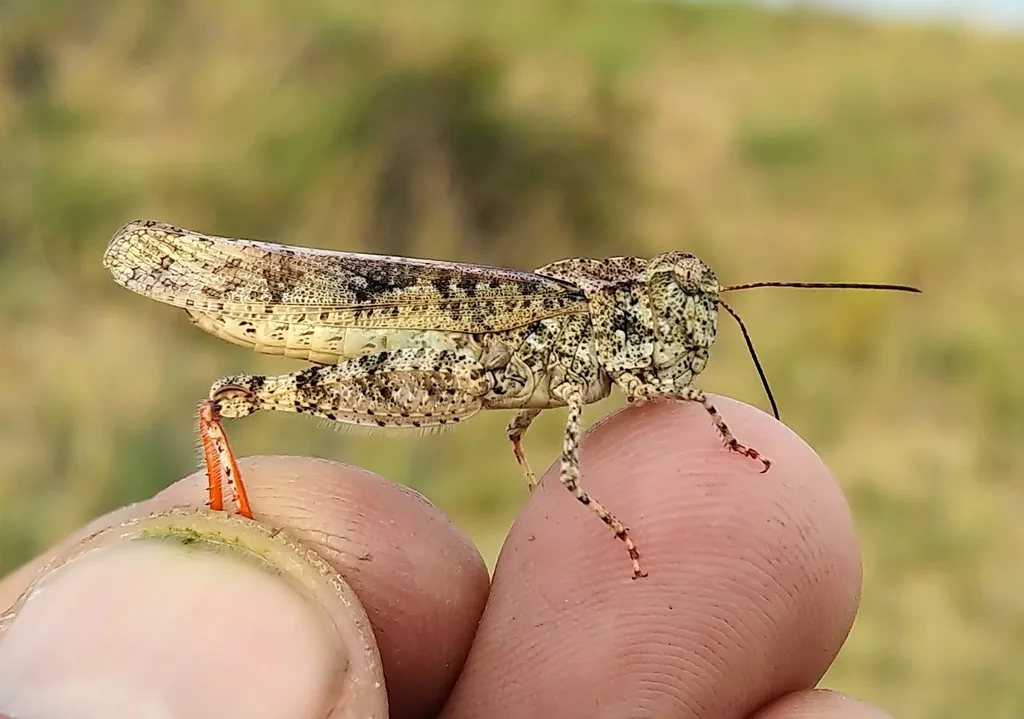
- A fairly large band-winged grasshopper, light brown to gray and strongly mottled or spotted with brown. Males are 19 to 27 mm long and females 23 to 32 mm.[1][2]
- The crest along the top of the pronotum is raised and is cut deeply by a single notch in front of the middle.[1][2]
- The hind wings are yellow at the base with a broad black band. The forewings are speckled, sometimes with faint bands.[1][2]
- The hind shins are deep orange to red. The inner face of the hind thigh is pale (yellowish to whitish) crossed by black bands.[1][2]
- Nymphs are tan and heavily spotted with brown, with a strongly raised crest on the pronotum.[1]
Look-alikes
| Look-alike | How to tell them apart |
|---|---|
| Orange-legged grasshopper (Spharagemon equale) | A close relative with similar orange shins and banded yellow hind wings. Its pronotal crest is low rather than high, and the inner face of its hind thigh is orange with two or three dark bands rather than pale. It is the common Spharagemon on loam and clay grassland, where the mottled sand grasshopper is rare.[1][3] |
Where it lives
Wide but patchy across North America, limited to sandy soils: sand prairie, vegetated dunes, blowouts and sandy banks of lakes and streams, plus disturbed sandy loam such as roadsides and wheat field edges. In Nebraska it occurs statewide where the soil is sandy and is especially common in the Sandhills.[1][2]
Biology and life cycle
It eats a broad mix of grasses, sedges and forbs, with blue grama, needleandthread, western wheatgrass, sand dropseed, witchgrass and threadleaf sedge eaten in large amounts, and kochia and Missouri milkvetch the forbs eaten most heavily. In Michigan it has been seen eating lettuce.[1][2]
It lives on the ground. Adults feed lying flat, pulling down leaves with their front feet or eating fallen leaves, seeds and litter, and they shelter at night under grass. When bare sand gets hot, around 105°F at the surface, they stand tall on their legs and then retreat to shade.[1]
Eggs lie about half an inch deep and hatch two to three weeks after those of Ageneotettix deorum, which often shares its sandy habitat; in the eastern Wyoming sand hills hatching runs from late May through mid-June. Nymphs need at least 42 days and five molts to mature, and adults are most common from mid-July to September.[1][2]
Females lay in bare sand close to plants. Pods are about three-quarters of an inch long and usually hold 21 to 28 eggs.[1]
It is a strong flier with wings well past the abdomen. Flushed adults in Michigan flew 50 to 100 feet, and strays have been caught as high as 12,200 feet in the Colorado mountains, about 22 miles from the nearest population.[1]
Damage and signs
Health risk
It is a plant-feeding grasshopper, and the sources describe no health concerns for people.[1][2]
Control
Prevention
Treatment aimed at this species is rarely warranted. Watch disturbed sandy ground such as roadsides and field edges, where it can build to higher numbers next to wheat or new grass seedings.[1]
Biological control
Birds keep it in check: in a Nebraska Sand Hills study, predation by grasshopper sparrows and meadowlarks significantly held down its numbers, and populations there stayed below 0.2 per square yard.[1]
Common questions
- What is the speckled grasshopper that flashes yellow wings on sandy ground?
- On dunes, blowouts and sandy roadsides it is often the mottled sand grasshopper, a sand-colored bandwing with yellow, black-banded hind wings and orange-red shins.[1][2]
- Do mottled sand grasshoppers damage gardens?
- They are mostly a minor rangeland species, though they have been recorded eating lettuce in Michigan and can damage wheat and grain on disturbed sandy ground.[1]
Sources
- USDA Agricultural Research Service, Northern Plains Agricultural Research Laboratory, “Mottled Sand Grasshopper, Spharagemon collare (Scudder): species fact sheet, Grasshoppers: Their Biology, Identification and Management.” www.ars.usda.gov/plains-area/sidney-mt/northern-plains-agricultural-research-laboratory/pest-management-research/pmru-docs/grasshoppers-their-biology-identification-and-management/id-tools-apps/fact-sheets/oedipodinae-subfamily/fs-mottled-sand/ (accessed 2026-11-09)
- University of Nebraska-Lincoln Extension, “The Grasshoppers (Orthoptera: Acrididae and Romaleidae) of Nebraska, EB3 (M. L. Brust, W. W. Hoback and R. J. Wright).” extensionpubs.unl.edu/publication/eb3/2009/pdf/view/eb3-2009.pdf (accessed 2026-11-09)
- USDA Agricultural Research Service, Northern Plains Agricultural Research Laboratory, “Orangelegged Grasshopper, Spharagemon equale (Say): species fact sheet, Grasshoppers: Their Biology, Identification and Management.” www.ars.usda.gov/plains-area/sidney-mt/northern-plains-agricultural-research-laboratory/pest-management-research/pmru-docs/grasshoppers-their-biology-identification-and-management/id-tools-apps/fact-sheets/oedipodinae-subfamily/fs-orangelegged/ (accessed 2026-11-09)
- iNaturalist, “Spharagemon collare taxon page (order and family).” www.inaturalist.org/taxa/129235 (accessed 2026-11-09)