On this page
How to identify it
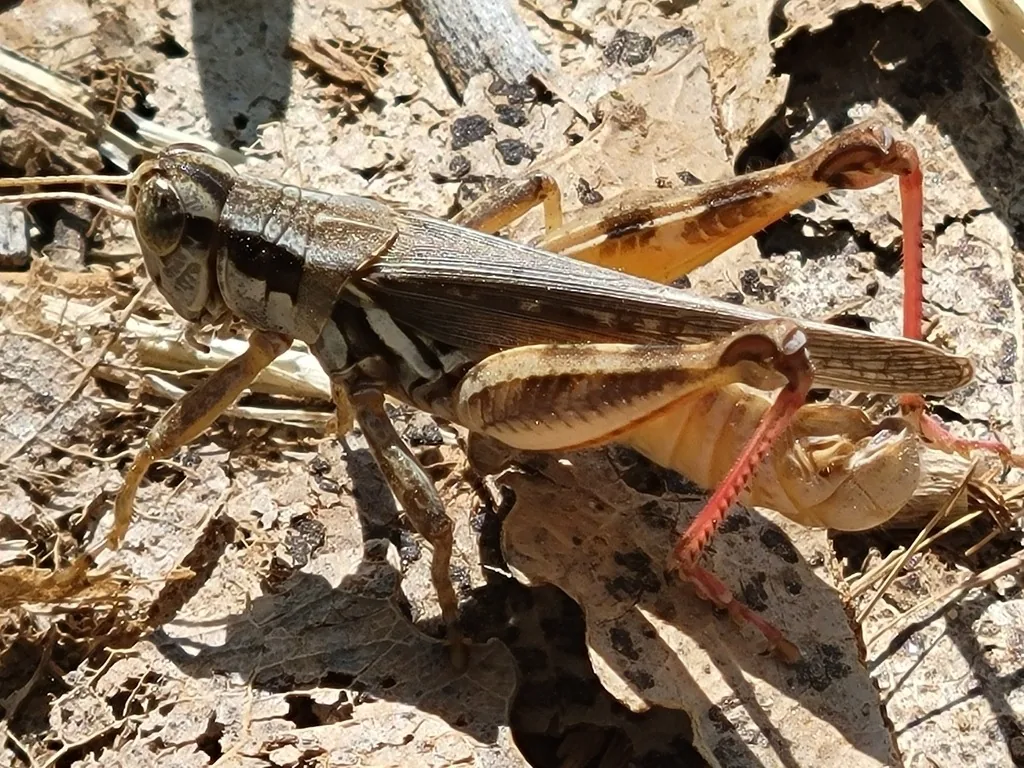
- A medium-sized spur-throated grasshopper, ranging from dull gray to bright yellow and tan. Males are 19 to 25 mm long and females 21 to 29 mm.[1][2]
- The hind shins are usually pinkish red but sometimes blue; blue-shinned ones are more common toward the Wyoming border.[1][2]
- The wings reach the end of the abdomen or a few millimeters beyond, and the hind wings are clear.[1][2]
- Males have distinctly spoon-shaped cerci (the small appendages at the tip of the abdomen), and the tip of the plate above them narrows abruptly. Females are best identified by matching them to males in the same collection.[1][2]
Look-alikes
| Look-alike | How to tell them apart |
|---|---|
| Packard grasshopper (Melanoplus packardii) | Males of both have spoon-shaped cerci, but the Packard grasshopper is consistently bigger (males 24 to 31 mm, females 26 to 37 mm), has two distinct pale stripes on top of the pronotum and usually blue shins, and prefers heavier soils.[2] |
Where it lives
Wide range in North America but local, confined to sand prairie and smaller patches of sandy ground. In Nebraska it is found mostly across the western two-thirds and is especially abundant in the Sandhills. In eastern Wyoming it turns up on sandy roadsides and Conservation Reserve Program land but not in the surrounding mixed-grass prairie.[1][2]
Biology and life cycle
It eats forbs, grasses, shrubs, moss, fungi and dead insects, but mostly forbs: about 62 percent of its diet on average versus 21 percent grass. Western ragweed, prairie sunflower, western sticktight and cudweed sagewort are main foods, and females have been found with their heads buried in sunflower blossoms.[1][2]
Given a choice, it picked sunflower petals, dandelion, downy brome and alfalfa over blue grama, western wheatgrass, sweetclover, kochia, lambsquarters and tumble mustard. It probably feeds heavily on grass only when its preferred forbs run out.[1]
It hatches early, in early to late May in eastern Wyoming, over about two weeks. Nymphs take 36 to 42 days and five molts to mature. Adults appear in the first half of July, are most common through September, and a few live into October.[1][2]
Females mature about two weeks after their final molt and lay curved pods of 12 to 18 eggs in bare sand, preferably close to plants.[1]
It spends most of the day on the ground, basking in the morning and hiding under litter at night. In weedy roadside sites many climb tall sunflower, ragweed and sweetclover instead.[1]
Damage and signs
- In sandy rangeland it can reach 15 adults per square yard, but because it prefers weedy forbs it may even be considered beneficial.[2]
- In 1978 it was the dominant species in a high-density outbreak in the Nebraska Sand Hills that alarmed ranchers; the outbreak ended by 1980. Populations that build up on roadsides and abandoned fields can threaten nearby winter wheat, and in Ontario it has damaged grain crops on sandy soil.[1]
Health risk
It is a plant-feeding grasshopper, and the sources describe no health concerns for people.[1][2]
Control
Prevention
Watch weedy roadsides, abandoned fields and Conservation Reserve Program land on sandy soil next to wheat. These are where populations build up, and checking such breeding grounds early in the season can head off severe crop infestations later.[1][3]
On rangeland, think before treating: because it prefers weedy forbs to grass, Nebraska's guide suggests it might be considered beneficial even when abundant.[2]
Common questions
- Does the narrow-winged sand grasshopper eat grass?
- Some, but mostly it eats broadleaf plants. Forbs averaged about 62 percent of its diet and grasses about 21 percent in crop studies from Nebraska, North Dakota and Colorado.[1]
- How do I tell it from other spur-throated grasshoppers?
- Size and the male's spoon-shaped cerci separate it. Only a few relatives share that cercus shape, and they are all consistently larger.[2]
Sources
- USDA Agricultural Research Service, Northern Plains Agricultural Research Laboratory, “Narrowwinged Sand Grasshopper, Melanoplus angustipennis (Dodge): species fact sheet, Grasshoppers: Their Biology, Identification and Management.” www.ars.usda.gov/plains-area/sidney-mt/northern-plains-agricultural-research-laboratory/pest-management-research/pmru-docs/grasshoppers-their-biology-identification-and-management/id-tools-apps/fact-sheets/melanoplinae-subfamily/fs-narrowwinged-sand/ (accessed 2026-11-09)
- University of Nebraska-Lincoln Extension, “The Grasshoppers (Orthoptera: Acrididae and Romaleidae) of Nebraska, EB3 (M. L. Brust, W. W. Hoback and R. J. Wright).” extensionpubs.unl.edu/publication/eb3/2009/pdf/view/eb3-2009.pdf (accessed 2026-11-09)
- Utah State University Extension, “Grasshoppers (E. Evans and E. Hodgson, June 2008).” extension.usu.edu/planthealth/research/grasshoppers (accessed 2026-11-09)
- iNaturalist, “Melanoplus angustipennis taxon page (order and family).” www.inaturalist.org/taxa/129255 (accessed 2026-11-09)