On this page
How to identify it
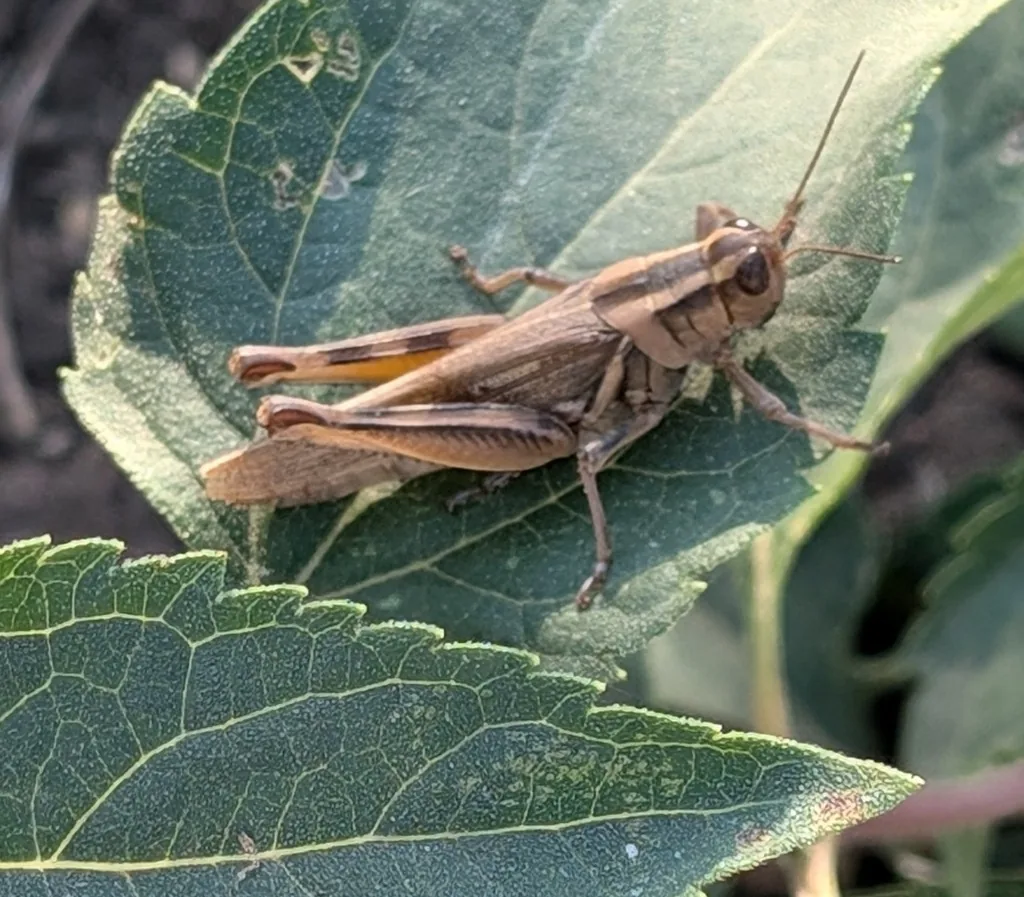
- Adults are about 1 to 1.5 inches long (males 24 to 31 mm, females 26 to 37 mm), patterned in tan, yellow-brown, olive and gray. Southern populations tend to be paler.[4][2][1]
- Two pale stripes run from just behind the eyes down the top of the head and the shield behind it (the pronotum). The forewings are plain gray without stripes and reach at least the tip of the abdomen.[1][2]
- The hind shins (tibiae) are usually blue or blue-green, sometimes red or purple, and the hind wings are clear.[4][1][2]
- Young nymphs are pale green to yellow-brown and sprinkled with small dark spots, as if dusted with pepper.[2]
Look-alikes
| Look-alike | How to tell them apart |
|---|---|
| Two-striped grasshopper | The two-striped grasshopper also has two distinct stripes along its back, but it is a larger, heavier grasshopper with a black stripe on the hind leg. Separating the Packard grasshopper from a close relative, Melanoplus foedus, requires examining the male's genitalia.[1][3] |
| Migratory grasshopper | The migratory grasshopper often shares crop fields and roadsides with the Packard grasshopper and usually outnumbers it in prairie crop outbreaks, with the Packard grasshopper typically third behind the migratory and two-striped grasshoppers.[1] |
Where it lives
Widespread in western North America, from the Canadian prairies south to Kansas and Oklahoma, and up to about 9,000 feet in mountain meadows. In Nebraska it occurs across most of the state but most consistently in the west. It is most abundant in the cooler, northern part of its range.[1][4]
Biology and life cycle
Eggs spend the winter in the soil. Females lay pods of about 16 to 29 eggs in bare ground, often in grain fields or along roadsides, mostly in August and September.[1][2]
It hatches early. In the mixedgrass prairie of eastern Montana and Wyoming, nymphs appear from May to early June, pass through five stages over about 47 to 63 days, and become adults in early July. There is one generation a year.[1][2]
Adults live about 50 days on average, and much of the population survives through August and September. They are strong fliers with long wings.[1]
It prefers broadleaf plants, especially scurfpeas, milkvetch, peavine and sweetclover, but also eats grasses, weeds and dead insects. Sandy soils and dry weather favor population increases.[1][2]
Damage and signs
- Because it favors wildflowers over grasses and usually stays at low numbers, it does little damage to rangeland.[1][4][2]
- In cropland it can be a serious pest of cereals, alfalfa and legume pastures and also damages garden crops. It has damaged fall rye and winter wheat in Alberta and has been recorded damaging cotton, vegetables, small grains and legumes in Oklahoma.[2][1]
- It is the second most important grasshopper pest in Alberta and the third in Saskatchewan, often as part of crop-damaging outbreaks along with the migratory and two-striped grasshoppers.[2][1]
Health risk
The sources describe it only as a crop and range grasshopper; they mention no harm to people.[1][2]
Control
Prevention
Control is often not needed. Treat only when numbers pass an economic threshold and the expected loss is greater than the cost of control; thresholds depend on the grasshopper's stage, the crop and its stage, and crop value.[3]
Scout weedy roadsides, fence rows and field edges, where this species can reach about six adults per square yard. The worst crop damage happens while grasshoppers are in their third to fifth nymphal stages.[1][3]
Biological control
After weather, natural enemies such as predators, parasites and diseases are the biggest check on grasshopper numbers, and control measures can harm them.[2][3]
Common questions
- Is the Packard grasshopper a problem in pastures?
- Usually not on native range, where it stays scarce and eats mostly wildflowers such as scurfpea. It is more of a problem in grain fields, alfalfa and legume pastures next to weedy or sandy ground.[1][2]
- When are Packard grasshoppers active?
- Nymphs hatch in spring, from early May onward, and adults are most common from mid-July through September.[2][4]
Sources
- USDA Agricultural Research Service, Northern Plains Agricultural Research Laboratory, “Packard Grasshopper, Melanoplus packardii Scudder: species fact sheet, Grasshoppers: Their Biology, Identification and Management.” www.ars.usda.gov/plains-area/sidney-mt/northern-plains-agricultural-research-laboratory/pest-management-research/pmru-docs/grasshoppers-their-biology-identification-and-management/id-tools-apps/fact-sheets/melanoplinae-subfamily/fs-packard/ (accessed 2026-11-09)
- Government of Alberta, “Packard's grasshopper.” www.alberta.ca/packards-grasshopper (accessed 2026-11-09)
- Government of Alberta, “Grasshoppers - Overview.” www.alberta.ca/grasshoppers-overview (accessed 2026-11-09)
- University of Nebraska-Lincoln Extension, “The Grasshoppers (Orthoptera: Acrididae and Romaleidae) of Nebraska, EB3 (M. L. Brust, W. W. Hoback and R. J. Wright).” extensionpubs.unl.edu/publication/eb3/2009/pdf/view/eb3-2009.pdf (accessed 2026-11-09)
- iNaturalist, “Melanoplus packardii taxon page (order and family).” www.inaturalist.org/taxa/224742 (accessed 2026-11-09)