On this page
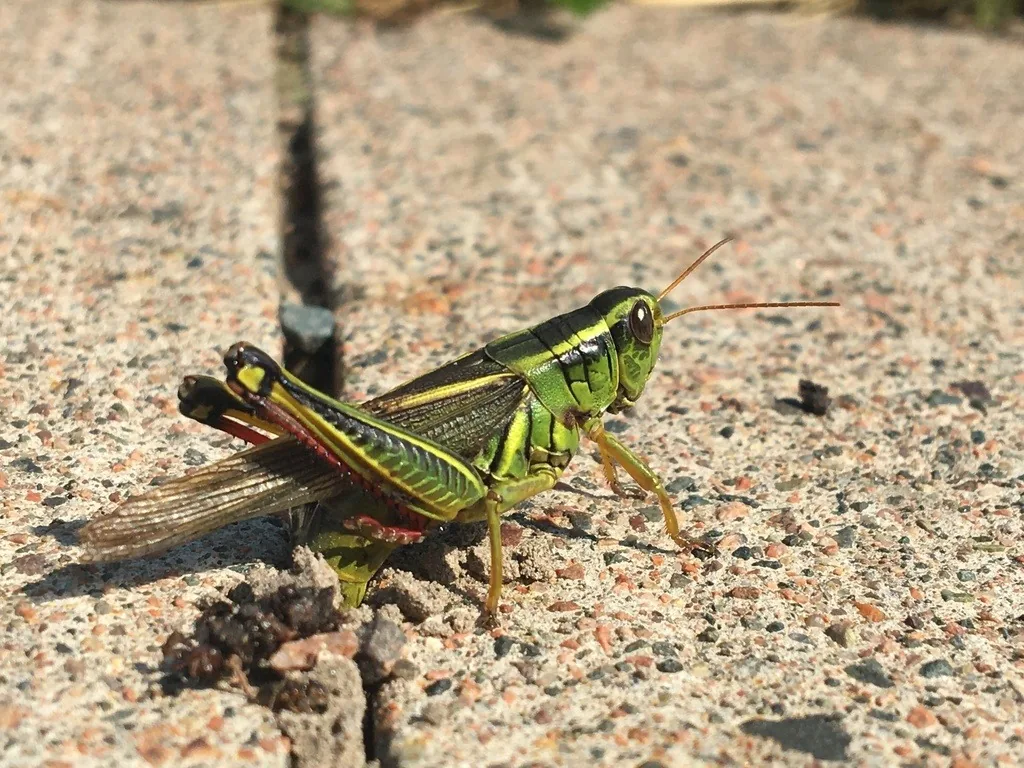
How to identify it
Look-alikes
| Look-alike | How to tell them apart |
|---|---|
| Red-legged grasshopper | Reddish-brown with yellow undersides and red hind legs instead of two pale stripes.[2] |
| Differential grasshopper | Yellowish to olive green with black chevrons on the hind leg.[2] |
Where it lives
Colorado State calls it often the most common grasshopper damaging gardens; it also occurs in Minnesota and North Carolina.[1][2][3]
Biology and life cycle
Nymphs are active from early May to early July and adults from early June to September in Minnesota.[1]
It migrates into gardens from empty lots, roadsides and other undisturbed sites, and often hatches a few weeks later than many grasshoppers.[3]
Grasshoppers lay eggs in pods in soil, and prolonged dry springs over several years can sharply increase their numbers.[1][3]
Damage and signs
Health risk
None to people or pets.[1]
Control
Prevention
Watch weedy lots, roadsides and other undisturbed sites nearby, where grasshoppers develop before moving into gardens.[3]
Biological control
Nosema locustae bait infects only young grasshoppers and works slowly, as part of a long-term program.[3]
Pesticides
Sprays or baits work best on young grasshoppers near egg-laying sites; on migrating adults, treating plants has limited effect and repeat applications may be needed.[2][3]
Common questions
Sources
- University of Minnesota Extension (What insect is this?), “Twostriped grasshopper.” apps.extension.umn.edu/garden/diagnose/insect/garden/beetles/large/tstripedghopper.html (accessed 2026-10-16)
- NC State Extension, “Grasshoppers on Ornamental Plants (PDIC Factsheet).” content.ces.ncsu.edu/grasshoppers-on-ornamental-plants (accessed 2026-10-16)
- Colorado State University Extension, “Grasshopper Control in Gardens and Small Acreages (Fact Sheet 5.536).” extension.colostate.edu/resource/grasshopper-control-in-gardens-and-small-acreages/ (accessed 2026-10-16)
- iNaturalist, “Melanoplus bivittatus taxon page (order and family).” www.inaturalist.org/taxa/1266323 (accessed 2026-10-06)