On this page
How to identify it
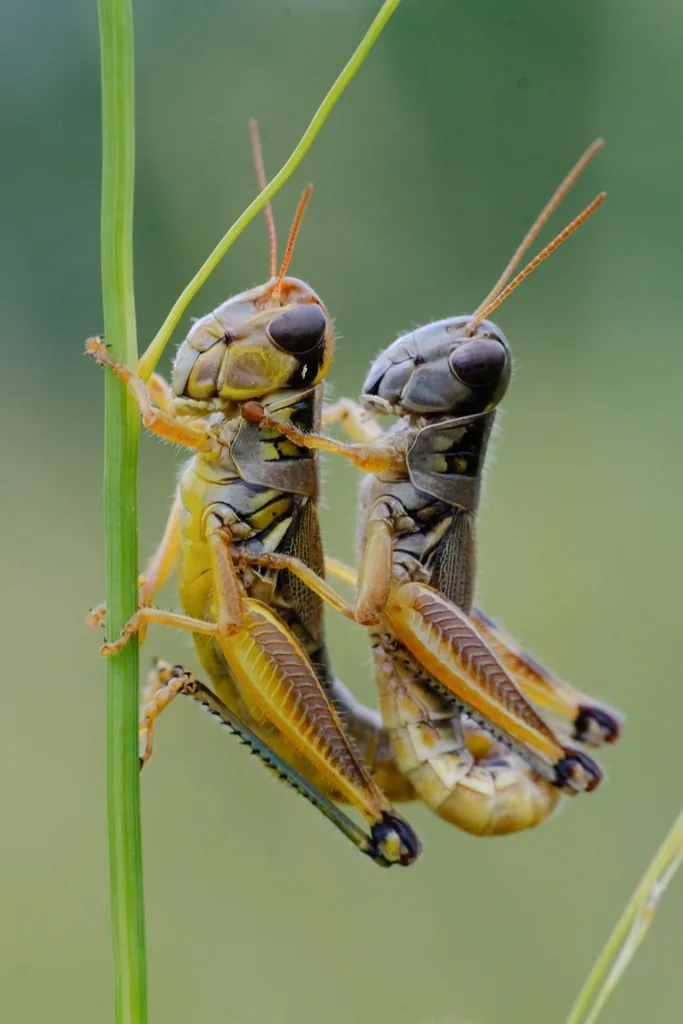
- A slim, medium-sized grasshopper with a very large head for its body and a slanted face. Males are 18 to 24 mm long and females 23 to 32 mm; females weigh about twice as much as males.[1][2]
- Most adults have short, pointed wings that reach only about a third of the way down the abdomen. A small share of each population has long wings that extend past the abdomen and can fly well.[1][2]
- Live adults are light gray to yellowish or greenish brown, often yellow underneath, with a brown stripe along the top of the hind thigh and blue hind shins.[1][2]
- Nymphs also have an oversized head, with a dark stripe below and behind the eye that stands out against the light gray head.[1]
Look-alikes
| Look-alike | How to tell them apart |
|---|---|
| Other spur-throated grasshoppers | It is a spur-throated grasshopper, and DNA studies suggest it may belong in the genus Melanoplus. Its oversized head, the short pointed wings of most adults and its nearly grass-only diet set it apart from its relatives, most of which eat broadleaf plants too.[2][1] |
Where it lives
Widespread in North American grasslands. It occurs statewide in Nebraska and has been studied from Kansas to Montana, Wyoming and Idaho.[1][2]
Biology and life cycle
It is a late-hatching species: eggs start hatching from late May in eastern Kansas and mid-June in Montana and Wyoming, with hatching spread over four weeks or more. Eggs lie an inch or more deep, and on freshly burned prairie they hatch about two weeks earlier.[1]
Nymphs take about 55 days to mature through five stages, perhaps because they perch on tall, cool grass. Adults appear from mid-July to early August and are most common from late July into October.[1][2]
It feeds mainly on grasses such as little and big bluestem, Kentucky bluegrass, western wheatgrass and smooth brome. It rests head-up on a grass blade and chews a long gouge out of the leaf edge.[1][2]
Because most adults cannot fly far, they stay near where they hatched, walking short distances to greener grass as plants dry out. In Wyoming, adults moved 30 to 90 feet from a dried-out draw into seedling winter wheat.[1]
Damage and signs
- In tallgrass prairie its feeding is visible but of little economic importance. In mixedgrass prairie it crowds into swales, especially during drought, and eats forage that livestock and wildlife need.[1]
- In fall, adults may move into winter wheat fields next to grassy draws and eat seedlings down to the ground.[1]
- Smooth brome along roadsides often holds very dense populations.[1][2]
Health risk
The sources describe it only as a grass-feeding grasshopper; they mention no harm to people.[1][2]
Control
Prevention
In tallgrass prairie, measurements have not shown a significant difference in damage between treated and untreated plots. On drier range, weigh forage value against expected grasshopper damage before paying for control.[1][3]
Watch winter wheat planted next to grassy draws or brome roadsides in fall, where short-winged adults walk in from drying grass.[1]
Pesticides
Where treatment is warranted, grasshopper sprays work better against nymphs than adults. Follow label directions.[3]
Common questions
- Why are there so many short-winged grasshoppers in the brome along my road?
- They are likely largeheaded grasshoppers. Smooth brome is a favored host, and roadside brome often holds dense populations of this mostly short-winged species.[1][2]
- Can largeheaded grasshoppers fly?
- Most adults cannot, because their wings are short. Long-winged adults, usually a few percent of a population, fly strongly.[1]
Sources
- USDA Agricultural Research Service, Northern Plains Agricultural Research Laboratory, “Largeheaded Grasshopper, Phoetaliotes nebrascensis (Thomas): species fact sheet, Grasshoppers: Their Biology, Identification and Management.” www.ars.usda.gov/plains-area/sidney-mt/northern-plains-agricultural-research-laboratory/pest-management-research/pmru-docs/grasshoppers-their-biology-identification-and-management/id-tools-apps/fact-sheets/melanoplinae-subfamily/fs-largeheaded/ (accessed 2026-11-09)
- University of Nebraska-Lincoln Extension, “The Grasshoppers (Orthoptera: Acrididae and Romaleidae) of Nebraska, EB3 (M. L. Brust, W. W. Hoback and R. J. Wright).” extensionpubs.unl.edu/publication/eb3/2009/pdf/view/eb3-2009.pdf (accessed 2026-11-09)
- Utah State University Extension, “Grasshoppers (E. Evans and E. Hodgson, June 2008).” extension.usu.edu/planthealth/research/grasshoppers (accessed 2026-11-09)
- iNaturalist, “Phoetaliotes nebrascensis taxon page (order and family).” www.inaturalist.org/taxa/154266 (accessed 2026-11-09)