On this page
How to identify it
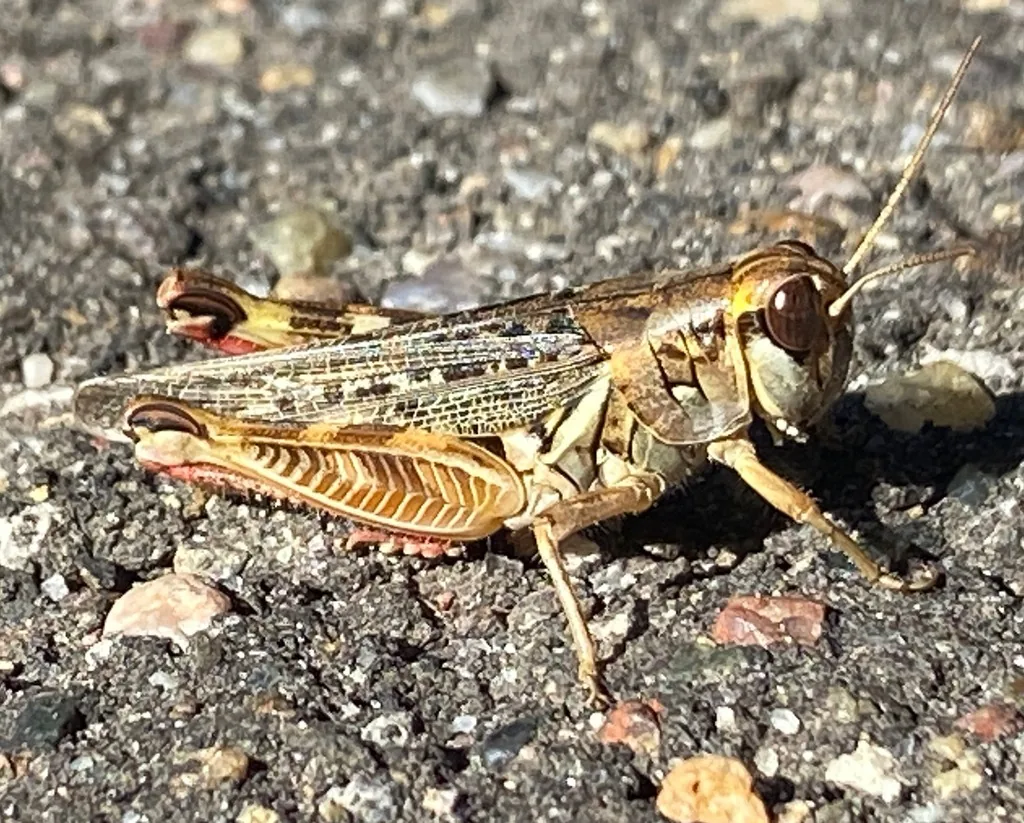
- A moderately large, long-winged grasshopper, dark brown to light brown. Males are 18 to 23 mm long and females 19 to 26 mm.[1][2]
- A broken line, dark alternating with ivory, runs lengthwise down the middle of each forewing.[1]
- The hind thigh is stout and barred, its dark stripe interrupted by two pale patches. The hind shins are usually red, though some southern specimens from Arizona have blue shins.[1][2]
- Two features settle the identification. The male's tail appendages (cerci) are undivided and bend inward near the tip, and in both sexes the lower edge of the hind thigh is straight for its first third instead of gently curved as in other Melanoplus.[1][2]
- Nymphs have a yellow or ivory crescent from below the eye onto the side of the thorax and a bright yellow underside.[1]
Where it lives
Rangeland across western North America, from shortgrass, mixed-grass, tallgrass, sand and desert prairie to grass-shrub basins, and up into foothills and mountain parks as high as 8,500 feet. It is common east of the Rocky Mountains. In Nebraska it has been recorded in the west and north and appears to prefer gravelly ground.[1][2]
Biology and life cycle
Forbs make up 70 to 85 percent of what it eats, especially scarlet globemallow, fringed sagebrush, Missouri goldenrod and Astragalus, with some blue grama and other grasses. It also takes seeds, moss, fungi, plant litter and dead insects.[1][2]
Eggs hatch between mid-June and early July in eastern Wyoming and northern Colorado, two to three weeks after the migratory grasshopper. Nymphs take about 56 days (42 to 70) and five molts to mature, so adults appear from mid-August, when many other range species are near the end of their lives.[1]
Females begin laying about three weeks after reaching adulthood. The pods are an inch or slightly longer, noticeably curved, and hold 16 to 29 tan eggs. Adults survive well through September and October and die off with November freezes.[1]
Young adults are strong fliers and sometimes leave the range in numbers. In late August 1991 hundreds turned up in Cheyenne, Wyoming, on pavement, in downtown doorways and in grassy lots.[1]
It lives mostly on the ground, sheltering at night under short grasses such as blue grama and basking in the morning and again in late afternoon. It will climb Russian thistle plants to feed and roost.[1]
Damage and signs
- On native range it is usually scarce, under one per square yard, and favors low-value forage plants, so it is not a serious pest. It can be beneficial: it climbs Russian thistle and eats the soft developing seeds.[1][2]
- In fall, adults and other late-maturing range grasshoppers can move into seedling winter wheat; as a group they can wipe out the edge rows. In one Wyoming field in October 1992 the first 16 rows next to the prairie had been eaten down to green stubs.[1]
- It also lives in alfalfa and eats it, but in a North Dakota study it made up only about 5 percent of the grasshoppers there.[1]
Health risk
It is a plant-feeding grasshopper, and the sources describe no health concerns for people.[1][2]
Control
Prevention
Where winter wheat is seeded beside native range, check the field edges in fall, when late grasshoppers such as this one move in from the prairie. Checking the grasshopper breeding areas nearby earlier in the season can help head off late-season crop damage.[1][3]
Biological control
Predators, parasites and diseases help hold grasshopper numbers down every year.[3]
Pesticides
Sprays work better on nymphs than on adults, and Gladston nymphs are still developing in July and August, later than most range species. Follow the label of any product.[1][3]
Common questions
- Why are there still grasshoppers on the range in October?
- Some species, like the Gladston grasshopper, hatch late and do not become adults until mid-August or later. Their adults survive well through September and October.[1][2]
- Do Gladston grasshoppers damage crops?
- Mostly not, but in fall they can join other late-season grasshoppers chewing the edge rows of young winter wheat next to rangeland.[1]
Sources
- USDA Agricultural Research Service, Northern Plains Agricultural Research Laboratory, “Gladston Grasshopper, Melanoplus gladstoni Scudder: species fact sheet, Grasshoppers: Their Biology, Identification and Management.” www.ars.usda.gov/plains-area/sidney-mt/northern-plains-agricultural-research-laboratory/pest-management-research/pmru-docs/grasshoppers-their-biology-identification-and-management/id-tools-apps/fact-sheets/melanoplinae-subfamily/fs-gladston/ (accessed 2026-11-09)
- University of Nebraska-Lincoln Extension, “The Grasshoppers (Orthoptera: Acrididae and Romaleidae) of Nebraska, EB3 (M. L. Brust, W. W. Hoback and R. J. Wright).” extensionpubs.unl.edu/publication/eb3/2009/pdf/view/eb3-2009.pdf (accessed 2026-11-09)
- Utah State University Extension, “Grasshoppers (E. Evans and E. Hodgson, June 2008).” extension.usu.edu/planthealth/research/grasshoppers (accessed 2026-11-09)
- iNaturalist, “Melanoplus gladstoni taxon page (order and family).” www.inaturalist.org/taxa/224672 (accessed 2026-11-09)