On this page
How to identify it
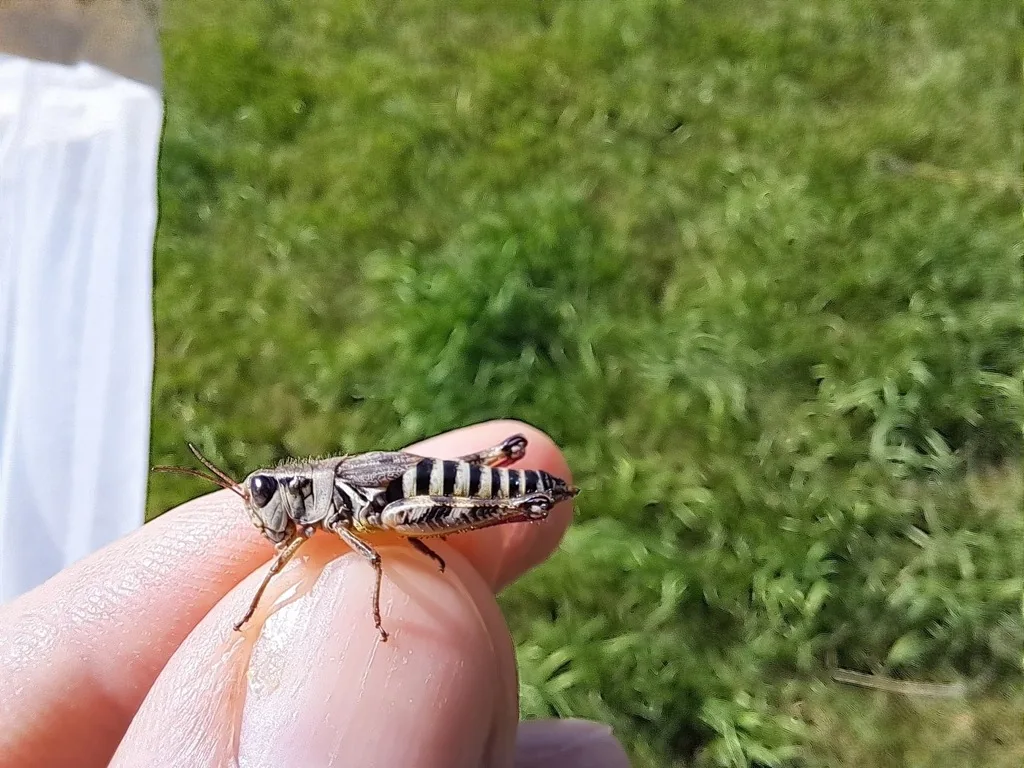
- Small: males are 13 to 18 mm long and females 19 to 23 mm. Most adults have short wings, a third to half the length of the abdomen; a small share have full-length wings.[1][3]
- The top of the abdomen is ringed in black and yellow, the underside is canary yellow, and the hind shins are red. The body is otherwise mostly brown.[1][3]
- The male cercus is short and broad at the base, narrowing to a rounded tip.[1][3]
- Nymphs have gray or dark sides to the abdomen with a yellow stripe down the middle of the back, and the underside turns yellow from the third stage on.[1]
Look-alikes
| Look-alike | How to tell them apart |
|---|---|
| Keeler grasshopper | Another red-shinned spur-throated grasshopper that eats forbs and legumes. Western Keeler grasshoppers are medium-sized and long-winged, while the Dawson grasshopper is small and usually short-winged.[2][1] |
Where it lives
Northern grasslands from the Atlantic coast to the Great Basin. It is common in mixedgrass prairie and in grass-forb mountain parks at 7,000 to 8,500 feet, and is most abundant in the Canadian prairie provinces. In Nebraska it has been collected at scattered sites, most consistently in the northern half.[1][3]
Biology and life cycle
It feeds mainly on forbs: about 40 species from 13 families, chiefly western ragweed, leadplant and milkvetches. Alfalfa and white clover are also hosts, and caged grasshoppers strongly preferred dandelion. It eats only small amounts of grass.[1][3]
It favors abandoned fields and roadsides where dandelion, volunteer legumes and other forbs grow thickly, and in the southern part of its range it often lives in ravine bottoms.[1]
Eggs hatch about a week after those of the migratory grasshopper, in northern Wyoming from early June into early July. Nymphs go through five stages; development is faster at high elevations, taking about 20 days at 8,500 feet in Colorado against 45 days at 3,700 feet in Wyoming.[1]
Adults appear in July. At lower elevations they are present from mid-July to mid-October, a long window for egg laying. Egg pods are about 3/4 inch long with 8 to 14 eggs.[1][3]
It lives mostly on the ground and spends cold nights in thick grass clumps or under dry cow dung.[1]
Damage and signs
- Some entomologists consider it of little economic importance, and in Nebraska it rarely reaches damaging numbers. But densities of 4 to 10 adults per square yard in the northern mixedgrass prairie show it can damage forage, especially in pastures seeded to legumes.[1][3]
- It frequently infests North Dakota alfalfa. In a 1958 to 1959 survey it was the dominant grasshopper in 2 of 12 counties, and 84 percent of the Dawson grasshoppers examined had eaten alfalfa, the same rate as the red-legged grasshopper, a recognized serious alfalfa pest.[1]
Health risk
The sources describe it as a forb- and legume-feeding grasshopper and mention no danger to people.[1][3]
Control
Prevention
In the northern plains, check alfalfa fields and legume pastures, and nearby grasshopper breeding areas, early in the season for nymphs.[1][4]
Pesticides
Consider treatment only in years when nymphs are extremely numerous. Sprays are more effective on nymphs than on adults; follow the label.[4]
Common questions
- What is the little short-winged grasshopper with a yellow and black striped abdomen?
- That combination, together with red hind shins, is typical of the Dawson grasshopper.[1][3]
- Does the Dawson grasshopper damage alfalfa?
- It can. It is a frequent and sometimes dominant grasshopper in North Dakota alfalfa fields, and most individuals examined there had fed on alfalfa.[1]
Sources
- USDA Agricultural Research Service, Northern Plains Agricultural Research Laboratory, “Dawson Grasshopper, Melanoplus dawsoni (Scudder): species fact sheet, Grasshoppers: Their Biology, Identification and Management.” www.ars.usda.gov/plains-area/sidney-mt/northern-plains-agricultural-research-laboratory/pest-management-research/pmru-docs/grasshoppers-their-biology-identification-and-management/id-tools-apps/fact-sheets/melanoplinae-subfamily/fs-dawson/ (accessed 2026-11-09)
- USDA Agricultural Research Service, Northern Plains Agricultural Research Laboratory, “Keeler Grasshopper, Melanoplus keeleri (Thomas): species fact sheet, Grasshoppers: Their Biology, Identification and Management.” www.ars.usda.gov/plains-area/sidney-mt/northern-plains-agricultural-research-laboratory/pest-management-research/pmru-docs/grasshoppers-their-biology-identification-and-management/id-tools-apps/fact-sheets/melanoplinae-subfamily/fs-keeler/ (accessed 2026-11-09)
- University of Nebraska-Lincoln Extension, “The Grasshoppers (Orthoptera: Acrididae and Romaleidae) of Nebraska, EB3 (M. L. Brust, W. W. Hoback and R. J. Wright).” extensionpubs.unl.edu/publication/eb3/2009/pdf/view/eb3-2009.pdf (accessed 2026-11-09)
- Utah State University Extension, “Grasshoppers (E. Evans and E. Hodgson, June 2008).” extension.usu.edu/planthealth/research/grasshoppers (accessed 2026-11-09)
- iNaturalist, “Melanoplus dawsoni taxon page (order and family).” www.inaturalist.org/taxa/224638 (accessed 2026-11-09)