On this page
How to identify it
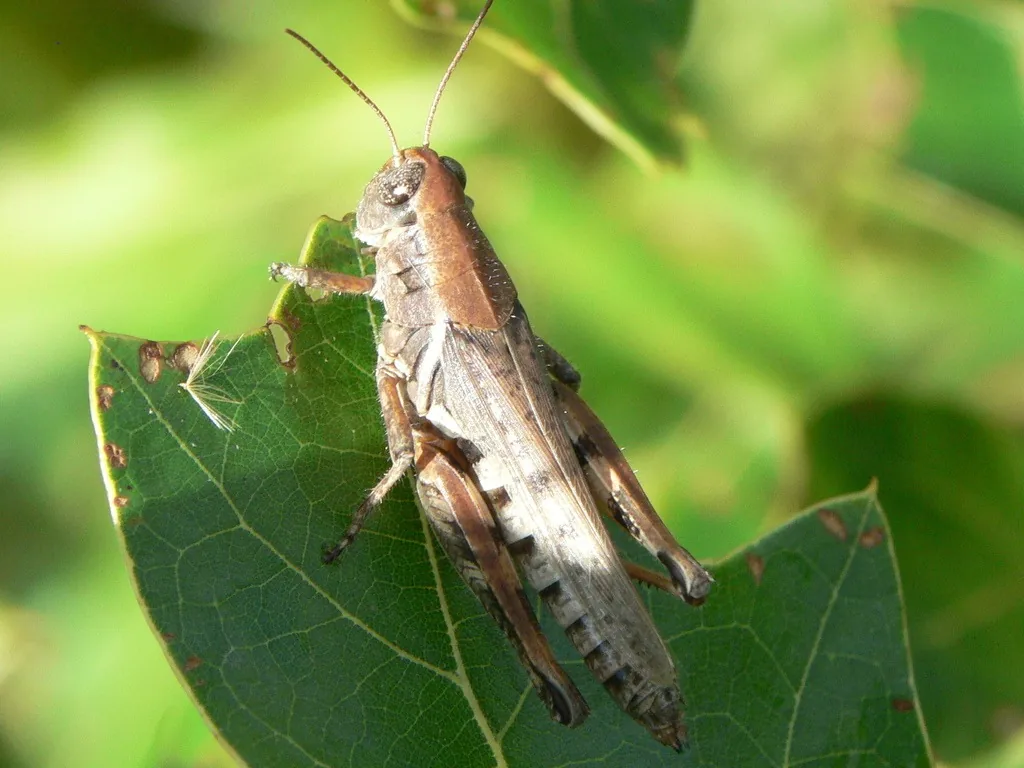
- A medium-sized spur-throated grasshopper: males are 16 to 25 mm long and females 21 to 30 mm. Western individuals are long-winged and fairly colorful in brown and yellow, while many eastern ones are dull dark brown.[1][2]
- The best mark is on the outside of the hind thigh: a solid dark stripe, not broken by any light band, that narrows toward the base. Below it the lower third of the thigh is whitish.[1][2]
- Hind shins are red and the hind wings are clear.[1][2]
- Males have a forked tail appendage (cercus), with one branch larger than the other.[1][2]
- Nymphs are yellow and black, often canary yellow underneath, and each eye is crossed by two parallel yellow stripes.[1]
Look-alikes
| Look-alike | How to tell them apart |
|---|---|
| Migratory grasshopper and other pasture spur-throated grasshoppers | In legume pastures it usually lives among major pest species such as the migratory, red-legged and two-striped grasshoppers. Check the hind thigh: the Keeler grasshopper's solid dark stripe that tapers toward the base is a shape ARS describes as distinctive for the species.[1] |
Where it lives
Found in upland grasslands from the Atlantic coast to the Great Basin and from southern Canada to the southern United States. Its stronghold is the Midwest; in the West it is common in tallgrass and taller mixedgrass prairie but rare in ordinary mixedgrass and shortgrass prairie there. It occurs statewide in Nebraska but is seldom numerous.[1][2]
Biology and life cycle
It eats a wide range of forbs: at least 52 species from 17 plant families have been recorded, mostly from the sunflower and bean families. Western ragweed, cudweed sagewort, Missouri goldenrod, scurfpea, asters and leadplant are typical hosts, and it takes only small amounts of grass.[1][2]
It is a late hatcher. In Colorado mixedgrass prairie eggs hatch in early to late June, about three weeks after the migratory grasshopper, and hatching is over in one to two weeks.[1]
Nymphs pass through five stages in about 46 days. Adults appear in late July in Colorado, but earlier at lower elevations: by the first week of July in eastern North Dakota and as early as June 23 in Iowa. In Nebraska adults are most common from late July into October.[1][2]
It spends most of its time perched in tall grass and forbs, resting head-up on plant stems 8 to 14 inches above the ground at night. Although long-winged, it moves little; when flushed it jumps or makes short, silent flights of 2 to 4 feet.[1]
Damage and signs
- On rangeland it is a minor pest. It occurs at low densities and mostly eats forbs of low forage value rather than grasses.[1][2]
- Alfalfa, lespedeza and sweetclover are among its preferred foods, so it can become a pest in pastures seeded with legumes. Even there it usually adds only a little to the damage done by the main pest grasshoppers.[1]
- It has also been seen eating cabbage and the leaves of apple and plum trees.[1][2]
Health risk
The sources describe a plant-feeding grasshopper and report no risk to people.[1][2]
Control
Prevention
On its own it rarely needs control. Where legume pastures or alfalfa sit next to grassland, check grasshopper breeding areas regularly early in the season for nymphs.[1][3]
Pesticides
Treatment is worth considering only in years when nymphs are extremely numerous; sprays work better on nymphs than on adults. Follow the label.[3]
Common questions
- Do Keeler grasshoppers eat grass?
- Very little. They feed mainly on forbs, especially plants in the sunflower and bean families, and take only small amounts of grass.[1][2]
- Can Keeler grasshoppers hurt my garden or fruit trees?
- They have been seen feeding on cabbage and on apple and plum leaves, but they are mainly prairie forb feeders and are seldom numerous.[1][2]
Sources
- USDA Agricultural Research Service, Northern Plains Agricultural Research Laboratory, “Keeler Grasshopper, Melanoplus keeleri (Thomas): species fact sheet, Grasshoppers: Their Biology, Identification and Management.” www.ars.usda.gov/plains-area/sidney-mt/northern-plains-agricultural-research-laboratory/pest-management-research/pmru-docs/grasshoppers-their-biology-identification-and-management/id-tools-apps/fact-sheets/melanoplinae-subfamily/fs-keeler/ (accessed 2026-11-09)
- University of Nebraska-Lincoln Extension, “The Grasshoppers (Orthoptera: Acrididae and Romaleidae) of Nebraska, EB3 (M. L. Brust, W. W. Hoback and R. J. Wright).” extensionpubs.unl.edu/publication/eb3/2009/pdf/view/eb3-2009.pdf (accessed 2026-11-09)
- Utah State University Extension, “Grasshoppers (E. Evans and E. Hodgson, June 2008).” extension.usu.edu/planthealth/research/grasshoppers (accessed 2026-11-09)
- iNaturalist, “Melanoplus keeleri taxon page (order and family).” www.inaturalist.org/taxa/154686 (accessed 2026-11-09)