On this page
How to identify it
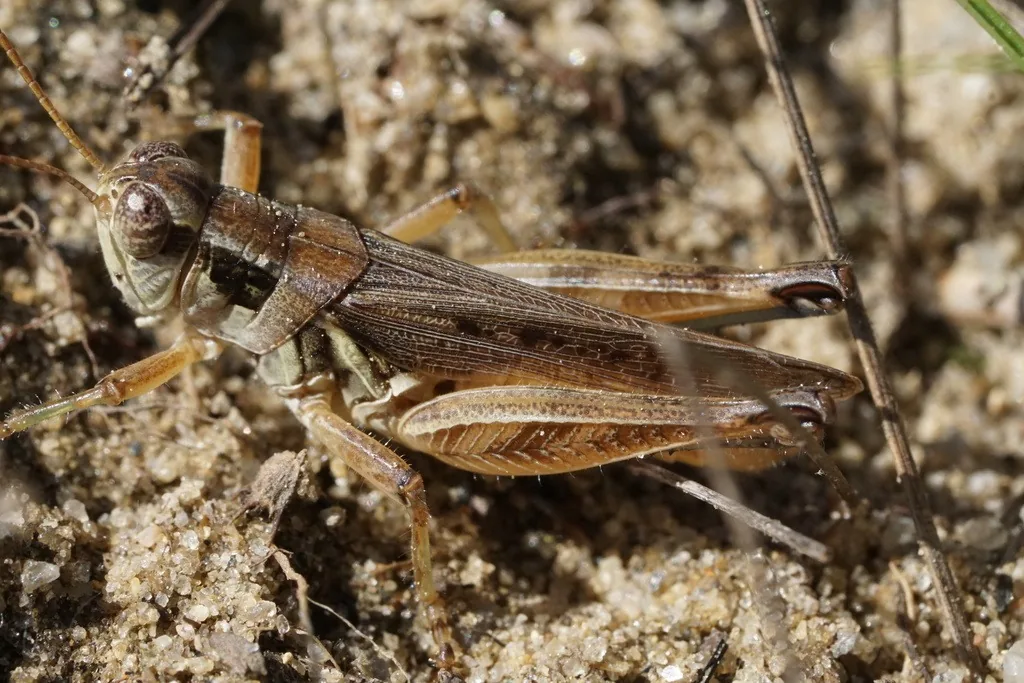
- A medium-sized, drab gray and brown grasshopper with a cream underside. Males are 17 to 22 mm long and females 18 to 28 mm, and the wings reach to or past the tip of the abdomen.[1][2]
- Behind each eye a shiny black patch runs back onto the side of the pronotum.[1][2]
- The lower edge of the hind thigh is orange (occasionally yellow), and the hind shins are blue to greenish blue, rarely red. The hind wings are clear.[1][2]
- Males can be confirmed by the shape of the cercus, the small appendage at the tip of the abdomen, which ARS calls diagnostic.[1][2]
Look-alikes
| Look-alike | How to tell them apart |
|---|---|
| Melanoplus bispinosus and flabellate grasshopper (M. occidentalis) | Two related spur-throated grasshoppers that are easily confused with it. Male genitalia separate them reliably.[2] |
Where it lives
Found from the northeastern states west to the western states and Canadian provinces: in grass prairie in the West and in meadows and pastures in the Midwest and East. It occurs statewide in Nebraska and lives up to 9,000 feet in the Colorado Rockies.[1][2]
Biology and life cycle
It is a very early hatcher. First nymphs appear in early spring, two to three weeks ahead of the bigheaded grasshopper, while adults of species that overwinter as nymphs, such as the velvet-striped grasshopper, are still around. Hatching continues for about a month.[1]
Nymphs reach adulthood in 40 to 46 days through five stages. In Nebraska adults are most common from late May to mid-July, earlier than any other Melanoplus species there.[1][2]
It eats more forbs than grasses. Favorites include western ragweed, spreading wild buckwheat, cudweed sagewort and western sticktight, along with early-season grasses such as downy brome, Japanese brome and Kentucky bluegrass. In Michigan a goldenrod is a favored host.[1][2]
Females are among the first grasshoppers to lay eggs each year, preferring spots shaded by shrubs or tall plants. They place 10 to 15 eggs about 1 1/4 inches deep in bare ground or buffalograss sod.[1]
Adults stay put while plants are green. When the range dries they shift to low swales or leave the area; in Michigan they gather along marsh edges.[1]
Damage and signs
- It is usually present at low densities, and because it feeds early in the season while vegetation is green and plentiful, it causes little or no economic damage. Over 12 years in Wyoming, adult numbers stayed under one per square yard in nine years and peaked at 2.7.[1][2]
- In Saskatchewan, small outbreaks together with the clubhorned grasshopper have damaged pastures and grain fields.[1]
Health risk
Neither source reports any harm to people; it is described only as a plant-feeding grasshopper.[1][2]
Control
Prevention
It seldom reaches numbers that justify treatment, since populations persist from year to year at low levels without erupting.[1][2]
Pesticides
Where grasshoppers need control along roadsides and fence rows, malathion and carbaryl may be sprayed there following label directions; sprays work better against nymphs than adults.[3]
Common questions
- Why are there full-grown grasshoppers in my pasture in late May?
- Early adults like these are often pasture grasshoppers, which hatch in early spring, two to three weeks ahead of species such as the bigheaded grasshopper, and mature in about six weeks.[1][2]
- Is the pasture grasshopper a serious pasture pest?
- Not usually. Despite the name, it is normally scarce and feeds while plants are lush, though small outbreaks have damaged pastures and grain in Saskatchewan.[1][2]
Sources
- USDA Agricultural Research Service, Northern Plains Agricultural Research Laboratory, “Pasture Grasshopper, Melanoplus confusus Scudder: species fact sheet, Grasshoppers: Their Biology, Identification and Management.” www.ars.usda.gov/plains-area/sidney-mt/northern-plains-agricultural-research-laboratory/pest-management-research/pmru-docs/grasshoppers-their-biology-identification-and-management/id-tools-apps/fact-sheets/melanoplinae-subfamily/fs-pasture/ (accessed 2026-11-09)
- University of Nebraska-Lincoln Extension, “The Grasshoppers (Orthoptera: Acrididae and Romaleidae) of Nebraska, EB3 (M. L. Brust, W. W. Hoback and R. J. Wright).” extensionpubs.unl.edu/publication/eb3/2009/pdf/view/eb3-2009.pdf (accessed 2026-11-09)
- Utah State University Extension, “Grasshoppers (E. Evans and E. Hodgson, June 2008).” extension.usu.edu/planthealth/research/grasshoppers (accessed 2026-11-09)
- iNaturalist, “Melanoplus confusus taxon page (order and family).” www.inaturalist.org/taxa/224634 (accessed 2026-11-09)