On this page
How to identify it
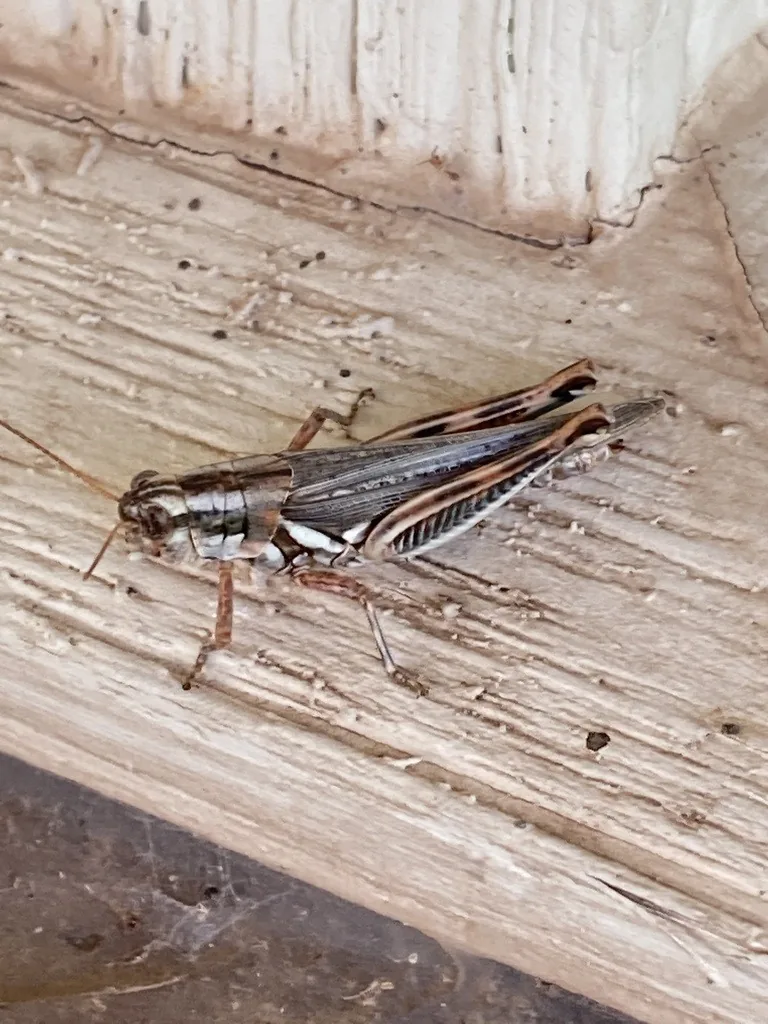
- A medium-sized grasshopper, pale to dark gray or yellowish brown with white and black markings. Males are 18 to 27 mm long and females 21 to 30 mm, and the long wings reach a few millimeters past the abdomen.[1][2]
- A blackish bar usually runs behind the eye along the side of the pronotum.[2]
- The outer face of the hind thigh carries dark chevrons separated by white lines, darker toward the top and paler below; the inner face is orange. The hind shins are light to medium blue.[1][2]
- Males have long, slender tail appendages (cerci).[1][2]
- Nymphs are pale gray with darker marks and a pale yellow crescent running from below the eye onto the side of the thorax. They stay close to their host shrubs.[1]
Look-alikes
| Look-alike | How to tell them apart |
|---|---|
| Yellowish spur-throat grasshopper (Melanoplus flavidus) | Very similar, and best told apart by habitat: it lives on sandy grassland with sparse plants and eats mostly forbs, not sagebrush. Its inner hind thigh is yellow to orange-yellow rather than orange, and the tips of the male's furculae are squared rather than rounded.[2] |
Where it lives
Western grasslands, including mixed-grass, shortgrass, desert and bunchgrass prairie and some desert shrublands, but only where sagebrush grows; the combined ranges of silver and sand sagebrush closely match its range. In Nebraska it is limited to the western third of the state.[1][2]
Biology and life cycle
It feeds almost entirely on sagebrush. In western North Dakota nearly all of its food was silver sagebrush, and in western Nebraska most was sand sagebrush, which replaces silver sagebrush on dunes and sandhills. Big sagebrush, fringed sagebrush, tarragon and cudweed sagewort are eaten in small amounts.[1][2]
It chews the edges of sagebrush leaves or snips a leaf at its base and holds it in its front feet to eat it whole. It also eats the flowers of silver sagebrush when they open.[1]
Nymphs and adults roost overnight head-up on sagebrush stems, 6 to 16 inches off the ground. By mid-morning many hop down to bask on bare soil, then return to the shrub to feed, and they are back on the shrub by early evening.[1]
In eastern Wyoming eggs hatch in the first week of June, about three weeks after the bigheaded grasshopper. Nymphs mature in 30 to 40 days, and adults are present from July through September.[1][2]
Caged females lay in bare soil and cover the hole afterward. Each pod is about three-quarters of an inch long and holds 12 or 13 tan eggs.[1]
Damage and signs
Health risk
It is a plant-feeding grasshopper, and the sources describe no health concerns for people.[1][2]
Control
Prevention
No treatment is needed for this species. Correct identification matters, though: a grasshopper that eats almost only sagebrush poses little risk to grass forage or crops, so check what species is present before planning control.[1][2][3]
Common questions
- What is the gray grasshopper sitting on sagebrush?
- If it has blue hind shins, an orange inner thigh and roosts on silver or sand sagebrush, it is likely the sagebrush grasshopper, which lives and feeds almost entirely on those shrubs.[1][2]
- Does the sagebrush grasshopper hurt rangeland?
- Not measurably. It eats sagebrush rather than grass, stays at low numbers and plays almost no part in grasshopper outbreaks.[1][2]
Sources
- USDA Agricultural Research Service, Northern Plains Agricultural Research Laboratory, “Sagebrush Grasshopper, Melanoplus bowditchi Scudder: species fact sheet, Grasshoppers: Their Biology, Identification and Management.” www.ars.usda.gov/plains-area/sidney-mt/northern-plains-agricultural-research-laboratory/pest-management-research/pmru-docs/grasshoppers-their-biology-identification-and-management/id-tools-apps/fact-sheets/melanoplinae-subfamily/fs-sagebrush/ (accessed 2026-11-09)
- University of Nebraska-Lincoln Extension, “The Grasshoppers (Orthoptera: Acrididae and Romaleidae) of Nebraska, EB3 (M. L. Brust, W. W. Hoback and R. J. Wright).” extensionpubs.unl.edu/publication/eb3/2009/pdf/view/eb3-2009.pdf (accessed 2026-11-09)
- Utah State University Extension, “Grasshoppers (E. Evans and E. Hodgson, June 2008).” extension.usu.edu/planthealth/research/grasshoppers (accessed 2026-11-09)
- iNaturalist, “Melanoplus bowditchi taxon page (order and family).” www.inaturalist.org/taxa/224620 (accessed 2026-11-09)