On this page
How to identify it
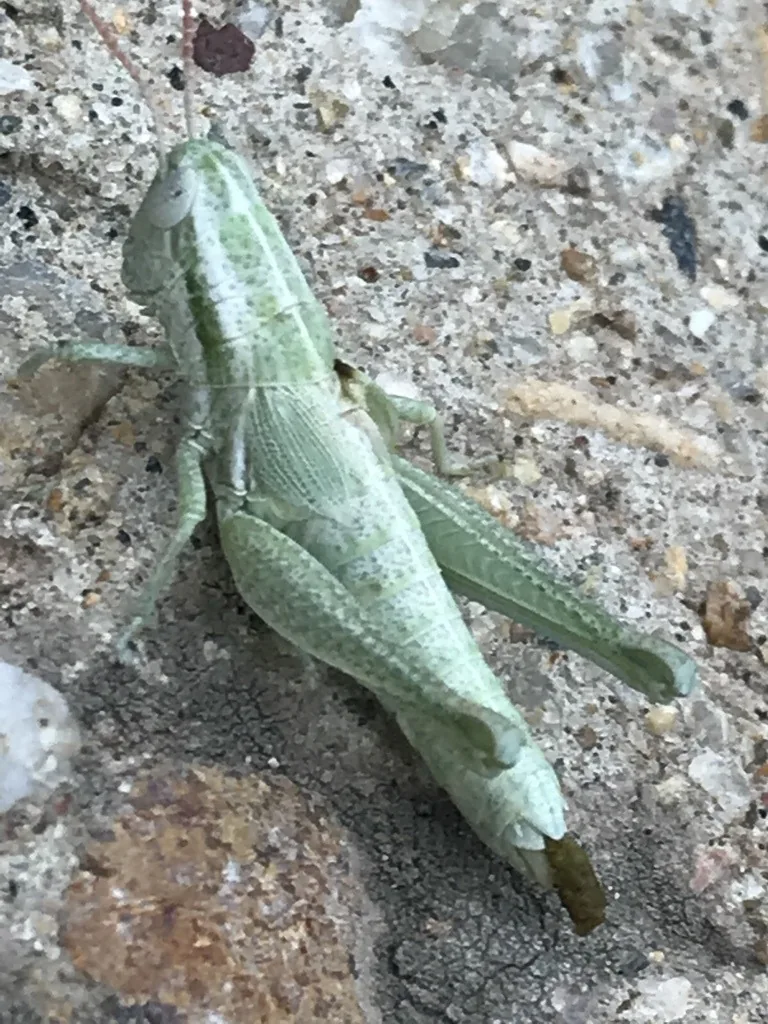
- Light green, pale whitish green or nearly white, with poorly developed markings and light green hind shins. Males are 16 to 20 mm long and females 20 to 27 mm.[1][2]
- The wings are short, normally about half the length of the abdomen. Long-winged females turn up only rarely.[1][2]
- A broad green band runs back from the eye along the side of the head and onto the pronotum and thorax. Under magnification the body is covered in many small brown spots.[1]
- Nymphs are pale green spotted with brown. First-stage nymphs have blue antennae; later stages have green antennae ringed with pale bands.[1]
- Look for it sitting head-up on the stems of cudweed sagewort, often in a patch of the plant. Dried, pinned specimens fade to a dull yellowish tan.[1]
Look-alikes
| Look-alike | How to tell them apart |
|---|---|
| Snakeweed grasshopper (Hesperotettix viridis) | Its green nymphs turn up in the same rangeland samples. They are a deeper medium green, with black antennae ringed in pale bands and black spots or chevrons on the hind thigh, where cudweed grasshopper nymphs are pale green with green antennae and brown spotting.[1] |
Where it lives
Grasslands east of the Rocky Mountains, in 11 states and 3 Canadian provinces, including tallgrass, sand and mixed-grass prairie. Its distribution is patchy because it follows cudweed sagewort, though the plant grows farther afield and at higher elevations; in Colorado the grasshopper has not been found above 6,000 feet. It has been recorded across much of Nebraska.[1][2]
Biology and life cycle
It feeds almost only on cudweed sagewort (Artemisia ludoviciana), with smaller amounts of fringed sagewort, silver sagebrush and other sageworts and traces of a few grasses and forbs. The plant's hairy leaves seem to hamper digestion in general feeders: migratory and two-striped grasshoppers cannot grow normally on it.[1][2]
Young nymphs gouge tissue from the upper, less hairy surface of the leaf, leaving thin spots and holes inside the leaf edge. Older nymphs and adults eat in from the leaf edges and prefer the young leaves at the top of the plant.[1]
It hatches late, about a month after the white-whiskered grasshopper, starting around May 15 in eastern Kansas and June 1 in southeastern North Dakota and northern Colorado, and hatching runs for about a month. Nymphs pass through five stages in 44 to 46 days. Adults are most common from mid-July to September, and in northern Colorado were seen from late July into early October.[1][2]
Females lay in bare patches of ground between plants, gripping an upright stem while they drill into the soil. The slightly curved pod is five-eighths to three-quarters of an inch long and holds 8 to 12 tan eggs.[1]
Nymphs and adults rest head-up on cudweed stems day and night, 8 to 12 inches up before sunrise. When disturbed they hop 2 to 8 inches to another stem rather than dropping to the ground, and on very hot days they simply shift to the shady side of the stem.[1]
Damage and signs
- Where cudweed sagewort grows in patches, the grasshoppers gather in them, up to six young adults per square yard. They eat large sections of young leaves from the edge to the midrib, which is easy to see, but the damage to the plants is minor. Nebraska's guide gives it no economic importance.[1][2]
- Its host is a native perennial forb of fair to good forage value for sheep and fair for cattle in New Mexico, and of less value farther north; it also helps bind soil against erosion.[1]
Health risk
It lives on a single wild plant and the sources describe no harm to people, pets or crops.[1][2]
Control
Prevention
No control is needed. It feeds almost entirely on cudweed sagewort, causes only minor damage to that plant, and has no economic importance.[1][2]
Common questions
- What is the pale green grasshopper on my sagewort?
- On cudweed sagewort east of the Rockies, a pale whitish-green, short-winged grasshopper sitting head-up on the stem is very likely the cudweed grasshopper, which matches the plant's color almost perfectly.[1][2]
- Can cudweed grasshoppers fly?
- Mostly not. It is a short-winged, flightless grasshopper, although a long-winged female turns up now and then, and it stays on its host plant almost all the time.[1][2]
Sources
- USDA Agricultural Research Service, Northern Plains Agricultural Research Laboratory, “Cudweed Grasshopper, Hypochlora alba (Dodge): species fact sheet, Grasshoppers: Their Biology, Identification and Management.” www.ars.usda.gov/plains-area/sidney-mt/northern-plains-agricultural-research-laboratory/pest-management-research/pmru-docs/grasshoppers-their-biology-identification-and-management/id-tools-apps/fact-sheets/melanoplinae-subfamily/fs-cudweed/ (accessed 2026-11-09)
- University of Nebraska-Lincoln Extension, “The Grasshoppers (Orthoptera: Acrididae and Romaleidae) of Nebraska, EB3 (M. L. Brust, W. W. Hoback and R. J. Wright).” extensionpubs.unl.edu/publication/eb3/2009/pdf/view/eb3-2009.pdf (accessed 2026-11-09)
- iNaturalist, “Hypochlora alba taxon page (order and family).” www.inaturalist.org/taxa/222031 (accessed 2026-11-09)