On this page
How to identify it
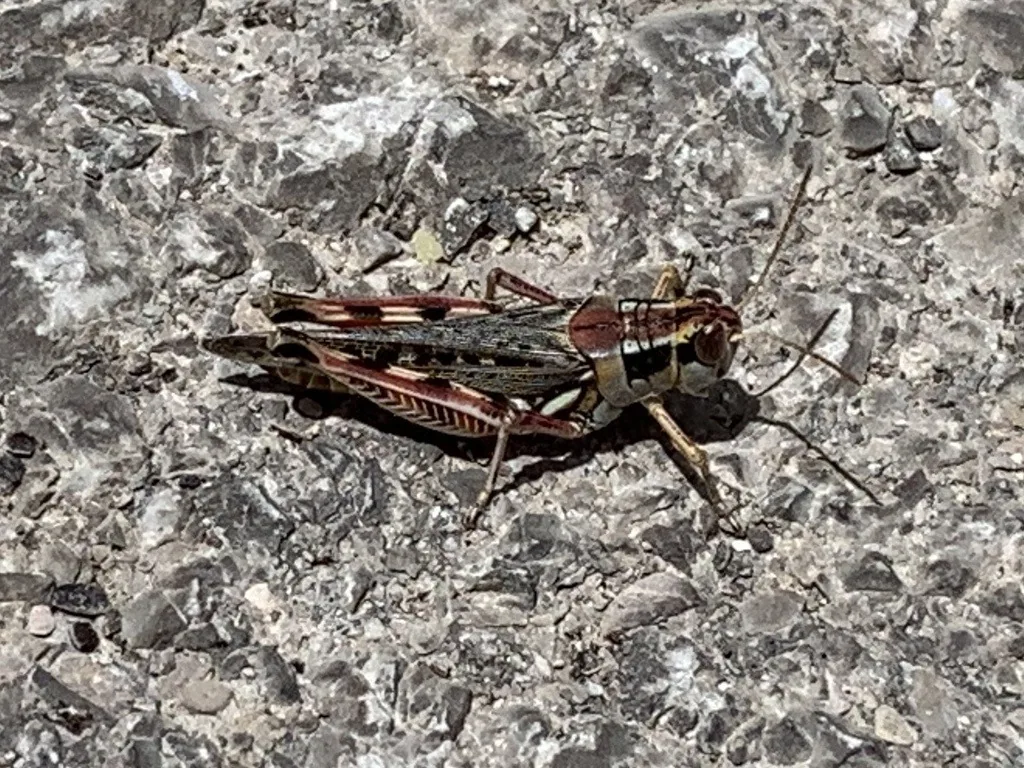
- A gray to gray-brown grasshopper with bright orange patches. Males are 18 to 25 mm long and females 20 to 27 mm, and the wings reach the end of the abdomen or beyond.[1][2]
- The lower and inner surfaces of the hind thighs are bright orange, and the hind shins are light blue.[1][2]
- The outer face of the hind thigh shows two dark patches, the middle one V-shaped, along with pale chevrons.[1][2]
- The male's cerci are very large and broad, shaped like an ear or a fan. This is the diagnostic feature and the source of the name.[1][2]
- Nymphs are gray, tan or green with a prominent cream crescent from below the eye onto the side of the thorax, a pale gray underside, and a dark stripe on the hind thigh broken across three times.[1]
Look-alikes
| Look-alike | How to tell them apart |
|---|---|
| Pasture grasshopper (Melanoplus confusus) | Easily confused with it, but the male genitalia are distinct.[2] |
| Gladston grasshopper (Melanoplus gladstoni), nymphs | Nymphs look similar, but Gladston nymphs have a bright yellow underside rather than pale gray and appear late in summer, when flabellate grasshoppers are already adults.[1] |
Where it lives
Nearly all the grasslands of the western United States and the Canadian prairie provinces, with the highest numbers on mixed-grass prairie; it is absent from some mixed-grass sites, often in Montana. In Nebraska it occurs in the panhandle and the southwest.[1][2]
Biology and life cycle
Most of its diet is forb leaves, especially scarlet globemallow, wild buckwheat and milkvetch, with some blue grama, needleandthread, western wheatgrass, bluegrasses and needleleaf sedge. It also eats moss, roots, seeds, bark and dying or dead insects; insect parts made up as much as a tenth of crop contents.[1][2]
Eggs hatch in mid-spring, at about the same time as the bigheaded, striped and spotted-winged grasshoppers, and hatching runs about 25 days. Nymphs pass through five instars in 40 to 45 days.[1]
About two weeks after becoming an adult, a female pushes her abdomen about an inch into a bare spot and lays a small pod of 8 to 10 eggs, then keeps laying for the rest of her short life. There is one generation a year.[1]
Adults are most common from late June to early September and are strong fliers; strays turn up high in the Colorado Rockies. On hot midsummer afternoons they climb small shrubs and rest a few inches up in the shade.[1][2]
Damage and signs
- Because it eats both grasses and forbs, it competes with cattle and with sheep. On its own it rarely reaches the economic level of 8 per square yard, but it frequently contributes one to three adults per square yard to heavy rangeland infestations.[1][3]
- In a Wyoming mixed-grass site, its numbers ranged from 0.1 to 7.3 adults per square yard over 10 years and stayed below one in half of those years. Nebraska's guide considers it unlikely to damage rangeland.[1][2]
Health risk
It is a plant-feeding grasshopper, and the sources describe no health concerns for people.[1][2]
Control
Prevention
It is seldom the reason to treat. When surveying a rangeland outbreak, count it with the other species present, and weigh the forage value of the range against the expected loss before deciding on control.[1][3]
Biological control
Predators, parasites and diseases help keep grasshopper numbers down each year.[3]
Common questions
- Why is it called the flabellate grasshopper?
- Flabellate means fan-shaped. The male's tail appendages, the cerci, are broad and fan- or ear-shaped, which is the key feature for identifying the species.[1][2]
- Do flabellate grasshoppers eat insects?
- They scavenge them. Besides forbs and grasses, they eat dying or dead insects, which have made up 1 to 10 percent of the crop contents in Nebraska and Wyoming samples.[1][2]
Sources
- USDA Agricultural Research Service, Northern Plains Agricultural Research Laboratory, “Flabellate Grasshopper, Melanoplus occidentalis (Thomas): species fact sheet, Grasshoppers: Their Biology, Identification and Management.” www.ars.usda.gov/plains-area/sidney-mt/northern-plains-agricultural-research-laboratory/pest-management-research/pmru-docs/grasshoppers-their-biology-identification-and-management/id-tools-apps/fact-sheets/melanoplinae-subfamily/fs-flabellate/ (accessed 2026-11-09)
- University of Nebraska-Lincoln Extension, “The Grasshoppers (Orthoptera: Acrididae and Romaleidae) of Nebraska, EB3 (M. L. Brust, W. W. Hoback and R. J. Wright).” extensionpubs.unl.edu/publication/eb3/2009/pdf/view/eb3-2009.pdf (accessed 2026-11-09)
- Utah State University Extension, “Grasshoppers (E. Evans and E. Hodgson, June 2008).” extension.usu.edu/planthealth/research/grasshoppers (accessed 2026-11-09)
- iNaturalist, “Melanoplus occidentalis taxon page (order and family).” www.inaturalist.org/taxa/224734 (accessed 2026-11-09)