On this page
How to identify it
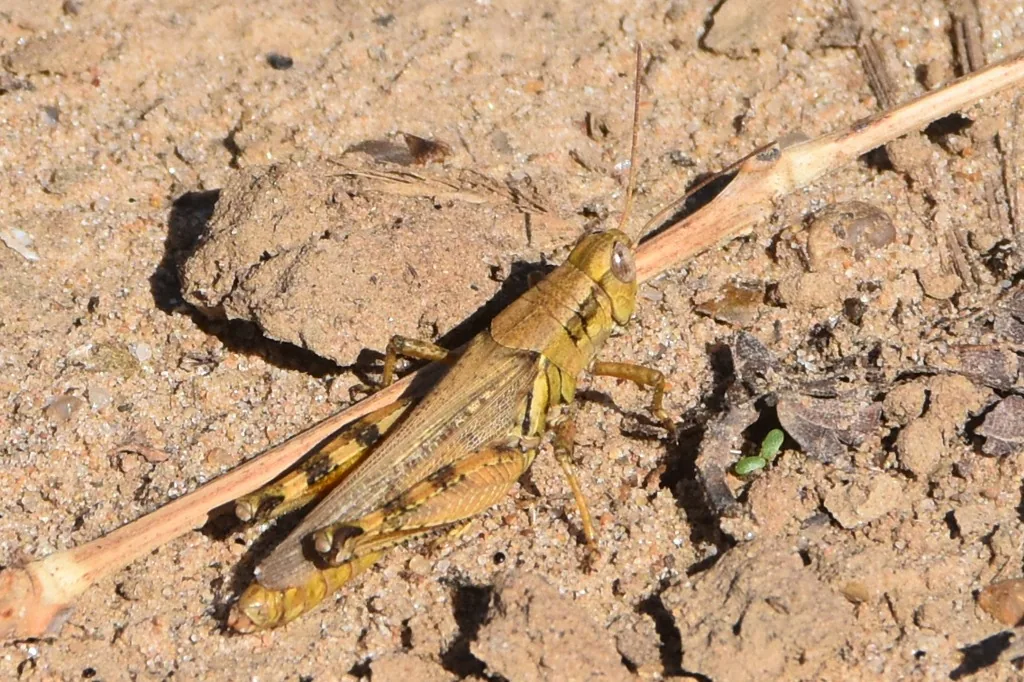
- A large grasshopper: males are 25 to 33 mm long and females 27 to 34 mm. It ranks among the largest third of North American grasshopper species.[1][2]
- A broad brown band runs down the top of the head and the middle of the pronotum, with a pale yellow stripe on each side of it. Those two pale stripes give the grasshopper its name.[1][2]
- Color varies by region. On sandy ground in eastern Wyoming and Colorado adults are bright yellow and brown with strong bars and stripes, while in eastern Oregon they are a dull pale tan with faint markings.[1]
- The hind shins are usually red or pinkish red, though they can be blue, especially farther north. The wings reach a little past the tips of the hind legs and the hind wings are clear.[1][2]
- Telling it from the Packard grasshopper reliably takes a close look at the male's genitalia. Nymphs of the two species are hard to separate, so nymphs found on sandy soil are provisionally called striped sand grasshoppers until adult males can be checked.[1][2]
Look-alikes
| Look-alike | How to tell them apart |
|---|---|
| Packard grasshopper (Melanoplus packardii) | Nearly identical in size and color pattern, but it lives on loamy rather than sandy soils. Certain identification needs the male genitalia: the Packard's valves are equally short, while the striped sand grasshopper's middle valve extends well past the outer one.[1][2] |
| Narrow-winged sand grasshopper (Melanoplus angustipennis) | Similar in appearance, but the striped sand grasshopper is larger.[2] |
Where it lives
Western North America, over nearly the same range as the Packard grasshopper, on sandy soils with native grasses and weedy forbs. In Nebraska it occurs across the western two-thirds of the state and is common in the Sandhills.[1][2]
Biology and life cycle
It eats a wide range of plants but prefers forbs. Crop contents from four states held 56 kinds of forbs, 19 grasses and two sedges. In southwestern Idaho it ate downy brome, thickspike wheatgrass, sunflower, redstem filaree and tumblemustard, and in lab tests it favored dandelion and young green wheat.[1][2]
Eggs hatch early, about the same time as those of the migratory grasshopper. In southeastern Wyoming hatching usually starts in mid-May and runs about two weeks; nymphs take roughly 34 to 42 days to mature, and adults are present from late June through September.[1]
Females lay in bare soil, including the edges of ranch roads, and brush soil over the hole afterward. A pod is half an inch to three-quarters of an inch long and holds 16 to 30 tan eggs.[1]
On native range it spends most of its time on bare ground and shelters under plants at night. In disturbed weedy sites it climbs kochia, Russian thistle, sunflower or sweet clover and roosts head-up on the main stem, a foot or two off the ground.[1]
Adults are strong, wary fliers; in Idaho they commonly fly 30 to 60 feet when disturbed. When upland plants dry out in summer they shift to swales, ravines and irrigated land that are still green.[1]
Damage and signs
- Because it favors weeds and usually occurs at low numbers, it is a minor pest on range. In 12 years of counts at a Wyoming sandy site it never topped one per square yard.[1][2]
- Damaging numbers have occurred on sandy range in western Idaho and eastern Oregon and in weedy land next to crops, where adults moved into wheat, barley, corn and alfalfa. Severe infestations, usually alongside other Melanoplus species, have been reported from Idaho, Nebraska, Kansas, Oklahoma and Texas; one 1961 Idaho outbreak averaged 8 per square yard along roadsides.[1]
Health risk
It is a plant-feeding grasshopper, and the sources describe no health concerns for people.[1][2]
Control
Prevention
Keep an eye on weedy roadsides, field margins and Conservation Reserve Program ground on sandy soil next to small grains, corn or alfalfa. Adults hatched there have moved into crops once the weeds dried down.[1][3]
Biological control
ARS researchers infer that mild spring weather, gentle rain, plenty of preferred food, few predators and little disease let it increase. Predators, parasites and diseases help hold grasshopper numbers down every year.[1][3]
Pesticides
Where a weedy margin holds many nymphs, treating while they are still nymphs works better than chasing adults; nymphs stay where they hatched until they mature. Bran bait laced with carbaryl is an option for roadsides, fence rows and waste ground, but it only kills grasshoppers that eat it. Follow the label.[3][1]
Common questions
- How do I tell a striped sand grasshopper from a Packard grasshopper?
- By habitat, mostly. The striped sand grasshopper lives on sandy soil and the Packard on loam, and the two look almost alike. A sure identification needs a look at an adult male's genitalia.[1][2]
- Will striped sand grasshoppers damage my crops?
- Usually not; they prefer weeds and stay scarce. But they can build up in weedy field edges and roadsides and then move into wheat, barley, corn and alfalfa as adults.[1]
Sources
- USDA Agricultural Research Service, Northern Plains Agricultural Research Laboratory, “Striped Sand Grasshopper, Melanoplus foedus Scudder: species fact sheet, Grasshoppers: Their Biology, Identification and Management.” www.ars.usda.gov/plains-area/sidney-mt/northern-plains-agricultural-research-laboratory/pest-management-research/pmru-docs/grasshoppers-their-biology-identification-and-management/id-tools-apps/fact-sheets/melanoplinae-subfamily/fs-striped-sand/ (accessed 2026-11-09)
- University of Nebraska-Lincoln Extension, “The Grasshoppers (Orthoptera: Acrididae and Romaleidae) of Nebraska, EB3 (M. L. Brust, W. W. Hoback and R. J. Wright).” extensionpubs.unl.edu/publication/eb3/2009/pdf/view/eb3-2009.pdf (accessed 2026-11-09)
- Utah State University Extension, “Grasshoppers (E. Evans and E. Hodgson, June 2008).” extension.usu.edu/planthealth/research/grasshoppers (accessed 2026-11-09)
- iNaturalist, “Melanoplus foedus taxon page (order and family).” www.inaturalist.org/taxa/224663 (accessed 2026-11-09)