On this page
How to identify it
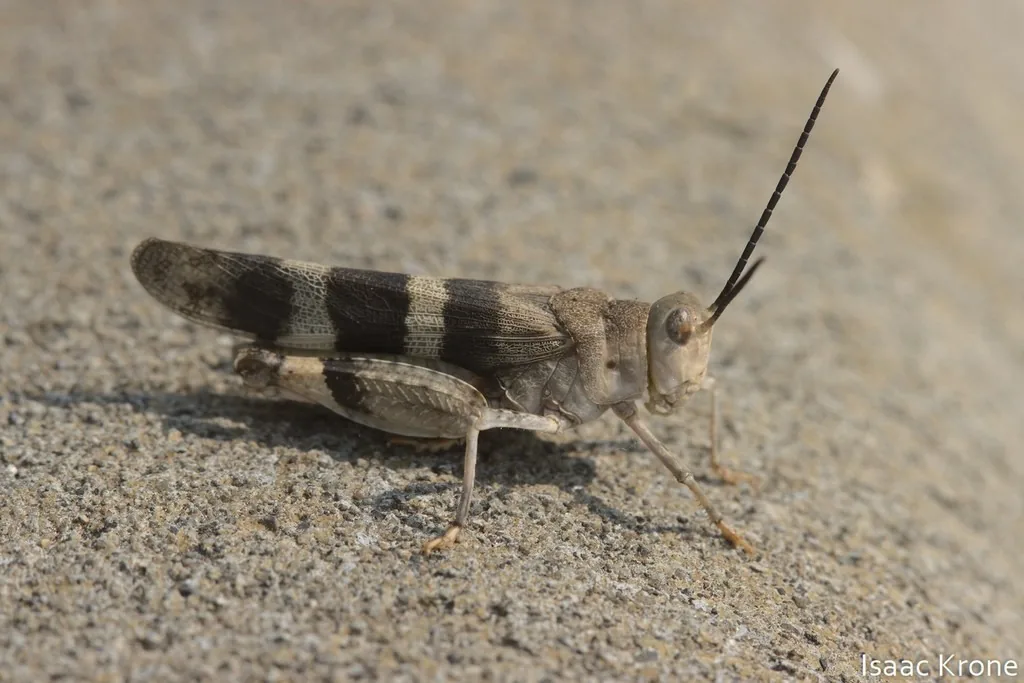
- A large, robust band-winged grasshopper. In Nebraska, males are 24 to 32 mm long and females 33 to 43 mm.[2][1]
- Three sharply marked dark bands cross the folded forewings, on a ground color that matches the local soil: orangish on rust-colored soils, gray or tan where the dirt is pale.[3][2][1]
- The hind legs are colorful. The shins (hind tibiae) are orange to red, and the inner face of each hind thigh (femur) is deep blue over most of its length, crossed toward the end by a whitish band. On the outer face, an oblique dark band is separated from the lighter outer part by a sharp diagonal line.[1][2][3]
- The antennae are long and dark. In flight, the hind wings show a pale yellow to nearly white center with a broad dark border.[1][3][2]
- Nymphs are brown or gray with dark brown spots, and their hind legs are patterned like the adult's.[1]
Look-alikes
| Look-alike | How to tell them apart |
|---|---|
| Band-winged grasshoppers in the genus Trimerotropis | Some Trimerotropis species are easily confused with it, but the three-banded grasshopper is more robust and has a distinctive blue and whitish pattern on the inner hind femur.[2] |
| Lichen grasshopper (Trimerotropis saxatilis) | Listed by the Missouri Department of Conservation as a similar species. The lichen grasshopper is mottled and speckled like lichen-covered rock rather than banded, and its hind tibiae are usually yellow rather than orange-red.[3] |
Where it lives
A grassland species of the desert Southwest, the western rangelands and the Great Plains, ranging from Arizona and Texas north to the Dakotas and southern Alberta and Saskatchewan. It is common in shortgrass, desert and mixedgrass prairie, occurs statewide in Nebraska though more sparsely to the east, and reaches the eastern edge of its range in Missouri.[3][1][2]
Biology and life cycle
It lives on bare and sparsely vegetated ground: gravelly hillsides, eroded shortgrass prairie and, in the tallgrass prairie, sparse gravelly hilltops and slopes.[2][1]
It eats a wide mix of foods: mostly broadleaf plants (forbs), with as many as 40 species recorded, plus grasses, sedges, plant litter, dry cattle dung and dead or weakened insects. Near North Platte, Nebraska, forbs made up 75 percent of crop contents, with scarlet globemallow the most common.[1][2]
It hatches early in the season, in early May in the Southwest and usually late May in eastern Wyoming. The nymphs need only four stages, but development is slow, about 56 to 62 days.[1]
Adults appear in mid-June in southwest Texas and Arizona and about a month later in Montana and Wyoming; in Nebraska they are most common from mid-July to early September.[1][2]
About a month after becoming adults, females retreat into grass cover and lay through the plant litter into the soil. The egg pod is about an inch long, strongly curved, and holds 18 to 26 eggs.[1]
It is a ground dweller. It spends the night on the soil surface, basks in the morning sun, and when bare soil gets hotter than about 120 degrees F it climbs onto litter or up grass stems to get off the ground.[1]
It is a strong flier with wings that extend well past the abdomen. Flushed adults crackle in flight, males covering about 9 to 24 feet and the heavier females 6 to 15 feet.[1]
Damage and signs
- Its numbers are low across most western grasslands, from under 0.1 to 0.3 per square yard in mixedgrass prairie, so it matters little either as a pest or as a beneficial insect. It feeds more heavily on poor forage plants and on plants poisonous to livestock, such as death camas, milkweeds and some milkvetches, than on good forage grasses. The University of Nebraska rates its economic importance as none.[1][2]
Health risk
It is a plant-feeding grasshopper of open grassland, and none of these sources describes any risk to people.[1][2][3]
Control
Prevention
No control is needed. Its densities stay low from year to year, and it is not rated as an economic pest on rangeland.[1][2]
Common questions
- What grasshopper has blue on the inside of its back legs?
- The three-banded grasshopper. Its hind thighs are deep blue on the inner face, its shins are orange to red, and three dark bands cross its brown body.[3][2]
- Is it a threat to pasture?
- No. It feeds mainly on broadleaf plants, including poor forage and plants poisonous to livestock, and its numbers stay low, so it has little effect on grazing land.[1][2]
- Why is it so hard to see on the ground?
- The dark crossbands break up its outline, and its body color varies to match the soil it lives on, from orangish on red soils to gray or tan on pale ground.[3]
Sources
- USDA Agricultural Research Service, Northern Plains Agricultural Research Laboratory, “Threebanded Grasshopper, Hadrotettix trifasciatus (Say): species fact sheet (Wyoming Agricultural Experiment Station Bulletin 912, September 1994), Grasshoppers: Their Biology, Identification and Management.” www.ars.usda.gov/plains-area/sidney-mt/northern-plains-agricultural-research-laboratory/pest-management-research/pmru-docs/grasshoppers-their-biology-identification-and-management/id-tools-apps/fact-sheets/oedipodinae-subfamily/fs-threebanded/ (accessed 2026-11-09)
- University of Nebraska-Lincoln Extension, “The Grasshoppers (Orthoptera: Acrididae and Romaleidae) of Nebraska, EB3 (M. L. Brust, W. W. Hoback and R. J. Wright).” extensionpubs.unl.edu/publication/eb3/2009/pdf/view/eb3-2009.pdf (accessed 2026-11-09)
- Missouri Department of Conservation, “Three-Banded Grasshopper (Field Guide).” mdc.mo.gov/discover-nature/field-guide/three-banded-grasshopper (accessed 2026-11-09)
- iNaturalist, “Hadrotettix trifasciatus taxon page (order and family).” www.inaturalist.org/taxa/202166 (accessed 2026-11-09)