On this page
How to identify it
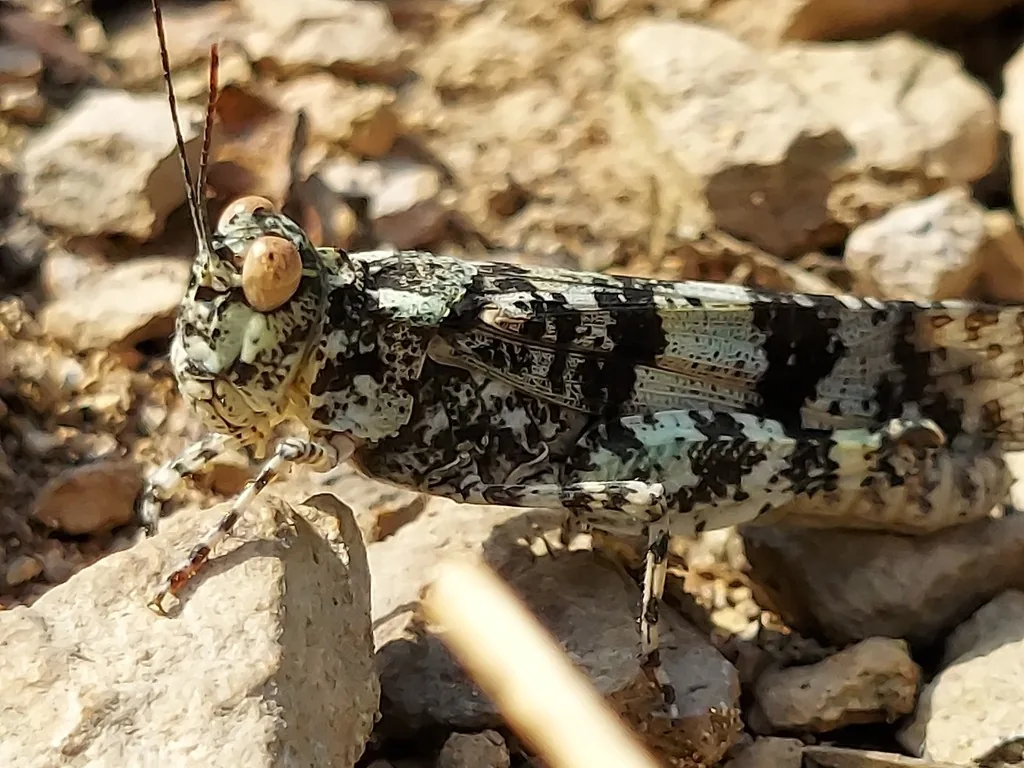
- Its body is mottled and speckled like lichen-covered rock. The overall color follows the rocks it lives on, so individuals may be greenish, tan, brown, gray, yellowish or slightly rusty.[1]
- The hind tibiae (shins) are usually yellow, sometimes darker brown.[1]
- When the wings open, the hind wings are pale yellow on the inner half, crossed by a dark band that widens toward the front and back edges, and clear beyond it.[1]
- It is one of the band-winged grasshoppers. Other names for it include rock-loving locust and rock grasshopper.[1]
Look-alikes
| Look-alike | How to tell them apart |
|---|---|
| Three-banded grasshopper (Hadrotettix trifasciatus) | Another bandwing of open, sunny ground listed as a similar species. It carries three sharp dark crossbands rather than a speckled pattern, and its hind shins are orange-red with deep blue on the inner hind thighs.[1] |
Where it lives
It ranges from eastern Colorado, Wyoming and northeastern New Mexico east to the western Carolinas and Georgia. Its strongholds are the Ozarks, the Ouachitas and the southern Appalachians, along with the eastern Rockies and rocky places in the Great Plains.[1][2]
Biology and life cycle
It is tied to open, rocky habitat. In Missouri it lives on glades of limestone, dolomite, chert, sandstone or granite, usually on hilltops or other high ground, and each population tends to occupy a single glade.[1][2]
When disturbed it hops or flies off, but it almost never enters the surrounding woods; it circles back to stay in the open. A study of marked grasshoppers found that a closed-canopy forest, more than distance, is what stops them from dispersing.[1][2]
Because of this, populations on separate glades do not interbreed; genetic data suggest no gene flow among them. Missouri populations studied by mark and recapture were all small, fewer than 280 individuals, and varied from year to year.[2][1]
Adults appear in late spring or early summer and can be found until hard freezes in fall. The eggs spend the winter.[1]
It is one of three abundant grasshoppers on Ozark glades studied for the effects of collared lizards, a predator on some glades; lichen grasshoppers living with lizards showed shifts in body chemistry but no change in body shape.[3]
Damage and signs
Health risk
It is a harmless grasshopper of open, rocky ground, and none of these sources describes any risk to people.[1][2]
Control
Prevention
No control is needed; leave it alone. Glade conservation is what matters for this species: many glades have been overgrown by eastern red cedar and turned to forest after long fire suppression, and restoration with cedar removal and prescribed fire keeps them open. Because forest blocks movement between glades, a population that dies out on one glade cannot easily be replaced from another.[1][2]
Common questions
- Why does this grasshopper look like a rock?
- Its mottled, speckled pattern matches the lichens growing on glade rocks, and its color varies with the color of the local stone, which makes it very hard to see until it flies.[1]
- Will it spread into my yard?
- Unlikely. It sticks to open, rocky glades and almost never enters woodland, even when chased, so it stays in its own patch of habitat.[1][2]
- Does burning a glade hurt lichen grasshoppers?
- At Graham Cave Glade in Missouri, burning and clearing began after the 1991 field season, and researchers found no significant change in how far the grasshoppers moved within the glade before and after. Fire and cedar removal are the main tools used to keep glade habitat open.[2][1]
Sources
- Missouri Department of Conservation, “Lichen Grasshopper (Field Guide).” mdc.mo.gov/discover-nature/field-guide/lichen-grasshopper (accessed 2026-11-09)
- Oecologia (Springer), “Gerber and Templeton. Population sizes and within-deme movement of Trimerotropis saxatilis (Acrididae), a grasshopper with a fragmented distribution. Oecologia 105: 343-350 (1996), doi:10.1007/BF00328737 (abstract, PubMed 28307107).” doi.org/10.1007/BF00328737 (accessed 2026-11-09)
- Oecologia (Springer), “Redinger, Halvorson and Gifford. Variable stoichiometric and macronutrient responses to lizard predation in Ozark glade grasshopper communities. Oecologia 199: 757-768 (2022), doi:10.1007/s00442-022-05185-w (abstract, PubMed 35610326).” doi.org/10.1007/s00442-022-05185-w (accessed 2026-11-09)
- iNaturalist, “Trimerotropis saxatilis taxon page (order and family).” www.inaturalist.org/taxa/194289 (accessed 2026-11-09)