On this page
How to identify it
- Small: most species never exceed 3/4 inch, and males are often only about two-thirds as long as females.[1]
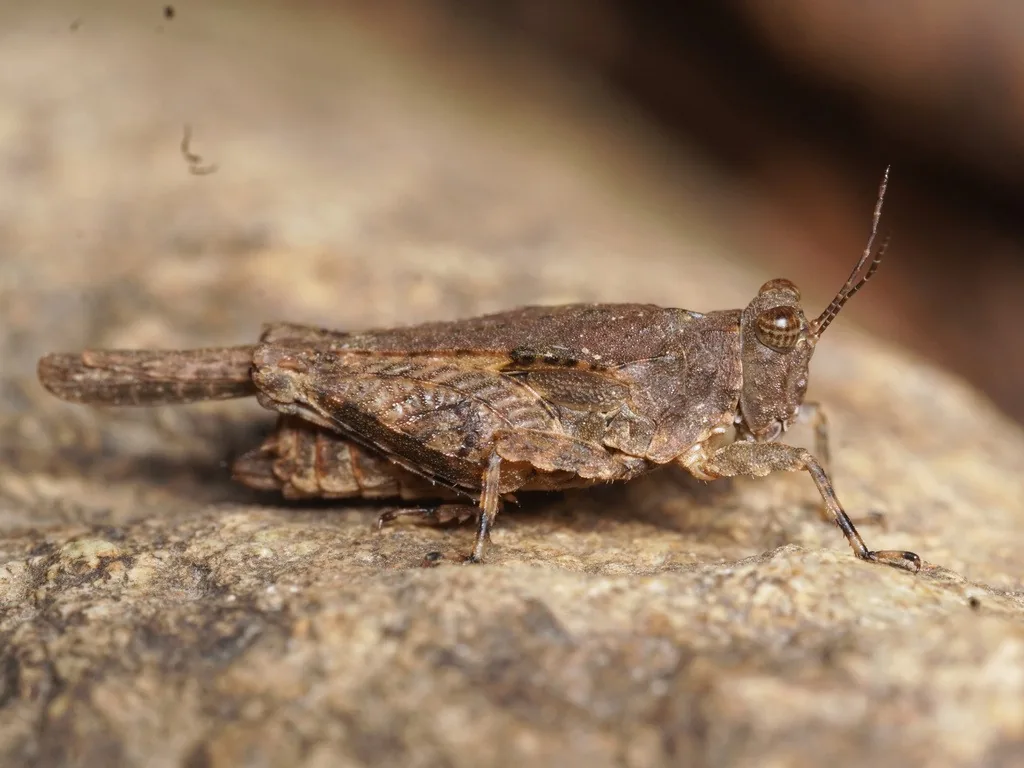
- The plate behind the head (the pronotum), which is short in other grasshoppers, is long and tapered in pygmy grasshoppers and usually stretches back over the whole abdomen, covering or mostly covering the wings.[1]
- The front wings are tiny pads or missing. The flying wings may be long, short or absent, and some species have both short- and long-winged forms.[1]
- Coloring is drab and camouflaged and often matches the local soil or rock, so the pattern of light and dark is more useful for identification than the exact color. The hind thighs are large and heavy, and the feet have 2, 2 and 3 segments on the front, middle and hind legs.[1]
Where it lives
About 30 species occur in North America north of Mexico, out of more than 1,600 worldwide. Common eastern species reach west to Texas, Colorado and Arizona, and the hooded grouse locust ranges across eastern North America west to Washington and Oregon.[1]
Biology and life cycle
Most species live at the edges of rivers, creeks, ponds and lakes or in wetlands and other damp places. Some are truly semiaquatic: they jump into the water and swim beneath the surface to escape, some have widened hind shins that help them swim, and they may even lay their eggs in water. A few species live in drier upland habitats.[1]
They eat small plants and organic matter near the water: algae, exposed roots, mosses, fungi and muck. Studies of groundhoppers in different regions find a remarkably consistent diet of about 80 to 90 percent detritus (soil particles with decomposed organic matter), 12 to 15 percent moss, and small amounts of pollen, fungi and algae.[1][2]
Unlike most grasshoppers, which die in fall and overwinter as eggs, pygmy grasshoppers usually spend the winter as adults. They are among the first grasshoppers active in spring and the last in fall, can be seen on warm winter days, and breed in late spring, when groups gather along pond edges. Some species may live more than two years.[1]
Toad bugs, which share their streamside habitats, often prey on them.[1]
Damage and signs
Health risk
They are small grasshoppers that eat detritus and mosses; neither the Missouri Department of Conservation nor the diet research describes any risk to people.[1][2]
Control
Prevention
No control is needed; leave them alone. Pygmy grasshoppers are part of the life of stream banks, pond edges and wetlands, feeding on detritus and mosses and serving as prey for toad bugs.[1][2]
Common North American pygmy grasshoppers
Hooded grouse locust (Paratettix cucullatus). A common pygmy grasshopper, usually camouflaged gray or tan but sometimes black or brown, with globe-shaped, prominent eyes and obvious lobes on the middle legs. It always has long wings and is often seen on gravel bars and wet, sandy shorelines.[1]
Black-sided pygmy grasshopper (Tettigidea lateralis). Usually has dark sides contrasting with a lighter top, and a light spot on the hind thigh. At up to about 5/8 inch it is large for a pygmy grasshopper, and it also turns up in dry places.[1]
Crested pygmy grasshopper (Nomotettix cristatus). A chunky, stubby species no more than about 3/8 inch long, with a crest along the middle of its pronotum, which reaches back only as far as the hind knee. It usually lives in fairly dry habitats.[1]
Common questions
- What is the tiny grasshopper with a long shield over its back near my pond?
- Probably a pygmy grasshopper. Its pronotum stretches back over the abdomen like a long shield, most species are under 3/4 inch, and many live along pond edges and streams.[1]
- Can pygmy grasshoppers swim?
- Some can. Semiaquatic species jump into the water and swim beneath the surface to escape danger, and some have widened hind shins that help them swim.[1]
- Why do I see small grasshoppers in late winter or early spring?
- Pygmy grasshoppers usually overwinter as adults, so they can become active as soon as it warms up and are among the first grasshoppers seen in spring. They may even appear on warm winter days.[1]
Sources
- Missouri Department of Conservation, “Pygmy Grasshoppers, Field Guide.” mdc.mo.gov/discover-nature/field-guide/pygmy-grasshoppers (accessed 2026-11-09)
- PeerJ; PMC7676350, “Kuřavová, Šipoš and Kočárek 2020. Energy balance of food in a detrito-bryophagous groundhopper (Orthoptera: Tetrigidae). PeerJ 8:e9603.” pmc.ncbi.nlm.nih.gov/articles/PMC7676350/ (accessed 2026-11-09)
- iNaturalist, “Tetrigidae taxon page (order and family).” www.inaturalist.org/taxa/57658 (accessed 2026-11-09)