On this page
How to identify it
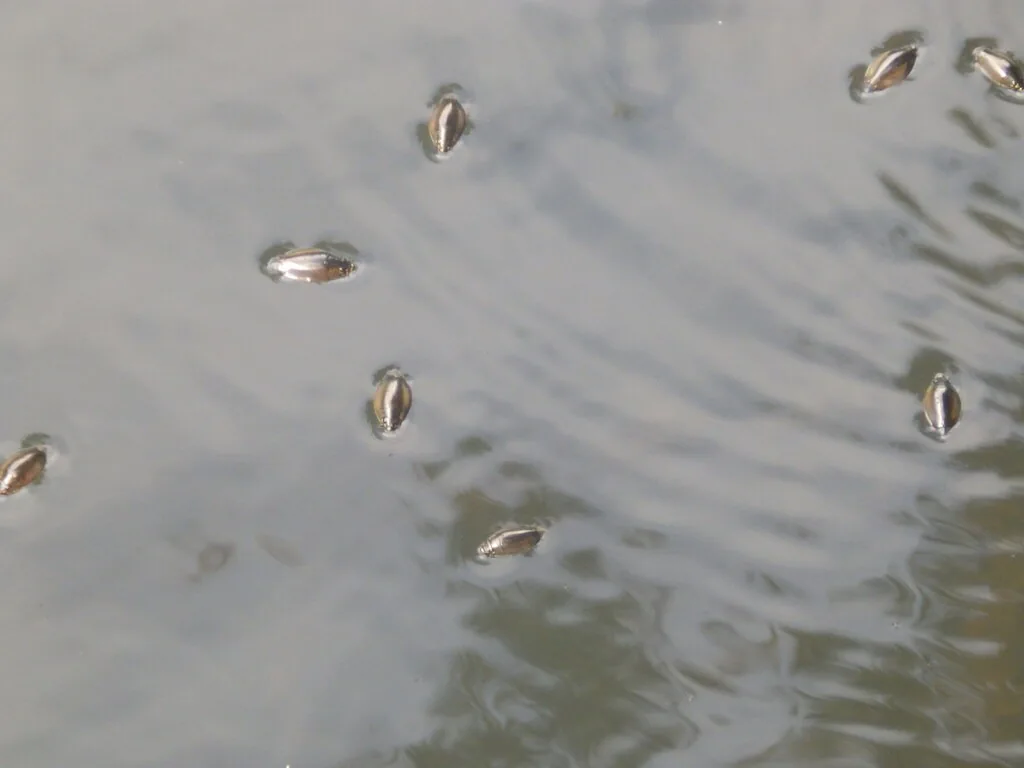
- Adults are oval, streamlined and usually blackish, sometimes bronzy or metallic, about 1/4 to 3/4 inch long depending on species.[1]
- Each eye is split in two, giving them two pairs of compound eyes: one pair looks above the water and the other below. Together with their short, clubbed antennae, this sets them apart from all other beetles.[1][2]
- The front legs are long and slender, while the middle and hind legs are short, flattened paddles folded tightly under the body.[1]
- They are usually seen in groups, whirling rapidly around each other on the water surface.[1][2]
- The larvae are pale, long and flattened, with three pairs of legs and eight pairs of feathery gills sticking out from the sides of the abdomen.[1]
Look-alikes
| Look-alike | How to tell them apart |
|---|---|
| Predaceous diving beetles (Dytiscidae) | Missouri lists diving beetles as similar water beetles. Diving beetles have long, threadlike antennae and usually rest hanging head down below the surface, while whirligigs have short, clubbed antennae and swim in groups on top of the water.[1][4] |
Where it lives
They live in many kinds of fresh water, including ponds, lakes and streams, and are found statewide in Missouri. Dineutus americanus is one common species.[1][3]
Biology and life cycle
Adults feed mostly on land insects that fall into the water. Ripples from a struggling insect draw them in, and a group may crowd around one meal, each taking bites; they also scavenge dead animals and sometimes eat other whirligigs.[1][2]
They sense ripples on the water to find food and to keep track of other whirligigs. Where a beetle swims in a group, at the edge or the center, depends on its sex, condition and hunger.[1]
They swim almost as easily underwater as on the surface, and they dive by carrying a bubble of air under the wing covers at the end of the abdomen.[1][2]
Eggs are laid on submerged plants. The larvae live underwater, crawling on the bottom and eating small worms, midge larvae and other aquatic insects; when grown they crawl out of the water and pupate on nearby plants.[1][2]
Adults spend the winter in mud and debris and come out in spring to form hunting groups. Their wings are well developed, so they can fly to new water if a pond or stream dries up.[1]
Fish, newts, frogs, birds and backswimmers prey on them. Fast swimming, sharp turns, diving and gathering in groups help them escape, and adults of the common genera Gyrinus and Dineutus release foul-smelling fluids from glands at the tip of the abdomen that deter fish and newts and alert nearby beetles.[3][2][1]
Damage and signs
Health risk
None of these sources describes any risk to people; their chemical defense is aimed at fish and other predators that try to eat them.[1][2][3]
Control
Prevention
No control is needed; leave them alone. Whirligig beetles are a normal part of pond and stream life, feeding on insects that fall into the water and in turn feeding fish and other animals.[1]
Common questions
- What are the little black beetles spinning in circles on my pond?
- Those are whirligig beetles. They gather in groups on the surface and whirl around each other while hunting for insects that have fallen into the water.[1][2]
- How can they see above and below the water at once?
- Their eyes are divided, so each beetle has one pair of eyes above the waterline and one pair below. This helps them catch prey and avoid predators.[1][2]
- Why don't fish eat them?
- Many predators do try, but whirligigs are fast and hard to catch, and when a fish grabs one it releases a distasteful chemical. Invasive bullfrogs in Japan, however, ate them easily in laboratory tests.[2][1][3]
Sources
- Missouri Department of Conservation, “Whirligig Beetles (Field Guide).” mdc.mo.gov/discover-nature/field-guide/whirligig-beetles (accessed 2026-11-09)
- Mississippi Entomological Museum, Mississippi State University, “Whirligig Beetle (Coleoptera: Gyrinidae) fact sheet (N. Artley, August 2023).” www.mem.org.msstate.edu/MIMS/FactSheets/26_Whirligig.pdf (accessed 2026-11-09)
- PeerJ, full text in PubMed Central (PMC11027905), “Sugiura. Defenses of whirligig beetles against native and invasive frogs. PeerJ 12: e17214 (2024), doi:10.7717/peerj.17214.” doi.org/10.7717/peerj.17214 (accessed 2026-11-09)
- Missouri Department of Conservation, “Predaceous Diving Beetles (Water Tigers) (Field Guide).” mdc.mo.gov/discover-nature/field-guide/predaceous-diving-beetles-water-tigers (accessed 2026-11-09)
- iNaturalist, “Gyrinidae taxon page (order and family).” www.inaturalist.org/taxa/119971 (accessed 2026-11-09)