On this page
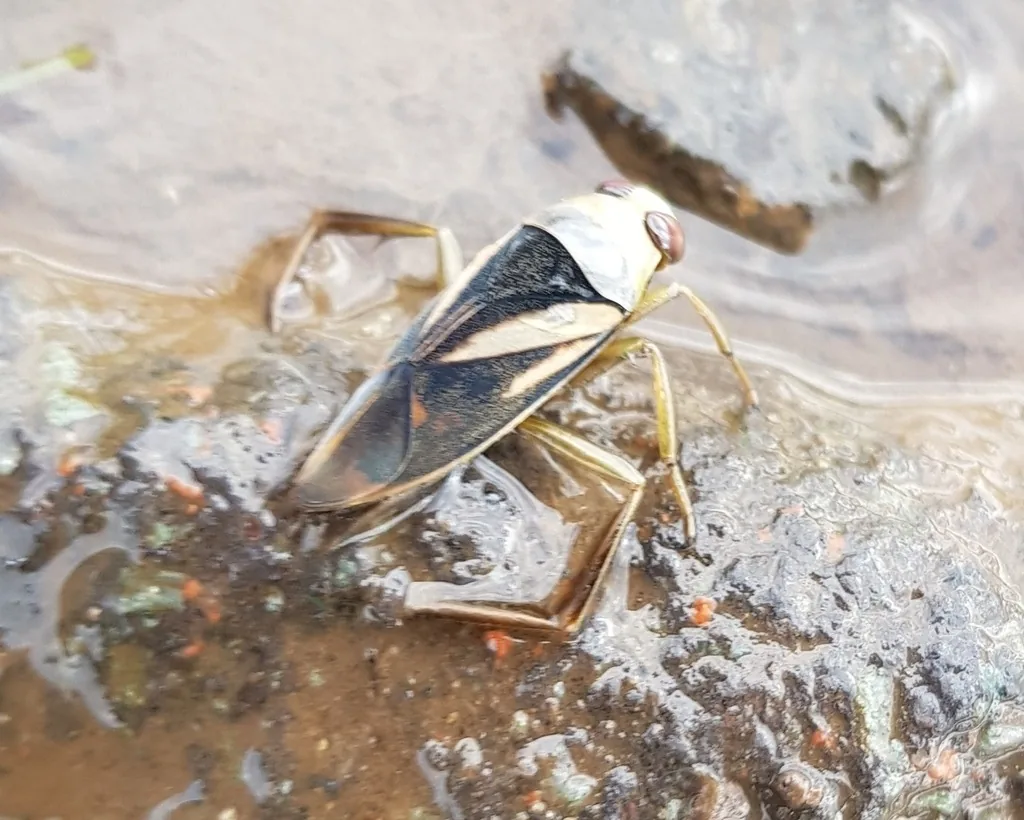
How to identify it
Look-alikes
| Look-alike | How to tell them apart |
|---|---|
| Water boatmen | Water boatmen swim right side up, have flatter, usually darker bodies with fine parallel crosslines on the back, and don't prey on animals or bite.[1] |
Where it lives
About 32 species occur in North America, in ponds and quiet areas of lakes and streams.[1][2]
Biology and life cycle
They lie in wait for prey such as other aquatic insects, tadpoles and small fish, then lunge and inject saliva that subdues the prey and begins digesting it; backswimmers also eat mosquito larvae.[1][2]
Females glue elongated eggs to the stems of submerged plants, and the young look like small wingless adults.[1]
Damage and signs
- Adults fly to artificial lights at night and are clumsy out of water, so they often land in swimming pools after a night's flight.[1]
Health risk
Backswimmers can deliver a painful bite if mishandled or pressed against skin, so take care handling them.[1]
Control
Keep them out
Because they are drawn to lights at night, lighting near a pool can draw more of them in.[1]
Traps and physical control
Scoop them out of pools with a skimmer rather than by hand, since they can bite.[1]
Common questions
- What bit me in the swimming pool?
- A sharp, painful bite while swimming, especially after pool lights were on overnight, is often a backswimmer, a water bug that swims upside down.[1]
- How do I tell backswimmers from water boatmen?
- Backswimmers swim upside down and have a keeled back without crosslines; water boatmen swim right side up, have fine parallel lines on the back and don't bite.[1]
Sources
- Missouri Department of Conservation, “Backswimmers (field guide).” mdc.mo.gov/discover-nature/field-guide/backswimmers (accessed 2026-10-17)
- UF/IFAS Extension (EDIS), “Common Backswimmer, Notonecta glauca (Featured Creatures, EENY-738).” edis.ifas.ufl.edu/publication/IN1262 (accessed 2026-10-17)
- iNaturalist, “Notonectidae taxon page (order and family).” www.inaturalist.org/taxa/56556 (accessed 2026-10-06)