On this page
How to identify it
- Adults are usually 3/4 to 1 1/2 inches long, and some species have a wingspan of up to 4 inches.[1]
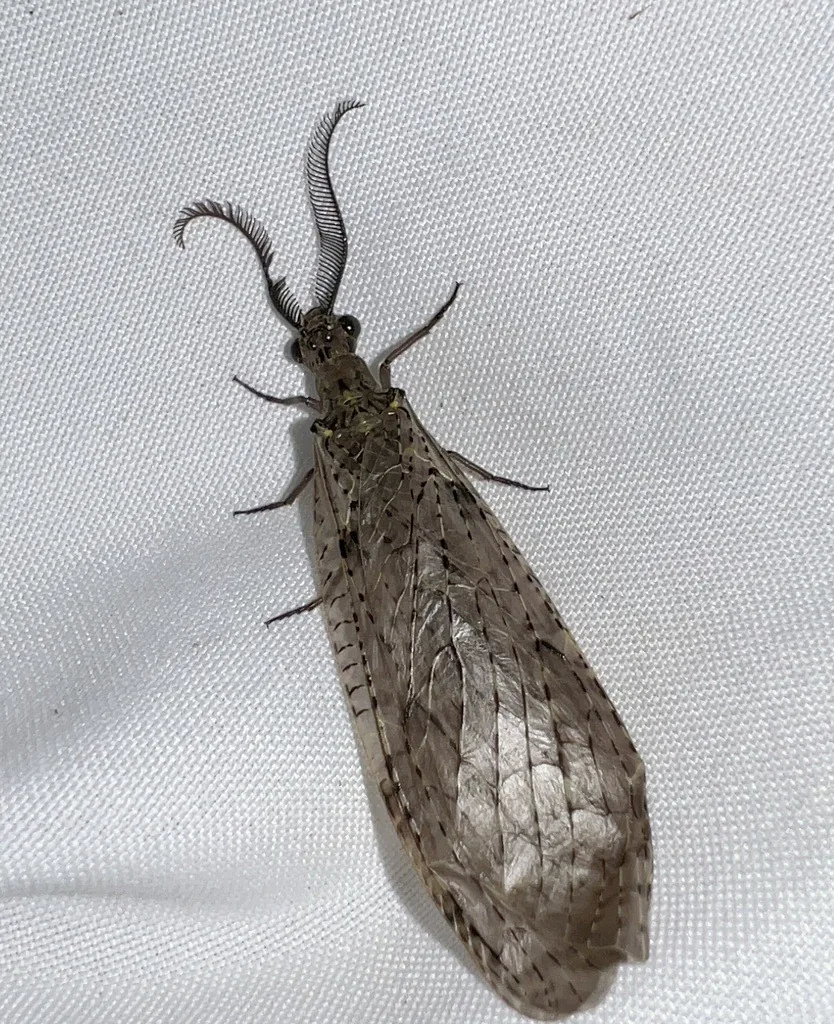
- Most species are light colored, gray, tan or rusty, with clear, gray or pale wings. Nigronia species have black wings with white marks.[1]
- Males often have large, feathery or comblike antennae; the females' antennae are thin and beadlike.[1]
- Fishflies lack the large, tusklike jaws that male dobsonflies are known for.[1]
- The larvae look like small hellgrammites, usually tan with a reddish cast, but have no gill tufts under the abdomen. The abdomen ends in two short, fleshy tails, each with a pair of hooks.[2]
- Fishfly larvae breathe mainly air through a pair of breathing tubes on the top of the abdomen, while dobsonfly larvae live in deeper water and absorb oxygen through gills on the underside of the abdomen.[3]
Look-alikes
| Look-alike | How to tell them apart |
|---|---|
| Eastern dobsonfly and hellgrammites | Dobsonflies are larger, with forewings usually over 2 inches long. Males have long tusklike jaws and no comblike antennae, and females have stronger jaws and a differently shaped pronotum than female fishflies. Hellgrammites are usually dark brown or black, larger, and have cottony gill tufts along the abdomen.[1][2] |
| Alderflies | Adult alderflies are smaller, usually 1 inch long or less, and blackish, and they hold their wings rooflike over the body. They also lack the simple eyes (ocelli) that fishflies have between the compound eyes.[1] |
Where it lives
North America has roughly 18 to 19 fishfly species. In the eastern United States they belong to Chauliodes, Neohermes and Nigronia, and western species include Dysmicohermes and Orohermes. A genetic study of the saw-combed fishfly, Nigronia serricornis, sampled populations from Tennessee, Kentucky and North Carolina north to Wisconsin, Michigan, Ontario, New York and Maine. MDC lists fishflies statewide in Missouri.[1][3][4]
Biology and life cycle
Females lay egg masses on leaves or branches hanging over water, and the young larvae move into the water soon after hatching.[1]
Larvae spend one to three years in the water and are omnivorous or predatory, depending on the species. Some prefer slow, debris-littered water, including stream edges, while others need clearer, faster, better-oxygenated streams. They often hide among stones.[2]
Larvae crawl out of the water to pupate in a sheltered spot: in soil, in rotting wood or behind loose bark.[1]
Adult life is short, sometimes less than a week. Adults generally do not eat; they mate, lay eggs and die soon afterward.[1]
Fishfly larvae are one of several groups of aquatic insects whose presence usually means good water quality, and stream ecologists treat them as a sign of a healthy stream. The saw-combed fishfly is studied as an environmental indicator species.[2][4]
Damage and signs
Health risk
Adults do not eat, but they can pinch hard if mishandled. The larvae can also pinch with their stout mouthparts, so MDC suggests holding one just behind the head or using forceps.[1][2]
Control
Prevention
No control is needed. Fishflies are harmless, and their larvae are a sign of a healthy stream nearby.[1][2]
Common questions
- Can a fishfly hurt me?
- MDC calls adult fishflies harmless, but they can pinch hard if you mishandle them, and so can the larvae.[1][2]
- How do I tell a fishfly from a dobsonfly?
- Fishflies are smaller, with forewings usually under 2 inches, and no fishfly has the long tusklike jaws of a male dobsonfly. Male fishflies often have comblike or feathery antennae, which male dobsonflies lack.[1]
- Why is there a fishfly at my porch light?
- Adults usually stay in the plants along the streams their larvae need, but they sometimes come to lights at night.[1]
Sources
- Missouri Department of Conservation, “Fishflies (Field Guide).” mdc.mo.gov/discover-nature/field-guide/fishflies (accessed 2026-11-09)
- Missouri Department of Conservation, “Fishfly Larvae (Field Guide).” mdc.mo.gov/discover-nature/field-guide/fishfly-larvae (accessed 2026-11-09)
- Comparative Cytogenetics (Pensoft), full text in PubMed Central (PMC12018883), “Chromosomes of four fishfly species (Megaloptera, Corydalidae, Chauliodinae) from North America. Comparative Cytogenetics (2025).” pmc.ncbi.nlm.nih.gov/articles/PMC12018883/ (accessed 2026-11-09)
- Molecular Ecology (Wiley), indexed in PubMed (PMID 16629816), “Heilveil and Berlocher. Phylogeography of postglacial range expansion in Nigronia serricornis Say (Megaloptera: Corydalidae). Molecular Ecology 15: 1627-1641 (2006), doi:10.1111/j.1365-294X.2006.02876.x (abstract).” doi.org/10.1111/j.1365-294X.2006.02876.x (accessed 2026-11-09)
- iNaturalist, “Chauliodinae taxon page (order and family).” www.inaturalist.org/taxa/83350 (accessed 2026-11-09)