The short answer
- Turn outdoor lights off when you don't need them, and don't leave them on for long periods. University of Georgia Extension calls this the simplest fix.[1]
- Use yellow or sodium vapor bulbs instead of white, neon or mercury vapor lights. Yellow or amber-filtered LEDs also draw fewer flying insects.[1][9][2][10]
- Close blinds or curtains at night. Light shining out through windows pulls in insects too.[1][17]
- Don't bother spraying the swarm. You may kill a few with an aerosol, but hundreds more come back the next night.[1]
- Fewer insects at the light also means fewer spiders. Spiders build webs where the insects gather.[2][3][13]
Insects you'll see at the light
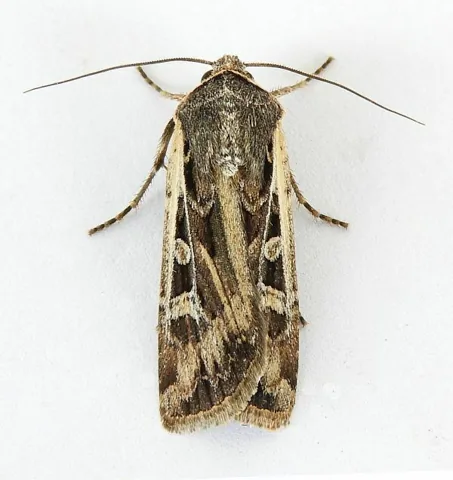 Miller Moth (Army Cutworm Moth)
Euxoa auxiliaris
Miller is a name for any moth that turns up in large numbers around homes. In Colorado and much of the Rocky Mountain West it is mainly the adult army cutworm, which passes through on a yearly migration from the plains to the mountains.
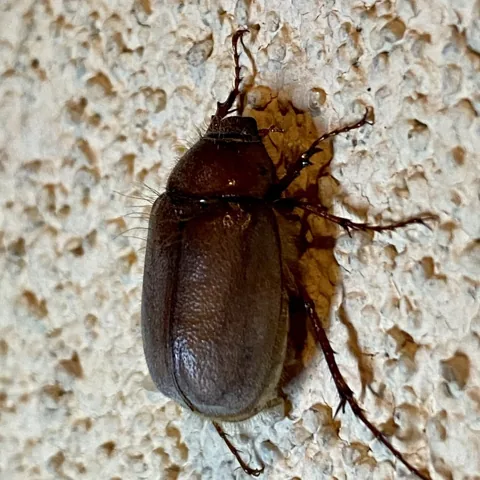 May and June Beetles
Phyllophaga species
May and June beetles, or June bugs, are native scarab beetles in the genus Phyllophaga. The adults buzz around porch lights on early summer nights, while their C-shaped grubs feed on roots, mostly in turf.
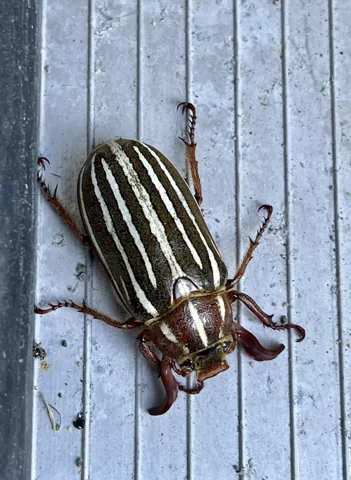 Ten-lined June Beetle
Polyphylla decemlineata
The ten-lined June beetle is a big, striped scarab of the western U.S. and Canada. Males fly to lights on summer nights and the beetles can hiss loudly when disturbed, but Colorado State calls them harmless. In yards the grubs rarely cause noticeable injury, though in some orchards and new poplar plantings they kill trees.
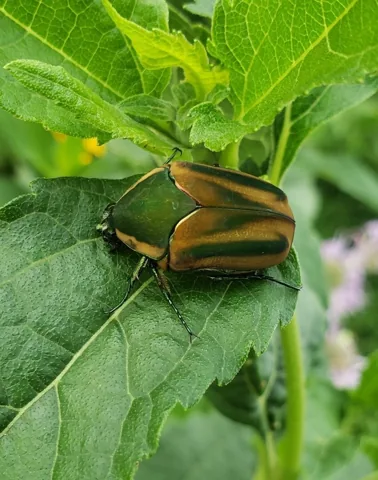 Green June Beetle
Cotinis nitida
Green June beetles are large, metallic green scarabs that cruise a few feet above lawns on summer days with a loud buzz. They are harmless to people; the adults damage ripe fruit, and their oversized grubs burrow in lawns rich in organic matter.
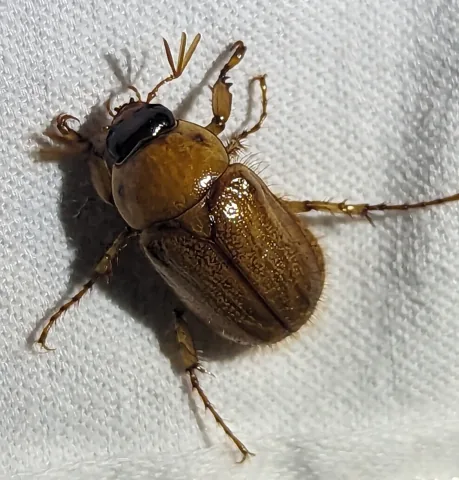 Masked Chafers
Cyclocephala species (northern masked chafer, C. borealis; southern masked chafer, C. lurida)
Masked chafers are native North American beetles whose larvae, called white grubs, feed on turfgrass roots. The adults don't feed at all; the grubs do the damage, mostly in late summer and fall.
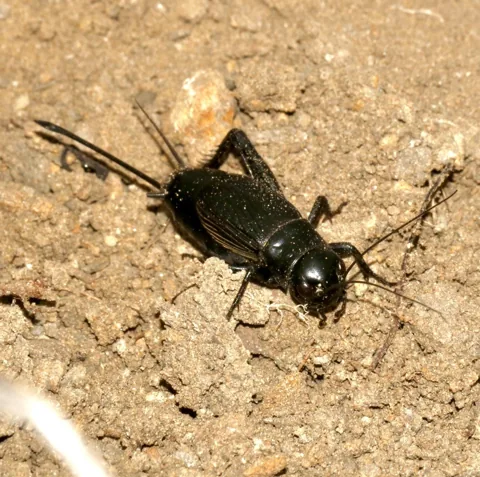 Field Crickets
Gryllus species (e.g., G. pennsylvanicus)
Field crickets are several species in the genus Gryllus that live outdoors in fields, pastures, roadsides and yards. They come into homes most often in late summer and fall, when cooler nights and outdoor lights draw them toward buildings.
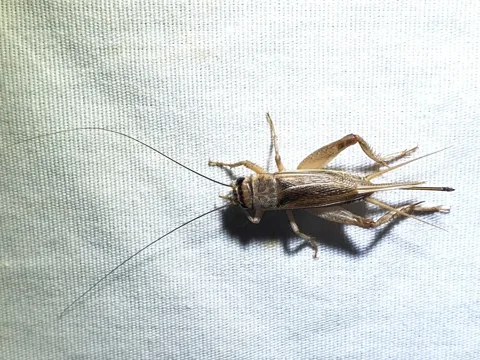 House Cricket
Acheta domesticus
The house cricket is a light brown cricket that is common outdoors, strongly attracted to light and often found inside houses, especially in late summer and fall.
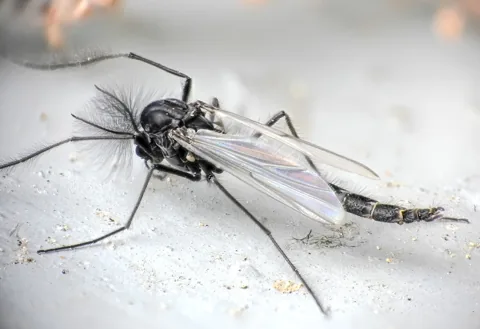 Non-Biting Midges
Family Chironomidae
Non-biting midges (family Chironomidae) are small, delicate flies that grow up in water and emerge in large swarms near ponds, lakes and streams. They are often mistaken for mosquitoes, but they don't bite; the problem is sheer numbers.
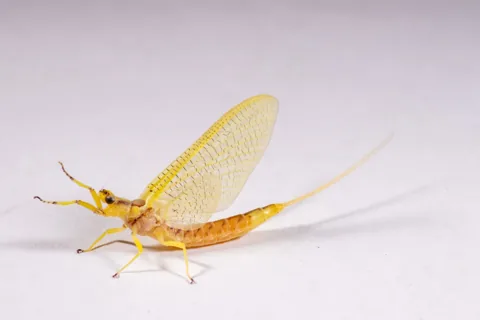 Mayflies
Order Ephemeroptera (e.g., Hexagenia limbata, the giant mayfly)
Mayflies spend most of their lives as aquatic nymphs, then emerge as winged adults that live only a few days at most. Big hatches near lakes and rivers can coat walkways, roads and lit buildings.
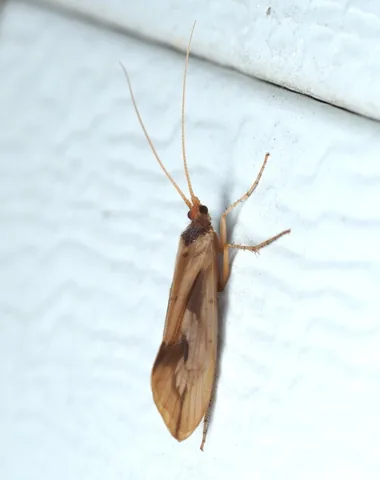 Caddisflies
Order Trichoptera (many species)
Caddisflies are moth-like insects whose young live in water; adults gather around lights near rivers, lakes and wetlands and are a harmless, temporary nuisance.
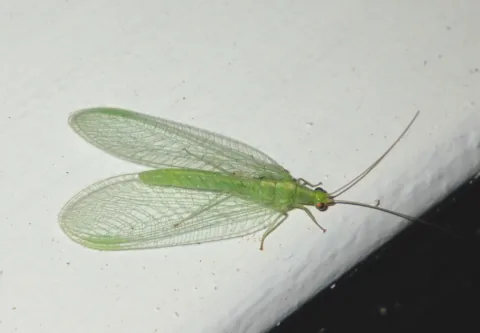 Green Lacewings
Chrysoperla species (e.g., C. carnea)
Green lacewings are beneficial insects, not pests. Their larvae, nicknamed aphid lions, are voracious predators of aphids and other soft-bodied insects, and they rank alongside lady beetles as important natural enemies in gardens and landscapes.
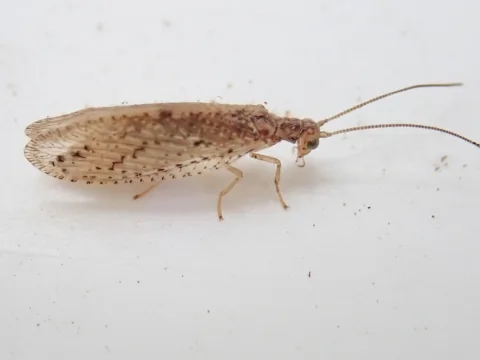 Brown Lacewings
Hemerobiidae (most common genus: Hemerobius)
Brown lacewings are smaller cousins of green lacewings, and both their larvae and adults hunt aphids and other soft-bodied pests, mostly on trees and shrubs.
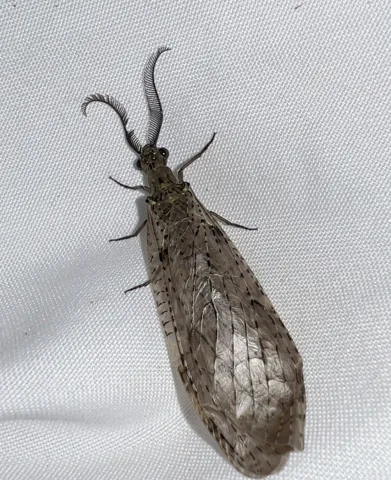 Fishflies
Chauliodinae (eastern US genera: Chauliodes, Neohermes, Nigronia)
Fishflies are smaller relatives of dobsonflies: usually gray, tan or rusty insects whose two pairs of wings fold flat along the body. Their larvae live in water for one to three years, and the short-lived adults stay in vegetation along streams and sometimes fly to lights at night.
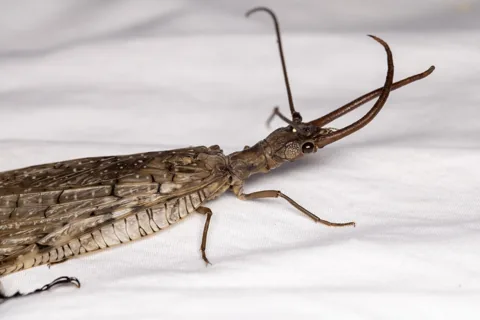 Eastern Dobsonfly
Corydalus cornutus
The eastern dobsonfly is one of the largest aquatic insects in the country. Despite the male's scary-looking tusks, only the female's short jaws can give a painful pinch.
Which bugs come to porch lights
Moths are the classic porch-light visitor. In the West, the big spring flights are usually miller moths, the adult stage of the army cutworm. Colorado State University says they have a wingspan of 1.5 to 2 inches, are gray or light brown with wavy markings, and fly in outbreak years for five to six weeks, generally starting between mid-May and early June. Montana State University says they are attracted to lights and suggests turning off porch lights. Our guide to moths in the house covers the moths that do breed indoors.[4][5]
May and June beetles (June bugs) are reddish-brown to almost black beetles about ½ to one inch long. Wisconsin Extension says they are active after dusk in late May and early June, are attracted to lights, often collide with windows and cling to screens. The Missouri Department of Conservation describes them flying clumsily around porch lights, crash-landing and lying on their backs, and notes they can't hurt people.[6][7]
Masked chafers, whose white grubs attack lawn turf, also fly at night. Ohio State University Extension says both mated females and males are strongly attracted to lights.[8]
Field crickets and house crickets come to lights and then work their way indoors, especially in late summer and fall. University of Minnesota Extension says field crickets are strongly attracted to light, while camel crickets are not. See our cricket guide for keeping them out.[9][10]
Clouds of small, mosquito-like flies near a lake, pond or slow river are usually non-biting midges. Clemson Extension says they congregate on window screens and around porch lights and street lights and, unlike female mosquitoes, don't bite. Washington State University says dense midge swarms are attracted to light and rest in shrubs, on patios and on the sides of homes.[11][13][12]
Mayflies emerge from rivers and lakes in huge numbers. The National Weather Service office in La Crosse, Wisconsin, which tracks Mississippi River emergences on radar, says the adults are often attracted by lights, can fly several miles inland and pile up and die under lights, sometimes so thickly on bridges that snowplows had to clear them. Mississippi State University says the emergences are usually short-lived, lasting about a week.[14][15][16]
Caddisflies are tan, moth-like insects about half an inch long that also grow up in water. Iowa State University Extension says they are especially noticeable at night when they swarm around lights. The adults can't bite or feed on plants. The Missouri Department of Conservation notes that, like moths, they are often drawn to artificial lights.[17][18]
Green lacewings are named for the lace-like pattern of veins in their wings. UC IPM says you often see the adults around lights, and University of Arizona Extension mentions finding them at porch lights at night. Their larvae feed on aphids and many other garden pests, so they are worth leaving alone.[20][21][19]
Other aquatic insects turn up too. The Missouri Department of Conservation says adult fishflies, which grow up in water and live along streams, sometimes come to lights at night.[22]
Wasps and hornets may hover around porches and doorways near flood lights. University of Georgia Extension notes that insects drawn to light can hit windows hard, but they aren't trying to get in to attack you.[1]
Why insects gather at lights
The old explanations were that insects mistake a lamp for the moon or try to escape toward light. A 2024 study in Nature Communications filmed insects flying around lights in the lab and in the field and found they don't steer straight at the light. Instead they turn their backs toward it.[24]
The researchers explain that under a natural sky, tilting the back toward the brightest part of the sky helps an insect stay level in flight. Near a lamp, that same reflex keeps the insect circling the light and traps it there. They call this the most plausible explanation for why flying insects gather at artificial lights.[24]
Water insects have a second problem. A study of mayflies swarming a lamp-lit bridge over the Danube found the insects were drawn up toward the bridge lights and also laid their eggs on the asphalt road, which reflects light polarized the way a water surface does. Millions swarmed the bridge lights for two weeks.[31]
Light affects insects in more ways than pulling them to a bulb. A 2018 review in Ecology and Evolution describes scientists' concern about how artificial light at night affects nocturnal insects in ways beyond flight to light, with fireflies singled out because their light signals are especially vulnerable to artificial lighting. University of Georgia Extension adds that artificial light can interfere with insects' ability to navigate at night and has been linked to declines in insect populations.[30][1]
Bulb color and LEDs: what the research shows
Color matters more than brightness alone. A study of white LED lamps in Los Angeles notes that ultraviolet and blue light are usually the most attractive to insects, though attraction varies among insect groups. University of Georgia Extension says soft yellow lights attract the fewest insects, and LEDs filtered to yellow or amber attract fewer flying insects too; some are sold as bug lights for May and June beetles.[27][1]
Extension advice is consistent: use yellow or sodium vapor bulbs at outside entrances rather than white, neon or mercury vapor lights. Kentucky, Minnesota, Clemson and the National Pesticide Information Center all give versions of this advice.[2][9][10][3]
Whether LEDs are better depends on what you compare them with. In a 2016 field experiment, LEDs attracted significantly fewer insects than an old filament bulb or a compact fluorescent, including fewer biting midges. A 2014 study compared white LEDs with the yellow high-pressure sodium lamps used in street lighting and found the LED traps caught 48% more insects. So a white LED is likely better than an incandescent bulb, but not as good as a yellow sodium lamp.[25][26]
Choosing a warmer or cooler white LED may not help. The 2016 study found no significant difference between cool-white and warm-white LEDs, and the 2014 sodium-lamp study found no evidence that changing the color temperature of white LEDs reduced their impact. A Los Angeles study found that custom LED lamps, configured using published attraction curves for honeybees and moths, attracted fewer insects than store-bought LEDs and compact fluorescents of the same color temperature, which means the label on the box doesn't tell the whole story.[25][26][27]
Amber versus red is still being worked out. A 2022 study at a popular firefly-viewing site found blue and broad-spectrum amber lights drew the most flying insects, and concluded that red light, rather than amber, was the least disruptive to insects overall. Other researchers have built a model that predicts how attractive a lamp is from its spectrum, so less attractive lights can be designed without long field trials.[28][29]
What to do about bugs at the porch light
Turn lights off. University of Georgia Extension calls keeping exterior lights off the simplest solution, and when you do use them, don't leave them on for long periods. For miller moths, Colorado State suggests turning off all unnecessary lights in and around the home during flights.[1][4]
Swap the bulb. Use yellow or sodium vapor bulbs, or yellow or amber LEDs, at doors and in fixtures you leave on.[1][2][3][9]
Close curtains and blinds at night. Light through windows attracts insects as well as outdoor fixtures do, and Iowa State suggests closing blinds or curtains when caddisflies are swarming.[1][17]
Wait out the swarm hour. Clemson Extension says that when midges are swarming, keeping lights off for about 45 minutes after sundown helps, since 90% of their activity happens before then.[11]
Move the light away from where you sit. Clemson suggests placing lights away from the home or activity area and pointing them back toward it. Washington State University suggests putting bright security lights between the midge source and the area you want to protect, so most midges stop at the security light, and using yellow incandescent bulbs where you are.[11][13]
Seal the gaps. Before miller moth flights, Colorado State recommends sealing obvious openings around windows and doors, and screens in good repair keep crickets out. Our pest-proofing guide covers doors, windows and foundations.[4][10]
Sweep up, don't spray. Iowa State says piles of dead caddisflies can simply be swept up and thrown in the trash or compost. Mississippi State says light management, exclusion, leaf blowers, vacuums and brooms usually work better than insecticides for mass mayfly emergences, and Washington State says spraying adult midges is impractical because they live briefly and new ones keep emerging.[17][15][13]
Skip the bug zapper. Texas A&M AgriLife Extension says ultraviolet bug zappers attract and kill many beneficial insects and don't control the female mosquitoes that bite. Our bug zapper guide reviews the evidence.[23]
Common questions
- What color porch light attracts the fewest bugs?
- Yellow. Extension services recommend yellow or sodium vapor bulbs, and University of Georgia Extension says yellow- or amber-filtered LEDs also draw fewer insects. One 2022 study found red light was the least disruptive to insects overall.[1][2][28]
- Do LED bulbs attract fewer bugs?
- Than old filament bulbs and compact fluorescents, yes, in a 2016 field test. But white LEDs caught 48% more insects than yellow high-pressure sodium lamps in a 2014 study, so a yellow or amber bulb is still the better choice.[25][26]
- Why do bugs fly around lights?
- A 2024 study found that flying insects tilt their backs toward the brightest light to stay level. Near a lamp, that reflex keeps them circling it instead of flying past.[24]
- Are the bugs at my porch light dangerous?
- Mostly not. May and June beetles can't hurt people, non-biting midges don't bite, and adult caddisflies can't bite. Midge swarms can be a nuisance, and Clemson notes that allergic reactions from breathing them in have occurred where swarms are thick.[7][11][17]
- Why are there so many spiders around my porch light?
- The insects at the light are their food. Kentucky Extension says yellow or sodium vapor bulbs draw fewer night-flying insects, which in turn means fewer spiders.[2][3]
- Should I spray the house to stop bugs at the light?
- It's the least effective option, according to University of Georgia Extension: an aerosol may kill a few on any given night, but hundreds more come back the next night.[1]
Photo credits
- Miller Moth (Army Cutworm Moth): (c) jimeckert49, some rights reserved (CC BY) — via iNaturalist, CC BY 4.0
- May and June Beetles: (c) Elliott Gordon, some rights reserved (CC BY) — via iNaturalist, CC BY 4.0
- Ten-lined June Beetle: (c) bcislander, some rights reserved (CC BY) — via iNaturalist, CC BY 4.0
- Green June Beetle: Jack, public domain (CC0), via iNaturalist
- Masked Chafers: (c) Michael, Antoni and Nihat Hinczewski, some rights reserved (CC BY) — via iNaturalist, CC BY 4.0
- Field Crickets: (c) Dustin Snider, some rights reserved (CC BY) — via iNaturalist, CC BY 4.0
- House Cricket: (c) Bob Miller, some rights reserved (CC BY) — via iNaturalist, CC BY 4.0
- Non-Biting Midges: (c) Robert Roach, some rights reserved (CC BY) — via iNaturalist, CC BY 4.0
- Mayflies: (c) DiegoH, some rights reserved (CC BY) — via iNaturalist, CC BY 4.0
- Caddisflies: Brighton Lee, public domain (CC0), via iNaturalist
- Green Lacewings: Andreas Manz, public domain (CC0), via iNaturalist
- Brown Lacewings: (c) Mike Bowie, some rights reserved (CC BY) — via iNaturalist, CC BY 4.0
- Fishflies: (c) Joshua Ebright, some rights reserved (CC BY) — via iNaturalist, CC BY 4.0
- Eastern Dobsonfly: (c) daksu, some rights reserved (CC BY) — via iNaturalist, CC BY 4.0
Sources
- University of Georgia Cooperative Extension, “Don't be bugged by insects seeing the light (P. Pugliese, 2021).” fieldreport.caes.uga.edu/news/dont-be-bugged-by-insects-seeing-the-light/ (accessed 2026-11-10)
- University of Kentucky Entomology, “Eliminating Spiders Around Homes and Buildings (ENTFACT-623).” entomology.mgcafe.uky.edu/ef623 (accessed 2026-11-10)
- National Pesticide Information Center, “Spiders.” npic.orst.edu/pest/spiders.html (accessed 2026-11-10)
- Colorado State University Extension, “Miller Moths (Fact Sheet 5.597).” extension.colostate.edu/resource/miller-moths/ (accessed 2026-11-10)
- Montana State University Extension, Urban and Horticulture IPM, “Miller Moths (Army Cutworm, Euxoa auxiliaris).” urbanipm.montana.edu/entomology/resources/fact-sheets/spiders_of_montana/miller-moths.html (accessed 2026-11-10)
- University of Wisconsin-Madison Extension, “May/June Beetles (P. J. Liesch).” hort.extension.wisc.edu/articles/mayjune-beetles/ (accessed 2026-11-10)
- Missouri Department of Conservation, “May Beetles (June Bugs).” mdc.mo.gov/discover-nature/field-guide/may-beetles-june-bugs (accessed 2026-11-10)
- Ohio State University Extension, “Masked Chafers (ENT-51).” ohioline.osu.edu/factsheet/ENT-51 (accessed 2026-11-10)
- University of Minnesota Extension, “Crickets.” extension.umn.edu/garden-and-home/home-maintenance/household-insects/crickets (accessed 2026-11-10)
- Clemson Cooperative Extension Home & Garden Information Center, “House and Field Crickets (HGIC 2425).” hgic.clemson.edu/factsheet/house-and-field-crickets/ (accessed 2026-11-10)
- Clemson Cooperative Extension Home & Garden Information Center, “Midges.” hgic.clemson.edu/factsheet/midges/ (accessed 2026-11-10)
- Missouri Department of Conservation, “Midges.” mdc.mo.gov/discover-nature/field-guide/midges (accessed 2026-11-10)
- Washington State University Puyallup Research and Extension Center, “Chironomid Midges (PLS-45, updated July 2003).” wpcdn.web.wsu.edu/wp-puyallup/uploads/sites/408/2015/02/PLS-45-Chironomid-Midges.pdf (accessed 2026-11-10)
- National Weather Service, La Crosse, WI office, “Tracking Mayflies.” www.weather.gov/arx/mayfly_tracking (accessed 2026-11-10)
- Mississippi State University Extension Service, “Mayfly (Bug's Eye View, Vol. 4, No. 11).” extension.msstate.edu/newsletters/bugs-eye-view/2018/mayfly-vol-4-no-11 (accessed 2026-11-10)
- Missouri Department of Conservation, “Mayflies.” mdc.mo.gov/discover-nature/field-guide/mayflies (accessed 2026-11-10)
- Iowa State University Extension and Outreach, “Caddisflies: Another One of Life's Frustrations (Yard and Garden, 2012).” yardandgarden.extension.iastate.edu/article/2012/5-16/caddisflies.html (accessed 2026-11-10)
- Missouri Department of Conservation, “Caddisflies.” mdc.mo.gov/discover-nature/field-guide/caddisflies (accessed 2026-11-10)
- Missouri Department of Conservation, “Green Lacewings (Field Guide).” mdc.mo.gov/discover-nature/field-guide/green-lacewings (accessed 2026-11-10)
- University of California Statewide IPM Program, “Pest Notes: Biological Control and Natural Enemies of Invertebrates, UC ANR Publication 74140.” ipm.ucanr.edu/home-and-landscape/biological-control-and-natural-enemies-of-invertebrates/ (accessed 2026-11-10)
- University of Arizona Cooperative Extension, “Backyard Bugs of Arizona (Insect Discovery, 2022).” extension.arizona.edu/sites/extension.arizona.edu/files/mblock/insect-discovery-backyardbugs2022.pdf (accessed 2026-11-10)
- Missouri Department of Conservation, “Fishflies.” mdc.mo.gov/discover-nature/field-guide/fishflies (accessed 2026-11-10)
- Texas A&M AgriLife Extension, “ENTO-054: Do-It-Yourself Backyard Mosquito Control.” agrilifeextension.tamu.edu/wp-content/uploads/2025/07/Mosquitoes-Backyard-Mosquito-Control-1.pdf (accessed 2026-11-10)
- Nature Communications, abstract via PubMed, “Why flying insects gather at artificial light (Fabian, Sondhi and others, Nat Commun 2024;15:689; PMID 38291028).” pubmed.ncbi.nlm.nih.gov/38291028/ (accessed 2026-11-10)
- Ecology and Evolution, abstract via PubMed, “Experimentally comparing the attractiveness of domestic lights to insects: Do LEDs attract fewer insects than conventional light types? (Wakefield and others, Ecol Evol 2016; PMID 27878075).” pubmed.ncbi.nlm.nih.gov/27878075/ (accessed 2026-11-10)
- Ecological Applications, abstract via PubMed, “LED lighting increases the ecological impact of light pollution irrespective of color temperature (Pawson and Bader, Ecol Appl 2014; PMID 29210222).” pubmed.ncbi.nlm.nih.gov/29210222/ (accessed 2026-11-10)
- Philosophical Transactions of the Royal Society B, abstract via PubMed, “Tuning the white light spectrum of light emitting diode lamps to reduce attraction of nocturnal arthropods (Longcore and others, Philos Trans R Soc B 2015; PMID 25780237).” pubmed.ncbi.nlm.nih.gov/25780237/ (accessed 2026-11-10)
- Oecologia, abstract via PubMed, “Costs and benefits of 'insect friendly' artificial lights are taxon specific (Owens, Dressler and Lewis, Oecologia 2022; PMID 35650413).” pubmed.ncbi.nlm.nih.gov/35650413/ (accessed 2026-11-10)
- Journal of Experimental Zoology A, abstract via PubMed, “Colors of attraction: Modeling insect flight to light behavior (Donners and others, J Exp Zool A 2018; PMID 29944198).” pubmed.ncbi.nlm.nih.gov/29944198/ (accessed 2026-11-10)
- Ecology and Evolution, abstract via PubMed, “The impact of artificial light at night on nocturnal insects: a review and synthesis (Owens and Lewis, Ecol Evol 2018; PMID 30519447).” pubmed.ncbi.nlm.nih.gov/30519447/ (accessed 2026-11-10)
- PLoS One, abstract via PubMed, “Lamp-lit bridges as dual light-traps for the night-swarming mayfly Ephoron virgo (PLoS One 2015; PMID 25815748).” pubmed.ncbi.nlm.nih.gov/25815748/ (accessed 2026-11-10)