How to identify it
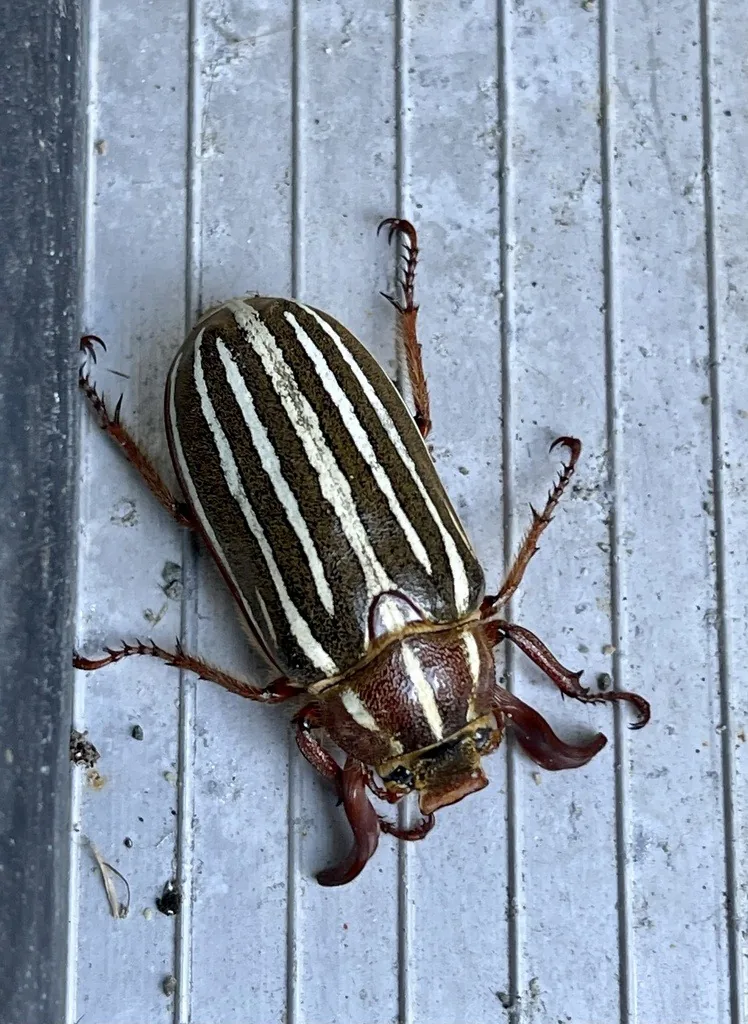
- Adults are large, about 7/8 to 1 1/4 inches long; in Colorado, they and their close relatives are the largest scarab beetles.[1]
- The wing covers carry bold lengthwise stripes, which give the beetle its name.[2][1]
- Males have large, fan-like antennae that can spread open; females have much smaller antennae.[1][2]
- When disturbed, adults hiss loudly by forcing air out of their breathing pores, and males may fan out their antennae.[1]
Look-alikes
| Look-alike | How to tell them apart |
|---|---|
| May and June beetles (Phyllophaga) | Ten-lined June beetle grubs are more tightly curled and stiffer-bodied than Phyllophaga grubs, and the adults have bold stripes.[1] |
| Other Polyphylla species | Two similar species found in Colorado have more diffuse or fainter, sometimes browner striping than the ten-lined June beetle.[1] |
Where it lives
Found in sandy soils west of the Rocky Mountains and near their eastern slopes in the U.S. and Canada; it is widespread in Colorado and most common where soils are light and sandy.[2][1]
Biology and life cycle
Adults fly from late June through early August in Colorado; males are strongly attracted to lights, while females fly poorly and rarely visit lights.[1][2]
Females release a scent that males follow with their large antennae; after mating, a female lays about a dozen eggs in the soil near where she emerged.[2]
The white grubs feed on roots, move deep into the soil in fall and return toward the surface in spring.[1]
Development takes about three years in Colorado and can stretch to four years at some northern sites.[1][2]
Damage and signs
- Grubs chew roots of grasses, perennials, trees and shrubs, but injury is usually slight; rarely they seriously damage woody plant roots, most often pines.[1]
- Adults feed on tree and shrub leaves, but the feeding is rarely noticeable.[1]
- In commercial plantings, grubs can strip bark from the buried stems of newly planted poplar cuttings, and they also feed on orchard, berry and vegetable crops.[2]
Health risk
The beetles are harmless despite their size and hissing display.[1]
Control
Prevention
Because the beetle causes little plant injury in most settings, the adults at your lights don't call for treatment.[1]
Traps and physical control
If groups of young plants look yellow, shriveled or stunted, dig and sift about a cubic foot of soil next to the stem to check for grubs and root or bark damage before acting.[2]
Biological control
Natural enemies include scoliid wasps, insect-killing nematodes and tachinid flies, which have been reared from the grubs or adults.[2]
Pesticides
For damaging grub populations in commercial plantings, WSU reports an imidacloprid soil drench can be effective; use only products labeled for the site.[2]
Common questions
- Why does this beetle hiss?
- Hissing is a defense: the beetle forcefully pushes air out of its spiracles, the breathing pores along its body, often while males fan their antennae.[1]
- Is the ten-lined June beetle the same as a June bug?
- It is one kind of June beetle and is sometimes called a June bug, watermelon beetle or hissing beetle, but it is a different genus from the common Phyllophaga May and June beetles.[2][1]
Sources
- High Plains Integrated Pest Management (Extension Services of Nebraska, Colorado, Wyoming and Montana), Bugwood Wiki, “Tenlined June Beetle (High Plains IPM Guide; compiled by Whitney Cranshaw, Colorado State University).” wiki.bugwood.org/HPIPM:Tenlined_June_Beetle (accessed 2026-10-06)
- Washington State University Extension, “Tenlined June Beetle (FS272E, Insect Pest Management in Hybrid Poplars Series, June 2017).” wpcdn.web.wsu.edu/wp-ecommerce/uploads/sites/2/product-4217-sku-FS272E.pdf (accessed 2026-10-06)
- iNaturalist, “Polyphylla decemlineata taxon page (order and family).” www.inaturalist.org/taxa/1699434 (accessed 2026-10-06)