How to identify it
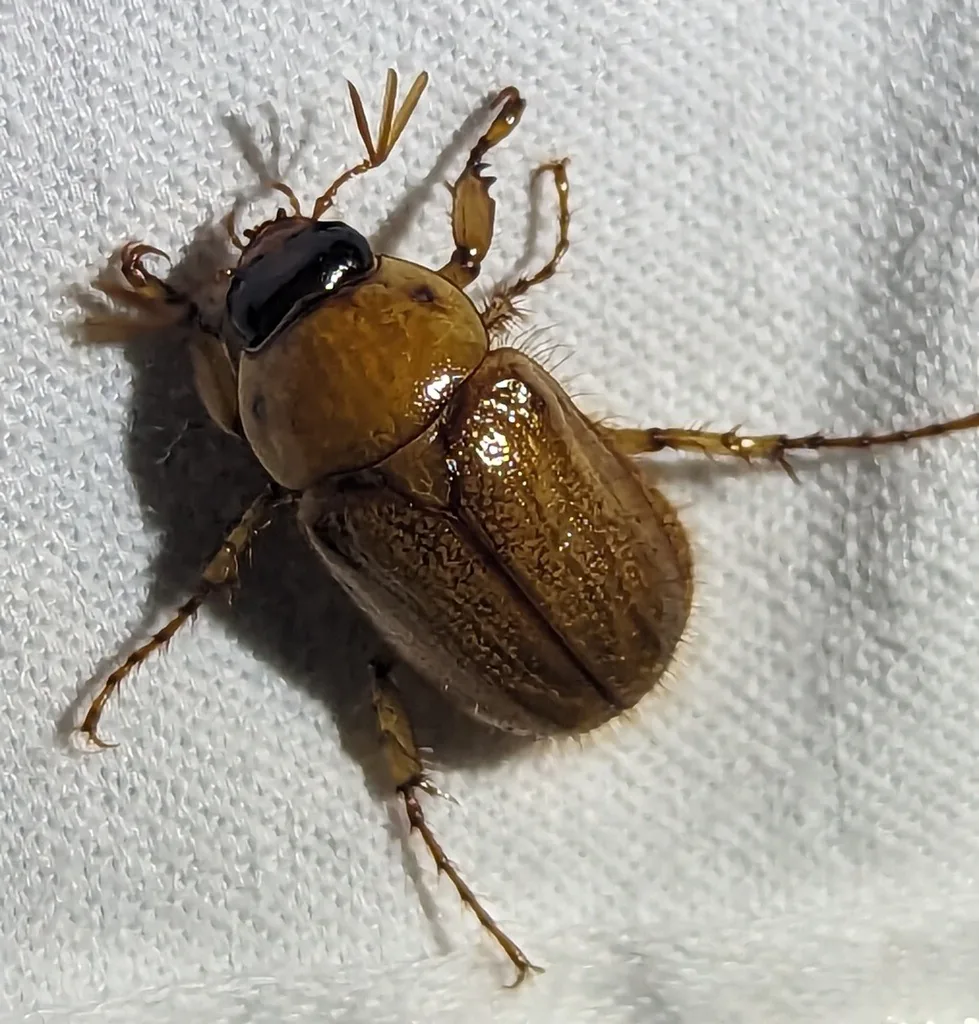
- Adults are about 1/2 inch long and dull yellowish-tan, with darker brownish-black markings on the head.[1]
- The northern masked chafer has conspicuous hair on the thorax and wing covers, while the southern masked chafer is sparsely haired.[1]
- Grubs are C-shaped and white with a brownish head and legs, reaching about 1 inch when full grown.[1][2]
- Under a magnifier, the spines on the underside of the grub's tail (the raster) are scattered randomly with no distinct rows.[1][2]
- Telling northern from southern masked chafers is difficult and usually needs a taxonomist.[1]
Look-alikes
| Look-alike | How to tell them apart |
|---|---|
| Japanese beetle grubs | Japanese beetle grubs have two short rows of raster spines that converge into a V; masked chafer spines are scattered.[2] |
| May and June beetle grubs | May/June beetle grubs have two parallel rows of raster spines and take two to three years to mature, versus one year for masked chafers.[2][3] |
| Oriental beetle grubs | Oriental beetle grubs look much the same; the raster pattern, seen with a 10x magnifier, separates the species, and more than one may share a lawn.[3] |
Where it lives
The northern masked chafer occurs from Maine to Nebraska in cool-season lawns; the southern masked chafer is common in southern states and is spreading into the lower Midwest. Both are found throughout Georgia.[1][2]
Biology and life cycle
Adults emerge from mid-June into mid-July, fly at night, and are strongly drawn to lights, sometimes appearing in large numbers at porch lights and swimming pools.[1][2]
Mated females dig 4 to 6 inches into the soil and lay 11 to 14 eggs; the eggs need soil moisture and hatch in about two to three weeks.[1][2]
Grubs feed on roots and organic matter and reach full size by late summer, when most damage happens.[1][2]
In fall they dig deeper to overwinter, return to the root zone in spring to feed for several weeks, then pupate a few inches down; there is one generation a year.[1][2]
Damage and signs
- Infested turf looks drought-stressed in late summer, fall or spring and doesn't green up after rain or watering; heavy infestations kill grass in irregular patches.[1]
- Damaged turf feels spongy and lifts easily like a loose carpet because the roots are gone.[1]
- Birds, skunks, raccoons and opossums dig up infested lawns to eat the grubs, and moles may tunnel where grubs are plentiful.[1]
- Damage often shows up near street lights, which attract egg-laying adults.[1]
Health risk
Masked chafers don't bite or sting, and the adults don't even feed; the harm is to lawns, not people.[1][2]
Control
Prevention
Check before treating: cut three sides of a 1-foot square of sod, fold it back, and count grubs in the top few inches of soil, sampling several spots.[2][3]
Maryland Extension says 5 to 10 grubs per square foot often means control may be needed; Georgia notes healthy turf can tolerate 10 or more masked chafer grubs.[3][2]
Because the eggs need moisture, holding back irrigation in July and early August may cut grub survival.[1]
Turn off exterior lights or switch to yellow or sodium vapor lights during the summer flight to attract fewer beetles.[1][3]
Biological control
Heterorhabditis bacteriophora nematodes have controlled masked chafer grubs well; apply them fresh, water them in, and keep the soil moist, ideally targeting young grubs in August.[1][3]
Bt galleriae gave about 70 to 80 percent control of young grubs in university studies; irrigate after applying. Milky spore products sold for Japanese beetles don't work on masked chafers.[1][3]
Pesticides
Preventive grub insecticides should target newly hatched grubs in mid-July to early August. Ohio State notes chlorantraniliprole lasts long enough for spring-to-summer use, while neonicotinoids fit June and July.[1]
For grubs already feeding, products with carbaryl or trichlorfon can work while grubs are small; water about 1/2 inch afterward to move the insecticide into the root zone.[1][2]
Maryland law limits outdoor use of neonicotinoids such as imidacloprid to certified applicators, so check your state's rules before buying.[3]
Common questions
- Why are skunks and raccoons tearing up my lawn?
- They may be digging for white grubs such as masked chafer larvae. Lift a square of sod and count the grubs to confirm.[1][2]
- What are the tan beetles flying around my porch light in June and July?
- They are often masked chafers, which fly at night and are strongly drawn to lights. The adults don't feed, but their grubs eat lawn roots.[1][2]
- Does milky spore control masked chafer grubs?
- No. The commercial milky spore strain targets Japanese beetle grubs and has no effect on masked chafers, according to Ohio State.[1][3]
Sources
- Ohio State University Extension, “Masked Chafers (ENT-51).” ohioline.osu.edu/factsheet/ENT-51 (accessed 2026-10-06)
- University of Georgia Cooperative Extension, “White Grub Pests of Turfgrass (Circular 940).” fieldreport.caes.uga.edu/publications/C940/white-grub-pests-of-turfgrass/ (accessed 2026-10-06)
- University of Maryland Extension, “White Grubs in Lawn and Garden Soil.” extension.umd.edu/resource/white-grubs-lawn-and-garden-soil (accessed 2026-10-06)
- iNaturalist, “Cyclocephala borealis taxon page (order and family).” www.inaturalist.org/taxa/301437 (accessed 2026-10-06)