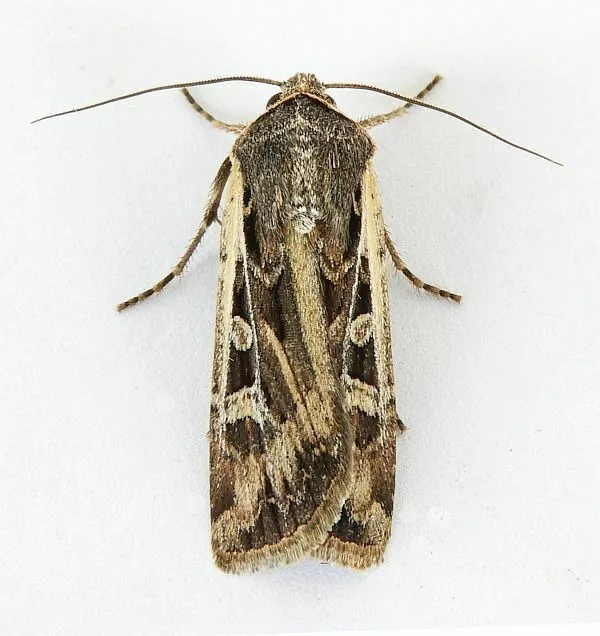
How to identify it
- Adults have a wingspan of 1.5 to 2 inches and are generally gray or light brown with wavy dark and light markings.[1][3]
- Wing patterns vary from moth to moth, but all army cutworm moths have a distinctive kidney-shaped mark on the forewing.[1]
- They hide by day in tight, dark cracks around doors, garages and cars, and fly at night; Montana State notes their wing scales rub off easily.[1][2]
Look-alikes
| Look-alike | How to tell them apart |
|---|---|
| Indian meal moth | Much smaller, about 1/2 inch, with yellow-brown wings that have dark tips; its caterpillars breed in stored foods indoors.[1] |
| Clothes moths | Very pale and even smaller than the Indian meal moth, and rarely seen flying.[1] |
Where it lives
Nuisance flights are worst in eastern Colorado and also occur in Nebraska, Montana and nearby states. Moths developing on the plains of Colorado, Wyoming, Nebraska, Kansas and Oklahoma fly west toward the Rocky Mountains.[1][3][2]
Biology and life cycle
Moths lay eggs in late summer and fall in wheat, alfalfa, weedy areas and turf; the caterpillars feed whenever it is warm enough and spend the winter partly grown.[1][3]
Caterpillars finish feeding by mid-spring, pupate in the soil, and adults emerge three to six weeks later.[1]
The adults fly to higher elevations to feed on flower nectar for the summer, and do not produce eggs during that time.[1]
Late in summer and into fall they return to the plains, where they mate and lay eggs, so there is one generation a year.[1][3]
In outbreak years, flights last five to six weeks, usually starting between mid-May and early June, but the worst nuisance lasts only two to three weeks.[1]
Damage and signs
- The moths don't feed or lay eggs indoors and don't harm furnishings or food; they either find their way out or die.[1][2]
- Large numbers of dead moths can cause a small odor problem and may feed carpet beetles if not cleaned up.[1]
- They can spot drapes, unfinished wood and other surfaces with fluid they excrete.[1][3]
- The caterpillar stage, the army cutworm, can damage alfalfa, winter wheat, gardens and lawns in early spring.[1][2]
Health risk
Miller moths are a nuisance only: they don't bite, feed or breed in homes.[1][2]
Control
Prevention
Turn off unnecessary outdoor and indoor lights at night during flights, or switch to yellow bulbs, which attract fewer moths.[1][3]
Keep them out
Before flights begin, seal gaps around doors and windows, add weather stripping, and repair window, door and vent screens.[1][3]
Traps and physical control
Swat or vacuum moths indoors, or hang a light over a bucket of soapy water so they fall in; use a GFI outlet and keep water away from wiring.[1][2]
Jingling keys or coins makes the moths fly erratically, which can flush them from hiding and speed up trapping.[1][2]
Pesticides
Insecticides have little or no place in miller control, because the moths aren't very susceptible and new ones arrive every night.[1][2][3]
Why some yards get more millers
Big miller flights follow years with many army cutworm caterpillars, and drought can concentrate moths around irrigated, flowering yards.[1]
Favorite nectar plants include lilac, cherries, spirea, cotoneaster, raspberry, euonymus and Russian olive.[1][2]
Dense, dark shrubs and trees such as cotoneaster, spruce and pines offer daytime shelter, so landscaping can affect how long moths linger.[1]
Common questions
- Will miller moths lay eggs in my house?
- No. During their migration they are in a resting state and don't produce eggs, and they don't feed on anything inside the home.[1][2]
- How long do miller moths stay?
- Most nuisance problems last two to three weeks in late spring; cool, wet weather can keep them around longer, while hot, dry weather pushes them west sooner.[1][3][2]
- Are miller moths good for anything?
- They pollinate flowers and are an important summer food for grizzly bears, which eat them under rocks at high elevations.[2][1]
Sources
- Colorado State University Extension, “Miller Moths (Fact Sheet 5.597).” extension.colostate.edu/resource/miller-moths/ (accessed 2026-10-06)
- Montana State University Extension, Urban IPM / Schutter Diagnostic Lab, “Miller Moths (June 2022).” urbanipm.montana.edu/entomology/resources/fact-sheets/spiders_of_montana/miller-moths.html (accessed 2026-10-06)
- University of Nebraska-Lincoln CropWatch, “Millers Pesky, but Cause Little Damage (April 20, 2012).” cropwatch.unl.edu/millers-pesky-cause-little-damage/ (accessed 2026-10-06)
- iNaturalist, “Euxoa auxiliaris taxon page (order and family).” www.inaturalist.org/taxa/84663 (accessed 2026-10-06)